The New York Times reported that American factories are broadly lagging in AI adoption, but that Bristol Myers Squibb is using the technology to monitor bioreactor conditions, detect quality issues in real time, and stabilize production of complex biologics, offering one of the clearest examples of where industrial AI is actually delivering results rather than remaining a conference slide.
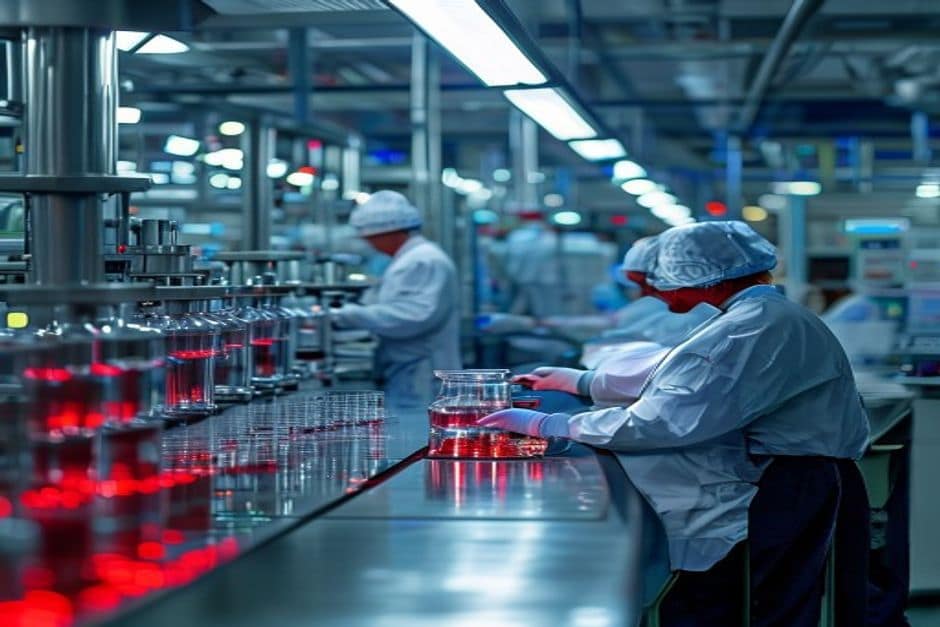
The detail in the Times story is worth understanding precisely. At Bristol Myers Squibb's facility roughly an hour north of Boston, living cells are transferred into two-thousand-liter steel bioreactors and cultivated over several weeks to produce proteins that target disease-causing cells. The process involves Orencia, a biologic drug for autoimmune conditions including rheumatoid arthritis. Minor fluctuations in temperature, light, or pH can disrupt cell growth and trigger drug shortages that harm patients. Previously, scientists had to wait for test results to diagnose problems during production. AI now monitors critical parameters continuously and alerts technicians to emerging issues before they compound. That is not a demo. It is live production monitoring at pharmaceutical scale, applied to a biological manufacturing process where the cost of failure is not missed revenue but harm to patients.
The reason this example stands apart from most manufacturing AI narratives is the combination of stakes, compliance requirements, and process complexity that drug manufacturing forces onto every deployment. The FDA has strict expectations around data integrity, process validation, and documentation in pharmaceutical manufacturing. That regulatory environment, often cited as a reason not to adopt new technology, turns out to also be one of the reasons early AI deployments in pharma are more serious than elsewhere. Companies cannot run an informal pilot on a critical production line and then quietly shelve it. Every change to a validated process requires documentation, testing, and regulatory support. The discipline that compliance demands also means that when a drug company commits to an AI deployment, it has to be serious about making it work. The result is that pharmaceutical manufacturers who get AI into production tend to get more out of it than their industrial peers who experiment more casually.
AstraZeneca offers a comparable picture. The company has disclosed that it uses AI-powered process digital twins to optimise yield and productivity while reducing raw material use, and has said manufacturing lead times have been compressed from weeks to hours in certain continuous manufacturing settings. Predictive modelling applied to active pharmaceutical ingredient development has reportedly cut development lead times by 50 percent and reduced material consumption in experiments by 75 percent in some programmes. Those are the kinds of numbers that industrial AI vendors promise and rarely deliver outside of carefully selected case studies. In pharma, they are appearing in regulatory-grade production environments, which gives them more credibility than most manufacturing AI claims. The reason is not that pharma has better technology. It is that the business case for getting it right is larger, the patient consequences of failure are more visible, and the continuous manufacturing model, where the process runs without interruption rather than in batch cycles, is inherently more compatible with real-time AI monitoring than a traditional production line that was never instrumented for it.
The broader pattern the Times story is pointing at is the gap between rhetoric and execution in industrial AI. Many manufacturing companies have launched AI initiatives, assigned executives to lead them, and published press releases about digital transformation. What they have not done, in most cases, is changed how the factory floor actually operates. The obstacles are consistent across sectors. Legacy equipment does not produce the data streams that AI needs to function. Workers are not trained to use and trust algorithmic outputs in high-pressure production situations. The ROI calculation for a manufacturer running at acceptable quality levels is harder to close than it is for a pharma company where a bioreactor failure is a multi-million dollar batch loss. And the integration work required to connect a predictive model to actual process controls, rather than just surfacing recommendations on a dashboard that someone may or may not read, is substantially harder than a proof-of-concept suggests.
For startups selling industrial AI, the pharmaceutical example is both encouraging and cautionary. It is encouraging because it demonstrates that regulated, conservative, compliance-heavy industries can be exactly the right market for serious AI deployment, provided the vendor is willing to do the validation work and support the documentation requirements. It is cautionary because it shows how different pharmaceutical manufacturing AI is from a software API integration. Selling into this space requires understanding GMP requirements, FDA process validation expectations, data integrity standards, and the economics of batch production. Startups that try to sell pharmaceutical manufacturers the same product they sell automotive or food manufacturers will usually find that the compliance requirements alone slow the sales cycle enough to kill the deal. The Bristol Myers Squibb story is a template, but it is a template that requires a very specific kind of startup to execute.
The broader signal for SF readers is about where AI productivity gains are actually appearing outside software. The honest answer, as the Times reporting suggests, is still narrowly. Drug manufacturing, aerospace parts inspection, semiconductor process control, and a small number of other sectors where the cost of failure is high enough to justify genuine AI investment are showing real results. Most of American manufacturing is not there yet. The factories that will be first are the ones where regulatory requirements, process complexity, and the economic consequence of errors create the business case that generic productivity rhetoric cannot. That is a more useful frame for founders and investors than the sweeping claim that AI is transforming manufacturing broadly. It is transforming manufacturing narrowly and precisely, in the sectors willing to do the hard work.
Also read: SpaceX's Terafab plan shows the startup economy is becoming a factory economy • Tencent's AniMatrix reframes generative video as a medium-native production tool not a physics engine • Bleeding Llama shows local AI is no longer a hobby project with hobby-grade security