Micron goes into its June 24 earnings report with a memory business Wall Street no longer knows how to value. The old commodity-cycle playbook doesn't explain 81% gross margin guidance, HBM contracts signed years ahead, or a stock that has already run hard into the print.
Micron's next earnings call is not a routine update. It is a test of whether investors should still treat the company like a boom-bust memory supplier, or like one of the companies collecting rent from the AI infrastructure buildout. That distinction matters if you own the stock, compete with it, or depend on the chips going into Nvidia-class servers.
The numbers already on the table are large enough. Investors Business Daily reported that Micron earned an adjusted $12.20 a share on $23.86 billion in revenue in its fiscal second quarter, beating FactSet expectations of $9.19 a share and $19.97 billion in sales. For fiscal Q3, Micron guided to adjusted EPS of $19.15 on $33.5 billion in revenue. MarketWatch also noted the company is targeting an 81% adjusted gross margin for the May quarter, up from 74.9% in the February quarter.
Those are not normal Micron figures. For years, the honest complaint about Micron was simple: memory prices rise, memory makers overbuild, prices fall, and shareholders remember why the market never paid a software multiple for DRAM. That history hasn't disappeared. But high-bandwidth memory has changed the rhythm of the argument.
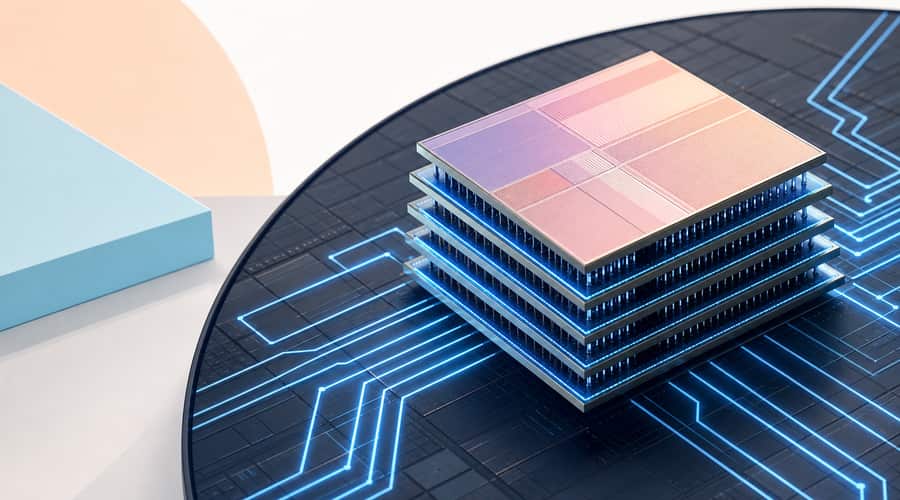
High-bandwidth memory is the part of the AI server story you can't hand-wave away. Nvidia's current Blackwell systems depend on HBM3E, and the next generation of accelerators pushes memory demand higher again. When Microsoft, Google, Amazon and Meta commit tens of billions to data centers, they are not only buying GPUs. They are also pulling forward scarce memory capacity from SK Hynix, Samsung and Micron.
Here's the thing: you don't solve an HBM shortage by calling a supplier a quarter before you need product. You sign early, you commit capital, and you hope your allocation holds. Tom's Hardware reported in December that Micron said DRAM supply constraints would persist beyond calendar 2026 and that the company was working on multi-year supply commitments. That is why this earnings report matters more than the headline beat or miss. The real issue is how much of 2027 is already spoken for.
Micron is still the smaller HBM player. SK Hynix leads the market, Samsung remains a force, and Micron has to prove that its share gains are not just a pleasant side effect of everyone being sold out at once. But a distant third place can still be a very profitable place when customers are desperate and supply is locked years ahead.
The company is spending like it believes the shortage will last. PC Gamer reported in January that Micron signed a $1.8 billion deal to acquire Powerchip Semiconductor Manufacturing Corporation's Tongluo facility in Taiwan, including a 300,000-square-foot, 300 mm wafer cleanroom, though the site is not expected to contribute meaningfully to DRAM output until late 2027. Tom's Hardware later reported that Micron began building a $24 billion 3D NAND fab in Singapore, while also noting a separate HBM assembly project there. In the U.S., Micron has tied its expansion story to new and existing sites in Idaho, New York and Virginia.
That time lag is the quiet part of the bull case. New memory capacity is expensive, slow and operationally unforgiving. If AI demand keeps rising before fresh supply arrives, Micron gets pricing power without having to pretend it has suddenly become a different kind of company. If demand cools faster than expected, investors will find out how much protection those multi-year commitments really provide.
Barron's reported last week that Micron will report after the market close on June 24, after a sharp rally that has already lifted expectations. The same report said the stock had hit repeated record highs in 2026 before pulling back with the broader semiconductor group. That is the uncomfortable setup: investors are not walking into this print skeptical. They are walking in after a re-rating.
So the quarter itself may not be enough. A revenue figure around guidance and another fat margin number will confirm that the AI memory cycle is still working. What you should listen for is management's language around HBM supply, contract duration, customer concentration and 2027 capacity. If the answer is still scarcity, Micron's old valuation argument gets weaker. If the answer gets vague, the market will notice fast.
Micron doesn't need to prove that AI demand exists. Nvidia, hyperscaler capex plans and memory shortages have already done that. It needs to prove that this cycle is not just bigger, but better contracted than the ones that burned investors before.
Also read: China's Z.ai open-sourced a frontier coding model the same day Washington banned its American rival • Brands are flooding social media with AI influencers and hoping you don't notice • Defense tech startups have pulled in $14.6 billion this year and Silicon Valley is not turning back