IIT Madras has released ANCHOR, a free 3D atlas of the human brainstem at cell-level resolution. The useful part is not the headline claim. It is that researchers can now inspect a structure that controls breathing, sleep and movement without relying on a few thin slices.
For more than a century, neuroscientists have had to study the human brainstem with maps that were too coarse for the job. That is a problem. The brainstem is small and dense - and unforgiving, sitting between the brain and spinal cord while controlling functions you only notice when they fail: breathing, wakefulness, sleep and movement. Now the Sudha Gopalakrishnan Brain Centre at the Indian Institute of Technology Madras says it has built a sharper map of that territory.
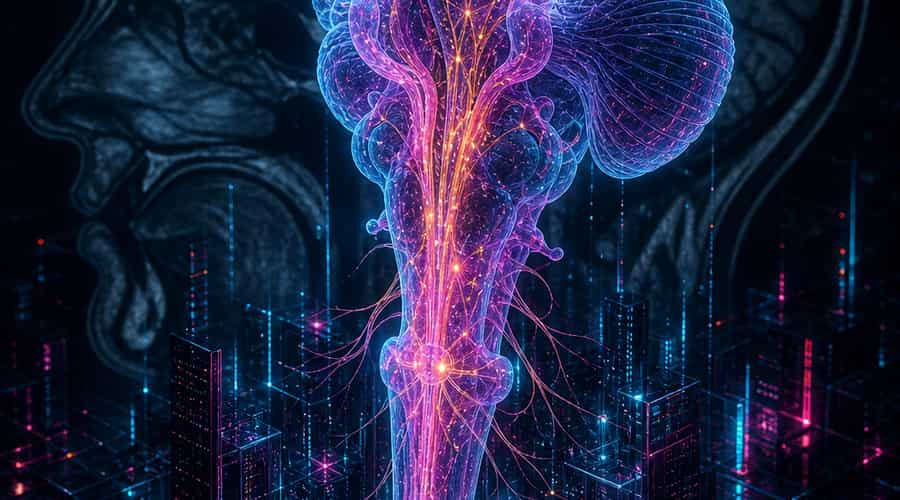
The project is called ANCHOR. That's short for the Atlas of Neurochemical Characterization of the human brainstem with 3D Reconstruction. According to the Times of India, IIT Madras released the atlas on June 12 after unveiling it during the 3rd BRICS Neuroscience Symposium 2026, held at the IIT Madras campus from June 5 to June 7. It charts more than 200 brainstem nuclei and fiber tracts at cellular resolution, using hundreds of serial sections and more than 500 sections overlaid with eight immunostains to distinguish neurochemical cell types.
That last detail matters. A colored scan that looks impressive on a screen is not automatically useful science. ANCHOR earns attention because it links three things in one model - MRI, histology, chemo-architecture - so a researcher can move from the larger structure down toward the cell populations inside it. You don't have to treat the brainstem as a gray stalk anymore. You can see its parts.
The atlas is also public at anchor.humanbrain.in. That is the right choice. If a lab in Chennai builds a reference map that only its own researchers can use, the work stays narrow. If neurologists and pathologists elsewhere can inspect it without asking permission or paying for access - imaging teams too - the map becomes infrastructure.
A Map Built From Real Tissue
The brainstem has always been brutal to study. The stakes are too high for shortcuts: damage a few millimeters of tissue and the consequences can be severe or fatal. You cannot casually biopsy the structure that keeps a person breathing. So researchers do the slow work instead: post-mortem tissue, thin sections, stains, imaging and reconstruction.
There is no glamour in that. There is value.
IIT Madras said ANCHOR spans brains from the prenatal period through childhood and adulthood, rather than freezing the brainstem at a single life stage. That is useful because a structure's chemistry and shape are not fixed from birth. They change as the brain develops. For researchers trying to understand what is normal before they study what is diseased, a life-spanning reference is a better starting point than one isolated adult sample.
The centre did not build this in isolation. The Times of India reported that IIT Madras collaborated with CMC Vellore, Government Kilpauk Medical College, Sri Ramachandra Institute of Higher Education and Research, and MediScan Systems. Those institutional details are easy to skip, but don't. Human brain atlases depend on tissue access, clinical judgment, imaging systems and computational reconstruction. One lab name on the front page rarely tells you how much machinery sits behind the work.
What Changes Now
Nothing about ANCHOR means a patient gets a new diagnosis tomorrow. Be suspicious of that kind of leap. Brain atlases are not treatments, and they are not magic. They are reference systems, the thing other research leans on when it tries to identify which cell populations are affected in a lesion or a degenerative disease.
Prof. Ajay Kumar Sood, principal scientific adviser to the Government of India, said at the launch that the maps could help identify specific cell populations affected in brainstem lesions, which may be critical for clinical applications. That is a careful claim, and it is the right one. The immediate value is comparison: a more detailed normal map gives doctors and scientists a better baseline when disease distorts the tissue.
Alzheimer's disease, dementia and rabies are already in the centre's field of view. IIT Madras director V. Kamakoti said the centre is studying brains affected by those diseases, while Mohanasankar Sivaprakasam, who heads the Sudha Gopalakrishnan Brain Centre, said the broader mission is to image more than 100 whole brains across the human lifespan and neurological disease states. That is ambitious. It also shows why ANCHOR is not a one-off announcement.
The centre has done this before. In December 2024, it released DHARANI, a detailed atlas of the human fetal brain, after reconstructing fetal brain tissue into a public digital dataset. ANCHOR moves the work from fetal brain mapping into the adult brainstem and adds neurochemical detail. That is a real step, not a press-release synonym for progress.
If you work anywhere near neuroscience, the point is plain. Better maps do not solve disease by themselves, but bad maps slow everyone down. ANCHOR gives researchers a more exact place to start, and because it is open, the next test is not whether IIT Madras can promote it. The next test is whether other labs actually use it.
Also read: Satya Nadella warns you pay for AI intelligence twice, in cash and in secrets • GCash parent Mynt files for what could be the biggest IPO in Philippine history • Together AI raised $800 million on the bet that cheaper AI wins