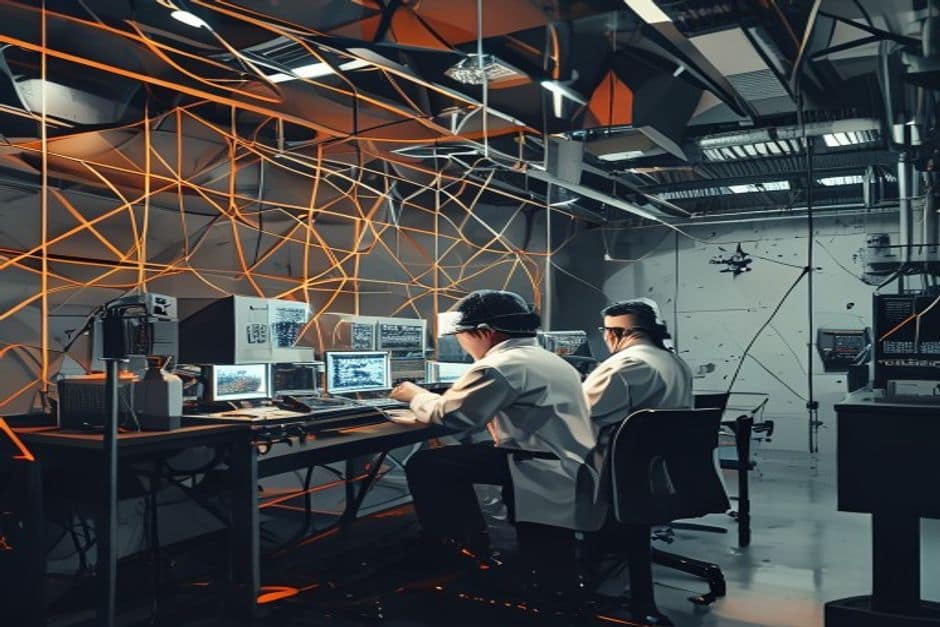
Swiss quantum technology company Terra Quantum has secured a U.S. Air Force contract ahead of its planned Nasdaq listing, establishing defense procurement as the commercial proof point that separates fundable quantum startups from the dozens of well-funded research plays that have yet to close government or enterprise revenue.
Terra Quantum operates in three connected areas: quantum-enhanced machine learning algorithms, quantum key distribution for secure communications, and hybrid quantum-classical computing that combines quantum subroutines with classical hardware to solve optimization and simulation problems at commercial scale. The Air Force contract aligns with all three: military networks require post-quantum cryptography now, before large-scale quantum computers break current encryption; defense AI workflows benefit from quantum-accelerated optimization for logistics, targeting, and surveillance; and hybrid systems can run today without waiting for fault-tolerant quantum hardware that is still years from deployment. The company raised $75 million in 2022 at a valuation around $800 million and has been building toward a U.S. listing since then. A defense contract with the Air Force is a more credible pre-IPO signal than any academic publication.
The contract scope and dollar value have not been disclosed in the Reuters report, which is typical for early-stage defense technology agreements that involve classified applications or sensitive capabilities. What matters for investors is the existence and structure rather than the size. Take-or-pay defense contracts, even at modest initial values, validate the product for institutional due diligence. They demonstrate that a U.S. government customer reviewed the technology, cleared the supplier through export control screening, and committed budget. For a Swiss company seeking a Nasdaq listing, a U.S. Air Force seal matters more than the check size.
Defense contracts are becoming the credibility bridge quantum companies need before public listings. IonQ listed via SPAC in 2021 with NASA and Air Force Research Laboratory as early customers. Rigetti went public the same year citing DARPA and government cloud contracts. D-Wave has sustained its Nasdaq listing through a combination of enterprise and defense use cases. The pattern is consistent: government procurement validates the technology, provides recurring revenue that covers burn, and gives public market investors a tangible revenue line rather than a research roadmap. Terra Quantum's Air Force deal positions it in exactly that pattern ahead of a listing where quantum multiples have compressed significantly from 2021 peaks.
The quantum-resistant security angle is the most commercially urgent. NIST finalised post-quantum cryptography standards in 2024, with CRYSTALS-Kyber for key exchange and CRYSTALS-Dilithium for digital signatures. U.S. government agencies are required to adopt these standards on defined timelines, creating a multi-billion-dollar procurement cycle for security software, hardware security modules, and key management infrastructure. Terra Quantum's quantum key distribution capabilities sit adjacent to this market, not identical to NIST-standardised post-quantum cryptography but complementary in high-security environments where information-theoretic security matters. Military communications, intelligence networks, and critical infrastructure are the natural buyers.
For SF readers, Terra Quantum's move signals that the deep-tech capital cycle is entering a new phase. The first phase was research funding: government grants, university spinouts, and pre-revenue venture capital building toward fault-tolerant quantum computers. The second phase is commercialisation through defense, enterprise, and government contracts that generate revenue before the hardware promise is fully delivered. The third phase, which Terra Quantum is trying to enter, is public markets that require real contracts, real customers, and defensible product differentiation. Each phase filters companies. Dozens of quantum startups raised venture money from 2018 to 2023. A smaller number will close meaningful government contracts. Fewer still will sustain public listings once investors demand earnings growth rather than hardware milestones.
The convergence of quantum-resistant security, AI infrastructure, and military demand is creating a specific category of deep-tech company. These companies do not need fault-tolerant quantum hardware to generate revenue. They sell quantum-enhanced software running on hybrid systems, post-quantum cryptography implementations, and secure communications that leverage quantum physics for near-term applications. Quantinuum's $300 million Series C at a $5 billion valuation was led by JPMorgan and Microsoft on the back of similar logic: the near-term market is cryptography and financial optimization, not the long-term promise of universal quantum computing. Terra Quantum's Air Force contract fits this template precisely.
Whether Terra Quantum's actual products match the scale of its listing ambitions requires scrutiny that Reuters has not provided. Quantum-sector hype has burned investors before. Companies that overstated hardware capabilities, timeline to fault tolerance, or customer traction have seen valuations collapse on public markets. The honest version of Terra Quantum's story is that it has real quantum-enhanced software products with a genuine Air Force customer, a management team that includes serious academic and engineering talent, and a listing plan that requires the market to value near-term hybrid quantum revenue rather than long-term hardware upside. That is a credible pitch if the products actually work. The defense contract makes it harder to dismiss as pure research theatre.
Also read: Google's $100 Fitbit Air challenges Whoop's subscription model with AI coaching on a budget • AMD's MI350P PCIe card makes CDNA 4 acceleration accessible beyond hyperscaler racks • Spotify wants to own AI-generated personal audio before anyone else defines the category