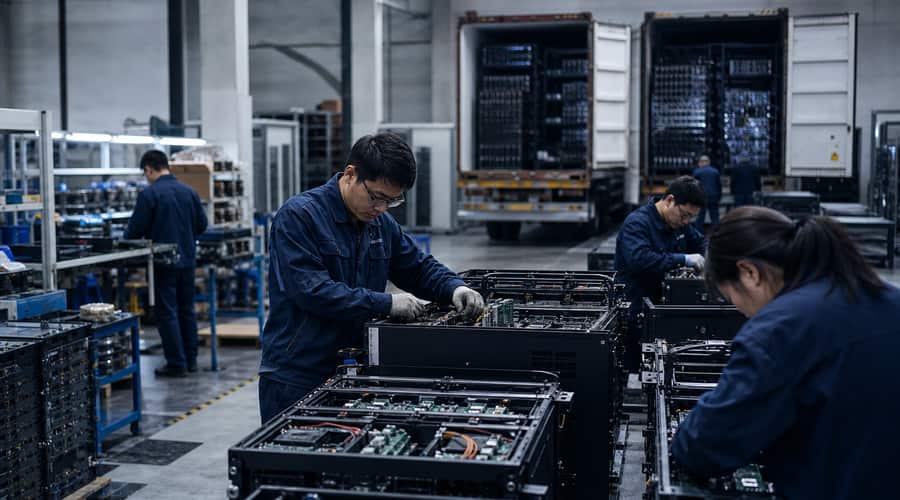
A DGX Spark owner used a water-filled cup as a heat sink and kept a large local AI workload under control. The funny part is the point: desktop AI hardware is now powerful enough to matter, but still physical enough to punish wishful thinking.
The most useful AI hardware story today is not coming from a lab benchmark or a polished launch video. It is coming from a DGX Spark user balancing a cup of tap water on a compact AI computer while running Qwen3.5-122B-A10B at Q6_K precision, with about 110GB of memory in use, an 80,000-token context window and reported generation of 18.77 tokens per second during continuous vision analysis.
That sounds like a joke because it is partly one. But it is also a clean little picture of where local AI infrastructure is heading. Buyers want cloud-style capability on a desk. They want privacy, fixed costs and freedom from API limits. Then they discover the same old rules still apply: heat, memory bandwidth, software maturity and workload shape decide how much value the machine actually delivers.
As a fresh r/LocalLLaMA post described it, the improvised water heat sink kept the device below 68C at roughly 95% GPU utilization. Nobody should read that as a recommended cooling method. Water near expensive electronics is still water near expensive electronics. But as a signal, it matters. The DGX Spark is being pushed hard by the community, and the community is finding out where the marketing promise meets the desk, the room and the workload.
NVIDIA positions DGX Spark as a compact Grace Blackwell AI computer for developers, researchers and data scientists, with up to one petaflop of FP4 AI performance and 128GB of coherent unified memory. According to NVIDIA's product materials, a single system is meant to run inference on models up to 200 billion parameters, while two connected systems can work with models up to 405 billion parameters.
That is a serious proposition for small teams. A startup that cannot send customer data to a third-party API can use local inference for document review, medical workflow experiments, industrial vision or internal code agents. A solo developer can test CUDA-oriented tools without renting a cloud GPU every time. A research group can prototype without waiting for a shared cluster. In those cases, the Spark is not trying to beat every cloud setup on raw speed. It is trying to make local iteration practical.
The catch is that unified memory does not remove every bottleneck. It changes the shape of them. The DGX Spark's 128GB memory pool helps fit large models that would break on consumer GPUs, but memory bandwidth remains a common complaint in developer discussions. NVIDIA lists the system memory bandwidth at 273GB per second. That is useful, but it is not the same kind of feeding pipe found on high-end discrete GPU setups built purely for inference throughput.
This is why a user can fit a massive model and still end up caring about thermals, quantization format, shard layout and kernel support. Local AI has become less about whether a model can load at all and more about whether it can run comfortably enough to be part of daily work. There is a big difference between a demo and a tool you trust for hours.
Community tuning is becoming part of the product
The DGX Spark story is also becoming a community software story. NVIDIA's own developer forums have been full of attempts to make Qwen3.5-122B-A10B run better on a single Spark. One thread that began in April 2026 reported moving from 28.3 tokens per second to 38.4 tokens per second, then later showed benchmark runs above 50 tokens per second after patches, speculative decoding and a more refined setup.
That progress changes how the hardware should be evaluated. The buyer is not only purchasing silicon and memory. They are buying into a living pile of recipes, Docker images, model conversions, quantization experiments and forum fixes. For traditional hardware buyers, that may feel messy. For AI developers, it is increasingly normal. The real product is often the machine plus the community path to making it useful.
Hugging Face model pages tell the same story. There are Qwen3.5-122B-A10B variants reshaped specifically for DGX Spark, including versions split into smaller shards to avoid large contiguous allocation problems and others optimized for GB10 behavior. That is not glamorous work, but it is the work that determines whether a buyer spends the weekend building an agent or fighting the loader.
The water-cup cooling post sits inside that broader pattern. It is not just a meme about heat. It is a user saying, in effect, that the workload is close enough to useful that an improvised thermal trick feels worth trying. That is a strange milestone, but an important one. People do not optimize hardware they have already given up on.
The economics are still personal
For entrepreneurs, the bigger question is not whether a cup of water can cool a DGX Spark. The question is when local AI hardware beats renting intelligence by the token. If a founder is spending heavily on coding assistants, vision analysis or internal agents, owning a box that runs meaningful workloads can start to look attractive. If the workload is occasional, cloud services will usually win on convenience.
The answer also depends on tolerance for friction. DGX Spark is not a generic office PC with a magic AI button. It is closer to a compact development node. The teams that get the most from it will be the ones willing to tune models, track community recipes and choose workloads that match the machine's strengths. Long-context private inference, local experimentation and edge development make more sense than chasing the fastest possible chatbot response.
That is the practical takeaway. Desktop AI hardware is becoming good enough to matter, but not simple enough to ignore engineering discipline. The next phase of local AI will not be decided only by who has the biggest model or the cleanest spec sheet. It will be decided by how well hardware makers, open model communities and developers turn awkward first-generation constraints into reliable workflows.
The cup of water will not become the future of AI cooling. But it did capture the present perfectly: local AI is powerful, imperfect and moving forward one strange experiment at a time.
Also read: Artificial Analysis shows coding agents are more than model scores • Unitree turns a mecha demo into a robotics startup test • AI deepfakes accuse Singapore of ingratitude toward China on social media