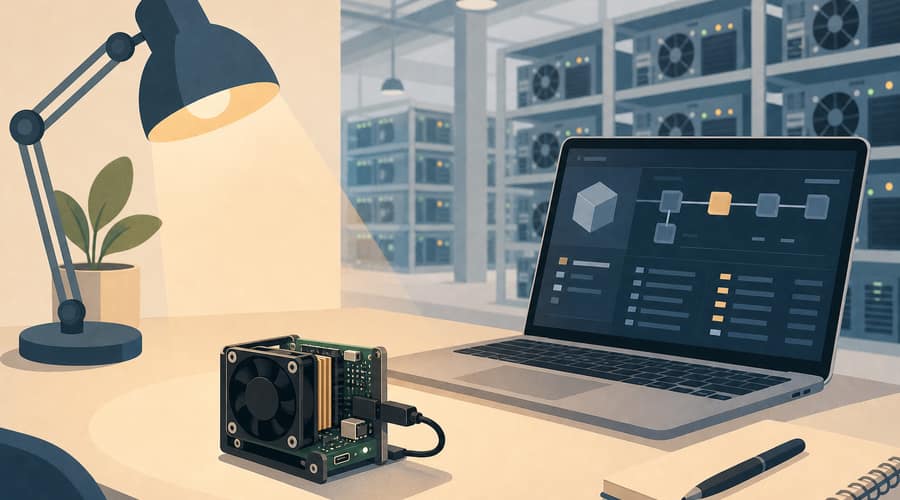
A $150 Bitaxe Gamma found Bitcoin block 957,382 and collected about $200,000. That doesn't change Bitcoin mining economics, but it does prove the lottery is still open.
On July 9, at around 03:30 UTC, a hobbyist running a single Bitaxe Gamma device found Bitcoin block 957,382. Eight hours. That's all it took. The reward was 3.1382 BTC, worth roughly $200,000 at the time, paid out in full because the miner was using Public Pool's solo mining setup rather than a conventional pool that splits rewards among participants.
The machine is almost absurdly small next to the prize it won. A Bitaxe Gamma is an open source, single chip miner built around Bitmain's BM1370, the same chip family used in industrial Antminer hardware. It runs at about 995 gigahashes per second, close to 1 TH/s, and draws about 15 to 21 watts. Depending on the seller and configuration, the device can be found from around $60, with many listings near $150.
You should read that number twice. One terahash per second sounds large until you put it beside Bitcoin's network hashrate, which has recently been around 874 exahashes per second. According to figures cited by CoinDesk and CryptoBriefing in reports on the Bitaxe win, a miner at that scale would expect to find a block roughly once every 18,300 years. This one did it before lunch.
The odds are still brutal
Getting lucky is the whole story here. A solo miner isn't earning a steady stream of small payments. They're throwing one machine at the network and hoping its hash happens to be the valid one when the next block is found. Most will never hit. That is not pessimism. That's the math.
Compare the Bitaxe with the rigs that actually dominate Bitcoin mining today. A single Antminer S21 can push roughly 200 TH/s and draw about 3,500 watts while doing it. Large mining farms run machines like that by the thousand, in buildings built around electricity contracts, cooling systems and uptime. Against that backdrop, a desk-sized Bitaxe winning a full block isn't a business model. It's a lottery ticket that happened to pay.
Public Pool is what makes the setup cleaner for hobbyists. The service lets a miner point hardware at the Bitcoin network without paying pool fees and without sharing the reward if a block is found. The tradeoff is obvious: you give up predictable pool income for the very small chance of keeping the whole block subsidy and transaction fees. Some people like that bargain. Frankly, if you're buying a 20-watt miner for a desk, the story may be part of the product.
Small miners are still showing up
This wasn't the only solo win. CoinDesk and CryptoBriefing reported that solo miners found 24 blocks over the past 12 months, up 41% from the year before. Twelve of those blocks came in 2026, and the combined rewards across the period totaled 75.44 BTC. That is real money. It is also tiny beside Bitcoin's usual pace of about 144 blocks a day, or roughly 52,560 blocks a year.
What changed isn't probability. What changed is access. Firmware such as AxeOS has made small boards easier to set up, Public Pool removes one piece of friction, and open source hardware gives hobbyists a way to participate without buying a warehouse-grade machine. You don't need to pretend this competes with Riot Platforms, Marathon Digital or the large private mining operators. It doesn't. But it does keep one old part of Bitcoin alive: anyone can still point hash at the network and take the shot.
There is a useful warning in the excitement, too. A headline like this can make solo mining look more rational than it is. It isn't. If your aim is reliable income, a Bitaxe Gamma is not going to beat industrial miners with cheaper power and far more hashpower. If your aim is to learn, tinker and hold a ticket in a lottery that usually ignores you, then the July 9 block is exactly why these devices keep selling.
The next winner could be another hobbyist tomorrow. It could also be nobody like this for years. Bitcoin doesn't care whether the hash comes from a $150 board on a desk or a mining farm full of S21s. It only cares which machine finds the valid block first.
Also read: Velocity Raises 38 Million Dollars to Turn Stablecoins Into Business Payment Rails • Robinhood built a blockchain for stocks and memecoin traders took it over • Bitmine Now Holds Nearly One in Twenty Ether Tokens Ever Issued