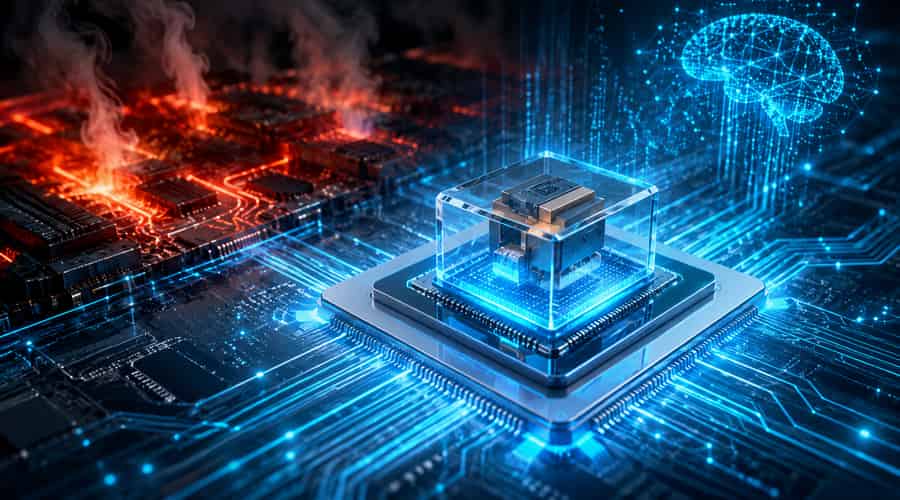
A University of Tokyo team has shown a chip component that switches in picoseconds while producing far less heat. The bigger question is whether a laboratory breakthrough can become something data centers can actually buy.
The race to build faster AI infrastructure usually runs into the same wall: heat. Bigger models need more computation, more computation needs more power, and most of that power ends up as heat that data center operators then have to remove with more power.
That is why a new nonvolatile switching device from researchers in Japan is worth paying attention to. The work is not a finished processor, and it is not ready to replace Nvidia GPUs sitting inside cloud data centers. But it points at one of the few ways the AI hardware story can change without simply adding more electricity, more cooling systems and more real estate.
As Live Science reported, the device can switch a bit of information in 40 picoseconds, or 40 trillionths of a second, while generating minimal additional heat compared with conventional high-speed electronic switching. The underlying study was published in Science on May 14 by researchers from the University of Tokyo, RIKEN and other Japanese institutions.
That detail matters because the bottleneck in computing is no longer only about how many chips the industry can manufacture. It is also about how much energy those chips can consume before the economics start to look absurd. If AI demand keeps rising, the winners will not only be the companies with the largest clusters. They will be the companies that can squeeze more useful computation out of every watt.
For years, semiconductor progress was sold to the public as a clean march toward smaller, faster and cheaper chips. That story has become more complicated. Modern processors are extraordinarily powerful, but the cost of pushing them harder shows up in electricity bills, cooling infrastructure, grid connections and construction timelines.
Data centers already need elaborate thermal management just to keep servers operating safely. In AI facilities, where dense clusters of accelerators can run heavy workloads for long stretches, heat is not a side issue. It affects where facilities can be built, how quickly they can be connected to power and whether a project makes financial sense.
The Japanese team's device attacks that problem at the switching level. Instead of relying on conventional mechanisms that usually require more write power as speed increases, the researchers used an antiferromagnetic material called Mn3Sn combined with tantalum. In simple terms, the device changes magnetic state using spin-orbit torque, which can move information quickly without the same thermal penalty.
The team also showed switching with 60 picosecond photocurrent pulses generated through a telecommunications wavelength laser and a photoelectric converter. That is an important clue about where this research could go next. If optical signals can be converted directly into nonvolatile memory writing, future computing systems may be able to reduce some of the waste involved in moving information between optical communication and electronic processing.
This is the kind of improvement that sounds technical until you connect it to the infrastructure boom now reshaping the technology sector. AI companies are not only competing on model design. They are competing on access to power, cooling capacity, land, chips and capital. Any technology that reduces heat at the device level changes the calculation further up the stack.
The hard part starts after the breakthrough
There is still a wide gap between a working laboratory device and a commercially useful chip. The researchers demonstrated endurance over more than a billion switching operations, which is promising, but processors and memory systems in real products must survive brutal manufacturing, reliability and integration requirements.
The materials question is also real. Tantalum is useful because of its electrical properties, but it is also a relatively scarce metal with existing demand from electronics, aerospace and industrial applications. If a future chip architecture depends on materials that are hard to source at scale, the economics can become difficult before the technology reaches the fab.
Then there is the question of compatibility. The semiconductor industry does not adopt new device structures simply because they work in a paper. They must fit into manufacturing processes, design tools, packaging methods and supply chains that have been optimized over decades. A prototype chip could be ready around 2030, according to the researchers, which is fast in scientific terms but not immediate in market terms.
Even so, the direction is important. The AI hardware market has been dominated by brute force scaling: more accelerators, larger clusters and larger power commitments. That approach can continue for a while, especially for companies with deep balance sheets. But it also invites a different kind of innovation, one focused on reducing the hidden costs of computation rather than just increasing peak performance.
For entrepreneurs, chip startups and infrastructure investors, the signal is clear. The next wave of AI hardware will not be judged only by benchmark charts. It will be judged by energy per operation, heat generation, manufacturing practicality and how easily it slots into the systems cloud providers already run.
The University of Tokyo work does not solve the data center energy problem by itself. No single switching element could. But it shows that the industry still has room to rethink the physics underneath computation, and that may matter more than another incremental gain in cooling. Watch the next phase closely: if researchers can move this from a device demonstration to a manufacturable architecture, the most valuable AI chips of the 2030s may be the ones that stay cool while everyone else is still buying more power.
Also read: BNB rally shows how Binance still moves crypto markets • Euro-Office gives Europe a sovereign office suite to test Microsoft • Defense officials now see AI risk as a front-line security threat