
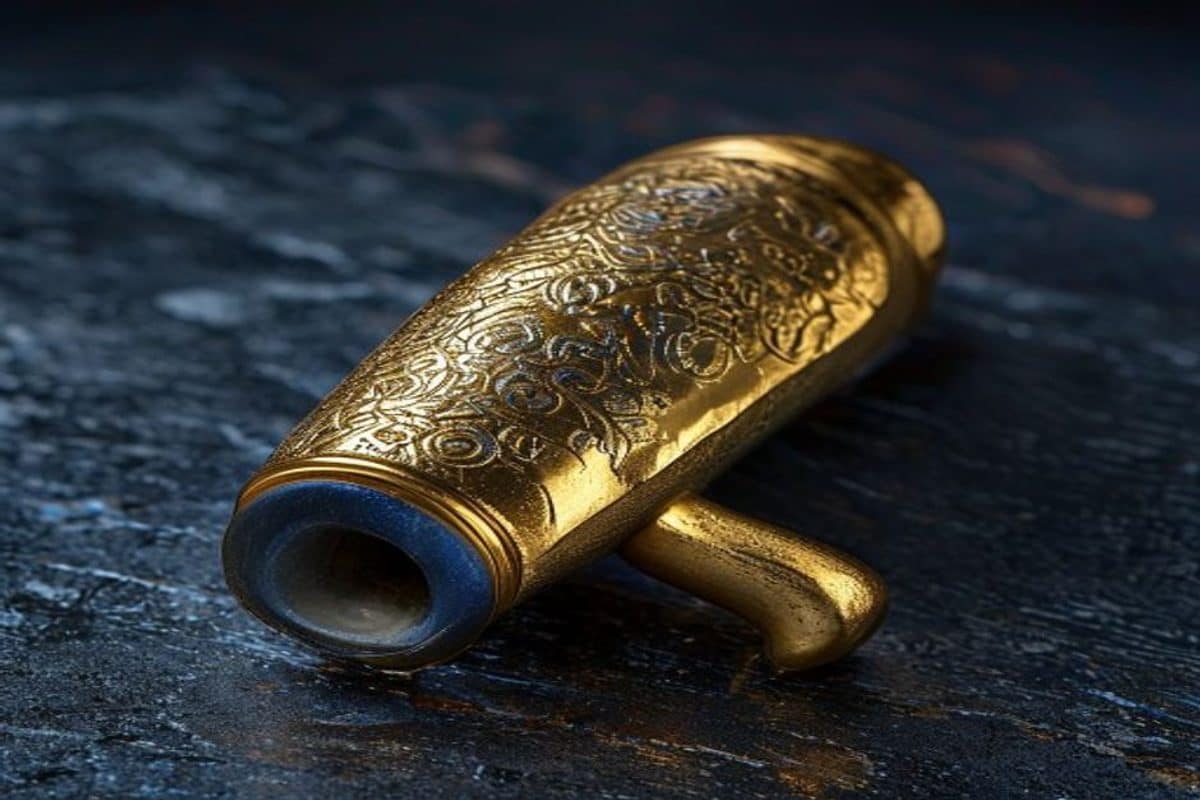
Independent metalsmith Elias Thorne has gone viral with a bespoke piece that encases a wild boar tusk in an 18K gold sleeve, sparking a broader conversation about what qualifies as a luxury asset in 2026.
The post was simple enough: a photograph, a caption reading '18K Gold but around a boar's tooth,' and within 48 hours, over 400,000 views on X. Elias Thorne, a metalsmith working out of the Pacific Northwest, announced the completion of his 'Boar's Tooth Denture Cap' on April 22 , a single intact wild boar tusk fitted inside a hand-engrailed granulation sleeve of 18-karat gold. The piece is not a concept. It is finished, wearable, and already reshaping a corner of the jewelry conversation that nobody expected to be reshaped this week.
What makes the piece financially interesting, beyond the obvious visual provocation, is Thorne's disclosure about sourcing costs. The heirloom tusk , harvested from a managed cull in Texas , cost him more to acquire than the gold used to fabricate the setting. That single detail inverts every assumption about material hierarchy in luxury goods. Gold is supposed to be the expensive part. Here, it is functioning as the frame for something rarer, at least in terms of provenance. Thorne has not released the weight of gold used, but that ambiguity may be doing more work for the piece's mystique than any specification could.
The piece sits squarely within what designers and collectors have begun calling the 'Bio-Luxe' movement, which integrates organic animal matter with high-precious metals to challenge conventional material hierarchies. This is not taxidermy, and it is not traditional gemstone jewelry. It occupies a deliberate middle ground that is attracting both serious collectors and a social media audience that skews younger and more culturally omnivorous than the typical fine jewelry buyer. The secondary trend already spreading under the label 'Tusk-core' on r/Bijou suggests the piece has moved beyond novelty into something that functions as aesthetic permission for other makers.
For the alternative assets conversation, the implications are worth taking seriously. Boar tusks have historically carried value only within tightly defined circles: Japanese netsuke collectors, hunting trophy communities, certain ethnographic antique markets. Their resale liquidity outside those circles has been negligible. By bonding a tusk to 18-karat gold , a universally recognized store of value with deep secondary market infrastructure , Thorne has produced what some analysts are calling a proof-of-concept for hybrid assets. The biological specimen gains liquidity through association with the metal; the metal gains narrative premium through association with the specimen. Neither would command the same attention alone.
This matters beyond the obvious novelty because it arrives during what collectors and advisors are calling the 'Heirloom Anomaly' , a sustained consumer preference for objects with traceable, specific origin stories over generic luxury signifiers. A plain 18K gold band and a 18K gold sleeve around a Texas boar tusk are materially comparable in metal content, but they are not comparable as objects people want to own, talk about, or pass down. That gap is where speculative value is being built right now, and Thorne's piece illustrates it more clearly than most market reports manage to.
What this signals for the dental jewelry and gold grill market
There is a more grounded market angle here that has not received enough attention in the initial coverage. The dental jewelry sector, specifically removable gold grills, has operated for decades as a fashion accessory with limited investment logic. Thorne's Denture Cap , permanently fitted over a biological tusk rather than a human tooth, but functioning visually and conceptually in the same register , offers a durable, singular alternative to the mass-produced grill. If Bio-Luxe gains traction as a legitimate design category rather than a viral moment, it may push the higher end of the dental jewelry market toward bespoke, material-hybrid pieces that carry genuine scarcity and provenance documentation.
Gold is sitting near historic highs in April 2026, which adds an ironic footnote to this story: the metal everybody is watching as a macro hedge just got used as decorative infrastructure for a pig's tooth. But that framing undersells what Thorne has done. He has demonstrated that the perceived value of gold can be leveraged to elevate and legitimize materials with no existing market infrastructure. That is a transferable idea. Watch for other metalsmiths, particularly in the Pacific Northwest and Brooklyn studio scenes, to test similar pairings in the next six months. The question is whether any of them can replicate the specificity of origin that made this particular piece land the way it did.
Also read: A viral Reddit debate about swapping 55 ounces of silver for one gold coin cuts to the heart of how retail investors think about wealth preservation in 2026 • Russia reverses course to sell twenty two tons of gold as sanctions force the liquidation of state reserves to plug a widening federal budget deficit • Russia reverses course to sell twenty two tons of gold as sanctions force the liquidation of state reserves to plug a widening federal budget deficit