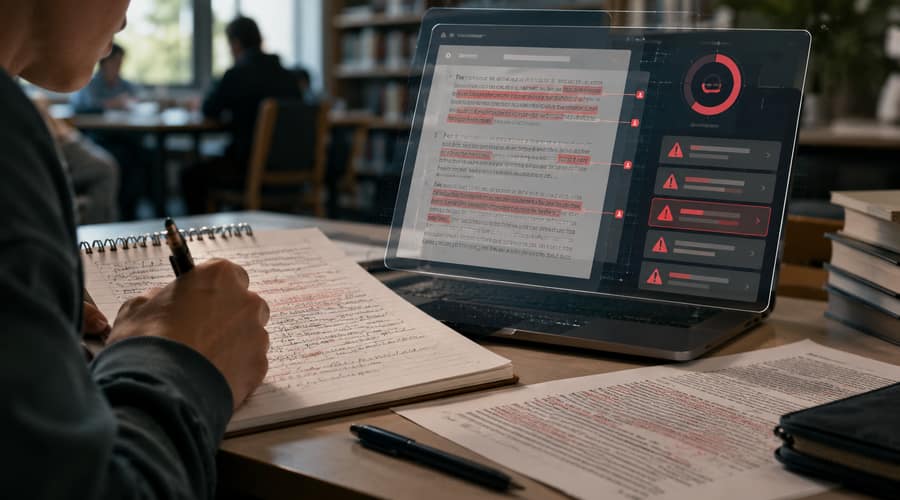
Students are finding out that careful, formal, heavily revised writing can now look suspicious to software. That is a serious problem for universities that still treat AI detector scores as evidence.
A student who spends weeks polishing a literature review should not have to defend the rhythm of their sentences like it is forensic evidence. Yet that is where academic writing has landed. The more structured the prose, the more likely some AI detectors are to see patterns they associate with machine writing.
This is not just a student complaint on Reddit or a one-off campus dispute. It is becoming a practical test of how schools handle academic integrity in an age when the tools meant to identify AI writing can also punish the habits teachers have spent years encouraging: clarity, consistency, careful transitions, and clean summaries of existing research.
As The Atlantic recently reported, Pangram and other AI detection tools are being used by universities to screen student work and by scientific organizations to scan research papers, even as their results remain contested. The debate is no longer about whether AI writing exists. Of course it does. The harder question is whether a probability score can carry the weight of an accusation.
Most AI detectors work by looking for statistical signals in language. They are trying to judge whether a passage looks more like known human writing or known machine output. That may sound reasonable, but academic prose is already patterned. Literature reviews follow tight structures because they have to map a field, group prior studies, explain gaps, and avoid casual phrasing.
That is exactly why students get trapped. A literature review is not a personal essay. It is supposed to be restrained. It often uses repeated author-date structures, cautious claims, and discipline-specific vocabulary. A strong student writer may remove quirks and tighten the paper during revision, only to make the final draft look more uniform than the detector expects from a human.
Independent research has been warning about this for some time. A 2025 NBER working paper by Brian Jabarian and Alex Imas focused on the policy problem around false positives and false negatives, arguing that institutions need to decide how much error they are willing to tolerate before relying on any detector. That sounds technical, but the point is simple. A tool can look impressive in a benchmark and still be dangerous when used against real students.
The risk gets sharper when schools use detector output as a shortcut. If an instructor sees a high percentage and then reads the paper looking for confirmation, the process can become circular. Formal writing becomes suspicious because the tool flagged it, and the tool feels credible because the writing now looks suspicious. That is not investigation. It is automation bias wearing an academic gown.
False positives do not fall evenly
The most uncomfortable part is that false positives may hit some students harder than others. Studies in educational integrity and academic AI detection have raised concerns about non-native English writers, students who use standardized academic phrasing, and writers whose prose is less idiomatic but highly organized. In other words, the students most likely to be careful may also be the students most likely to be questioned.
That matters because an academic misconduct allegation is not a normal grading dispute. It can affect scholarships, visas, graduate school applications, and a student’s confidence in their own work. Even if the student is later cleared, the process itself can feel like punishment. The university may think it is being cautious. The student experiences it as being presumed guilty by software they cannot interrogate.
Turnitin, GPTZero, Pangram, Copyleaks, and similar tools are not all the same. Some perform better than others in controlled tests, and vendors continue to improve their models. But the central weakness remains. A detector is making a probabilistic claim about authorship from text alone, while real writing often includes outlines, drafts, grammar tools, peer feedback, translation help, and legitimate AI-assisted editing that may be allowed under a course policy.
This is where universities need more discipline than students. If a course allows Grammarly but bans generative drafting, what exactly does the detector measure? If a student uses ChatGPT to brainstorm an outline but writes the paper themselves, is the final text misconduct? If a professor tells students to make prose more concise, then a detector flags the polished version, who created the problem?
The sensible answer is not to ignore AI use. Schools have a real issue to manage. Students can and do submit work they did not write. But detection should be one signal, not the case itself. Draft history, notes, citations, version records, oral follow-up questions, and a clear comparison with a student’s previous work tell a richer story than a single percentage score.
For students, the practical lesson is uncomfortable but clear. Keep drafts. Use Google Docs or Word version history. Save outlines, source notes, search trails, and feedback comments. Do not rely on a clean final paper to speak for itself, because clean writing is no longer always treated as innocent.
For universities, the bigger lesson is about trust. Academic integrity systems work only when students believe the process is fair. If detectors become the first judge rather than a limited tool, schools will create a new kind of misconduct problem: not students cheating with AI, but institutions outsourcing judgment to software that cannot understand how a person actually wrote.
The next phase should be less about catching every machine-written sentence and more about building assessment systems that make authorship visible. That means process, conversation, and clearer rules. Otherwise, the literature review will become a strange battleground, where the students who write most like academics are the ones asked to prove they are human.
Also read: Washington is closing an offshore route for Nvidia AI chips • Tesla faces a trust problem inside its own self-driving AI team • Erin Brockovich puts AI data centers on notice.