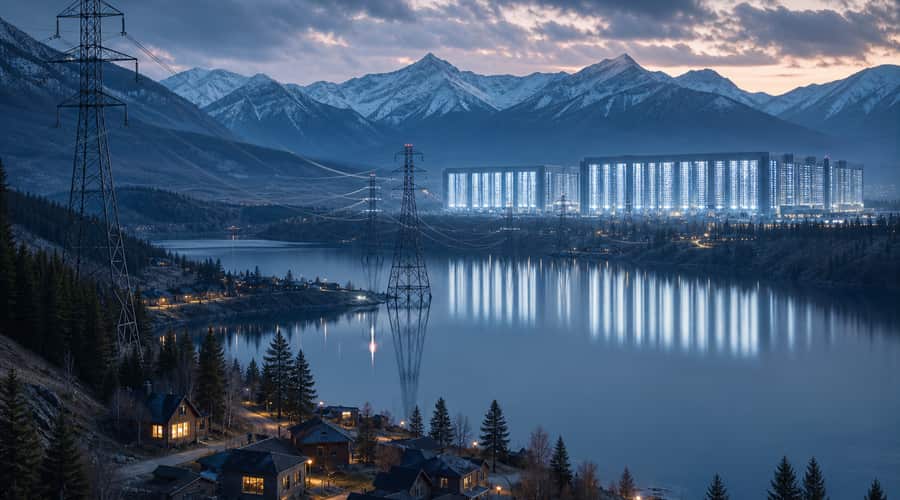
Lake Tahoe's power problem is no longer just a local utility issue. It is an early test of what happens when AI infrastructure starts competing with small communities for the same grid capacity.
Nearly 49,000 Lake Tahoe electricity customers are now staring at a hard deadline: by May 2027, Liberty Utilities must replace most of the power it has long bought from NV Energy. The wires are not being ripped out. The lights are not scheduled to go dark. But the supply arrangement that has helped keep the California side of the Tahoe basin powered for years is ending, and the timing could hardly be more uncomfortable.
Liberty serves a small, geographically awkward territory along California's eastern edge. It owns Nevada solar assets that provide roughly a quarter of its electricity, but about 75% has come through NV Energy. According to Fortune's reporting this week, NV Energy has told Liberty it will no longer provide full-requirements power after May 2027, leaving the smaller utility to find replacement electricity in a Western power market that is getting more crowded and more expensive.
The obvious villain is the AI data center boom, but the story is more complicated than that. NV Energy says the transition was planned for years and was not simply a reaction to recent data center growth. That matters. Utilities do not make billion-dollar grid decisions overnight. Still, it is difficult to ignore the pressure building in northern Nevada, where data centers tied to cloud computing and AI are becoming some of the most powerful electricity buyers in the region.
For entrepreneurs and investors, the lesson is not just that AI needs power. Everyone knows that by now. The sharper point is that access to power is becoming a business advantage, and small customer bases can quickly discover how little leverage they have when larger industrial loads enter the same market.
The Desert Research Institute's January 2026 report found that Nevada has more than 60 data centers, including 28 in the Reno-Tahoe region. It also found current operating data center capacity of 713 megawatts, with more than 5,900 megawatts of planned capacity. The report tied that growth to the 12 data center projects outlined in NV Energy's 2024 Integrated Resource Plan, which together could drive 25,590 gigawatt hours of load growth by 2033.
That is not a rounding error. DRI said data centers consumed about 22% of Nevada's electricity generation capacity in 2024, and that share could rise to more than 35% of forecast generation by 2030. When a sector moves that quickly, it changes the bargaining table for everyone nearby. A small resort-region utility is no longer just shopping for power. It is competing against hyperscale buyers, mining operations, large utilities and industrial projects that can shape transmission planning around their needs.
Lake Tahoe's structure makes the problem even more exposed. Liberty's California customers are regulated by the California Public Utilities Commission, but the utility is physically tied into NV Energy's Nevada balancing authority rather than California's main grid operator. Building a new direct connection over the Sierra would be expensive and disruptive. Liberty has said replacement power will most likely come from outside California, delivered across the same Nevada transmission system.
Small customers carry big-system risks
The practical question is who pays when the grid is redesigned around growth. Liberty has already been fighting affordability concerns. In its 2025 general rate case, the utility sought a 19.1% revenue increase, while California regulators approved a smaller 11.4% increase. That case involved wildfire exposure, insurance, infrastructure spending and the unusual cost profile of a mountain service territory with winter peaks, second homes, tourists and permanent residents living on very different budgets.
That mix is why this story has a sharper edge than a normal procurement dispute. Tahoe may look wealthy from the outside, but year-round communities include service workers, low-income households and small businesses that cannot absorb utility volatility as easily as a ski resort or vacation-home owner. When a small ratepayer base has to fund infrastructure in a high-risk region, every procurement decision matters.
Greenlink West may help, but it does not remove the risk. NV Energy's 525-kilovolt transmission project is expected to come online around May 2027, the same month Liberty's existing full-requirements arrangement is set to end. Liberty has said the project should open access to a wider pool of suppliers. That is useful, but a deadline that lines up almost exactly with a major transmission project leaves little room for delay, bad weather, procurement friction or unfavorable pricing.
The broader market signal is clear. AI companies and data center developers are not just customers of the power system anymore. They are forces that can redirect planning, accelerate transmission debates and change who gets favorable terms. That will create openings for energy startups, grid software companies, battery developers and project financiers. It will also create pressure on communities that never asked to be part of the AI supply chain.
The next thing to watch is how California regulators handle Liberty's replacement procurement and whether they demand a fuller public process before approving the plan. If Tahoe can secure affordable, renewable replacement power without major rate shock, it becomes a case study in managing AI-era grid stress. If not, it will be a warning that the race to build computing capacity can push smaller communities into a market where they have the least voice and the most to lose.
Also read: Five Unconventional Tactics to Unlock LinkedIn Growth and Revenue • TextGen turns local AI into a desktop product developers can trust • A Georgia data center exposed the water cost of AI growth