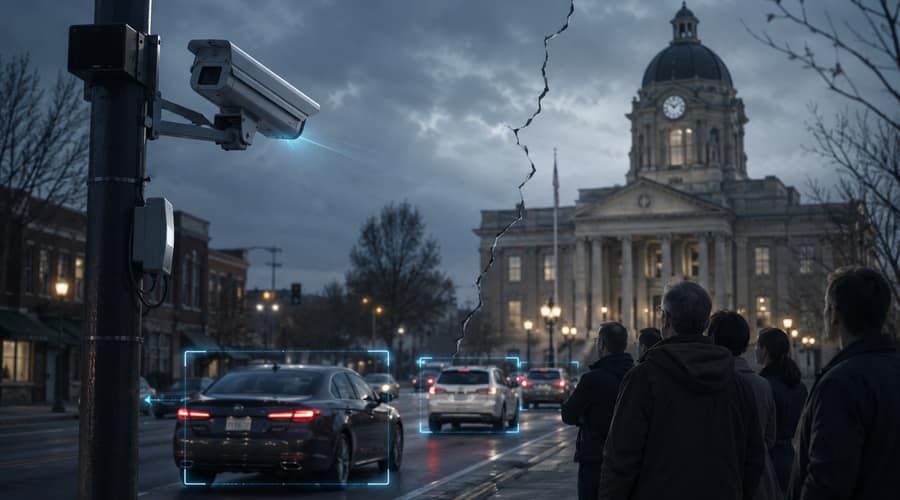
A fight over AI license plate readers is no longer just about crime prevention. It is becoming a test of whether local governments can deploy surveillance technology without losing the public's trust.
That tension is now visible in towns and cities across the US, where automated license plate readers have moved from a niche policing tool into a political flashpoint. The latest wave of backlash has been driven not only by the cameras themselves, but by what they can do, who can access the data, and how little many residents feel they were asked before the technology arrived.
Recent reporting shows how quickly that backlash can turn into policy reversal. In Dayton, Ohio, police indefinitely suspended fixed automated license plate readers after an internal review found what city leaders called "egregious" data-sharing violations, including 7,100 search requests citing immigration-related purposes from other law enforcement agencies, according to WYSO. In North Carolina, local governments have also been pushing back even as state officials seek to expand the network, a reminder that the same technology can be defended as a crime-fighting tool and rejected as surveillance infrastructure at the same time, as GovTech reported.
The core complaint is not hard to understand. These systems do more than read a plate. Flock Safety's AI-powered cameras also capture vehicle details such as make, model and color, and the company operates a national network that allows agencies to search across data gathered far beyond their own jurisdiction, NPR reported in February. For residents, that creates a simple but uncomfortable question: if local cameras can be queried nationally, who really controls the information?
That question has become sharper under President Trump's immigration crackdown, which has intensified fears that local data could be used for purposes far removed from the original promise of public safety. NPR said at least 30 localities had deactivated or canceled Flock contracts since the beginning of 2025, many of them after concerns that federal agencies could access data indirectly or that search logs could be used to track protests, immigration-related activity, or reproductive health cases. In Santa Cruz, one city council member told NPR she was dissatisfied with a multibillion-dollar company repeatedly making mistakes with local data, a remark that captures the broader mood well.
The backlash is also being fueled by scale. GovTech reported that North Carolina's State Bureau of Investigation says more than 100 cameras have been installed on state rights-of-way and have already captured over 150 million scans of plates. That kind of volume makes the promise of targeted policing look thin to critics, because once the system is built, it is no longer just about a handful of stolen-car alerts. It becomes a persistent record of movement that communities may never have fully agreed to create.
Trust became the product risk
The Dayton case shows how quickly the debate shifts once trust breaks. The city had passed an ordinance in 2021 requiring new police technology to go through commissioner review, public notice and a hearing, WYSO reported. On paper, that sounds like the guardrails startups usually say they want. In practice, the safeguards were not fully implemented, the review found, and city leaders said the failure damaged confidence in the whole program.
That is the lesson for civic AI vendors. Technical performance does not solve legitimacy. A tool can help locate a missing child or recover a stolen car, and still create political damage if residents believe data is being over-collected, over-shared or poorly governed. Flock itself has tried to answer those concerns by saying cities control sharing settings and by adding filters and dropdown menus meant to restrict certain searches, but those moves have not stopped the wider criticism, NPR reported. Once a community concludes that control is more theoretical than real, the conversation stops being about features and starts being about consent.
The commercial implications are broader than one vendor. If the go-to-market strategy for public safety software assumes that municipalities will adopt first and debate later, the pattern now visible in multiple states suggests that approach is getting harder to sustain. Cities are no longer evaluating these tools only on arrest statistics or response times. They are weighing whether the technology creates a shadow system of surveillance that could be repurposed, quietly or indirectly, by agencies they never meant to empower.
That is why this moment matters for startups building in smart city, public safety or government AI. The market is not just buying software. It is buying a governance model, whether vendors admit it or not. Communities that feel surprised by deployment are far more likely to organize against it, and once that happens, even a technically sound product can become politically toxic. The more AI gets embedded in local policing, the more the winning pitch will have to include auditability, narrow use cases, clear retention rules and genuine public buy-in, not just lower costs and faster searches.
What is unfolding around license plate readers is a useful warning for the whole category. The municipal AI playbook now needs to account for trust infrastructure as seriously as model accuracy or camera performance. Without that, a rollout that looks efficient from the vendor side can end up looking like a breakdown in democracy from the street.
Also read: Publicis buys LiveRamp for $2.2bn, betting the ad holding company can own the identity layer that powers AI marketing • LinkedIn prompt injection shows how brittle AI recruiting has become • Yum Brands is putting Nvidia AI into 500 restaurants