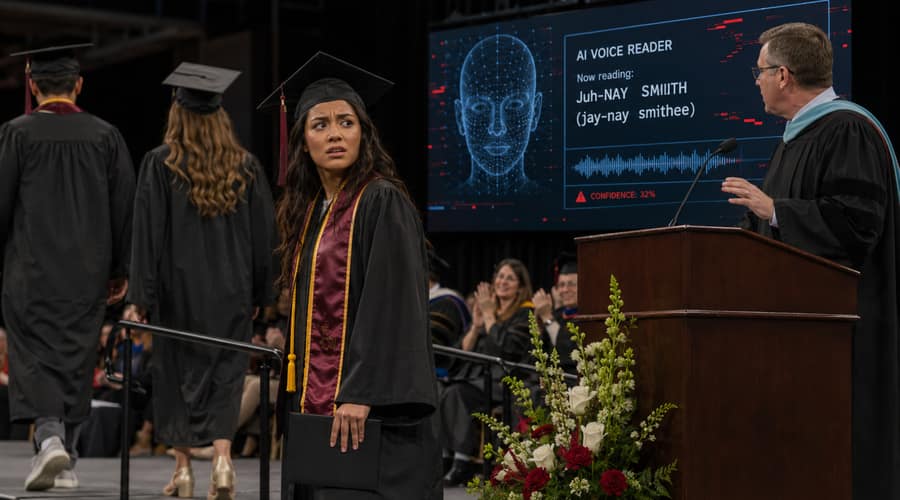
An AI system tasked with reading graduate names at Glendale Community College skipped students, displayed wrong identities on the jumbotron, and left the president apologizing to boos. The incident landed because it turned a personal milestone into a public test case for what happens when automation handles recognition badly.
Glendale Community College did not have an abstract AI problem. It had students walking across a stage while the wrong names appeared on screen and the wrong names came through the speakers. For graduates who had waited years for that moment, the glitch was not a minor production error. It was the ceremony failing at its most basic job.
According to AZFamily, the May 15 commencement used a new AI reader to announce names as students crossed the stage. The system began mismatching names and graduates, the lower-third names on the screen stopped changing, and the ceremony was paused at least twice while officials tried to recover. Student Grace Reimer said she realized something was wrong only after she had already crossed the stage and later heard her own name called for someone else.
President Tiffany Hernandez addressed the confusion during the ceremony and told the crowd the college was using a new AI system as its reader. The explanation drew boos. Hernandez initially indicated affected graduates would not be able to walk again, pointing to the photo opportunity as the most meaningful part of the moment. The room disagreed loudly enough that officials reversed course and let students re-cross the stage with a human announcer.
Why the failure felt bigger than a technical glitch
The system was supposed to make name reading smoother. Instead, it made the ceremony feel less careful. Graduates carried cards to be scanned, but the automated process could not reliably keep the audio, screen display, and student procession aligned. The Arizona Republic reported that the AI mixed up or skipped hundreds of names, and a spokesperson for Maricopa Community Colleges later apologized for a technical issue that affected the reading of some graduate names.
The student reaction was sharpened by an obvious double standard. Graduates told reporters that their classes included strict rules against using AI in coursework, with penalties for misuse. Then the college used an automated system for one of the most visible and emotionally important parts of graduation. That is why the backlash was not only about software. It was about trust.
Reimer also said the apology did not feel sincere. She later ran the college's apology letter through AI detectors and said the result suggested it may have been written with AI, a claim the college denied through a spokesperson. Even without that dispute, the optics were difficult. Once an institution blames AI for mishandling a human moment, every later message has to sound especially human.
The backlash is not happening in isolation
The Glendale incident arrived during a commencement season already full of tension around artificial intelligence. As the Associated Press recently noted, former Google CEO Eric Schmidt was booed at the University of Arizona when he spoke about AI's reach into classrooms, hospitals, workplaces, and relationships. Real estate executive Gloria Caulfield faced similar pushback at the University of Central Florida after describing AI as the next industrial revolution.
At Marquette University, students booed an AI-focused speaker after a petition had called for the school to choose someone else. The common thread is not that graduates reject every use of AI. It is that many are entering a difficult job market while being told that the same technology they were warned not to use in school will now reshape the work they hope to find.
That context matters for edtech companies and enterprise AI vendors. A tool can be technically efficient and still fail if it makes people feel processed rather than recognized. Graduation name reading looks like a small workflow from the outside, but for students and families it is the emotional center of the event. If automation gets that wrong, the damage is not measured in seconds lost. It is measured in whose family missed the moment.
There are established vendors in the commencement market, including Tassel and StageClip, that help colleges manage RSVPs, procession data, name pronunciation, and personalized clips. Those systems can be useful, but the Glendale example shows why human oversight still matters when identity is involved. A scan, screen, and voice need to line up perfectly, or the whole ceremony starts to feel careless.
The college says it is taking steps to ensure the issue does not happen again. That is the minimum response. The larger lesson is for every organization trying to insert AI into public-facing rituals, customer service, hiring, education, or workplace recognition. People will forgive a tool that saves time when the stakes are low. They are far less forgiving when the tool mishandles their name.