Rémi Cadène helped build Tesla's Optimus. Now his Paris startup UMA is trying to prove Europe can make humanoid robots for its own factories, not just buy them from the US or China.
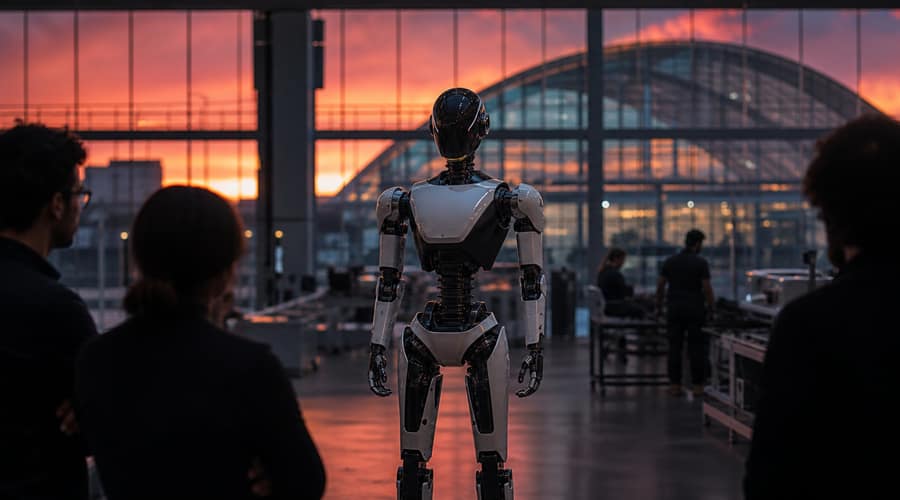
Rémi Cadène spent years inside Tesla, first on Autopilot, then on the Optimus humanoid program. On July 7, at the Machina Summit inside Station F in Paris, one day before the RAISE Summit, he showed what came next: Northstar, the debut robot from his own company, UMA. According to Bloomberg, Cadène said the machine will target European customers first. That's a direct choice, because nearly every other serious humanoid company is chasing American warehouse and factory contracts.
You should pay attention to that geography. Humanoid robotics is usually talked about as a contest between US venture money and Chinese manufacturing muscle. Cadène is making a narrower bet: Europe has the factories, the labor pressure and the political anxiety to support a homegrown robot company, if the robot can actually work.
UMA is not just a former Tesla engineer with a demo. Business Insider reported in August 2025 that Cadène's Paris-based startup was in talks to raise around $40 million in seed funding, with one source saying the company was working on full-stack robotics for industrial and commercial uses. That was before Northstar had a public face. Now the company has one, and the timing is not subtle.
The founding team also gives UMA a better claim than most robotics startups get on day one. Cadène built LeRobot at Hugging Face, an open-source library for training robots on real-world data. Pierre Sermanet spent years on deep learning and robotics research at Google DeepMind. Simon Alibert co-founded LeRobot with Cadène while both were at Hugging Face. Robert Knight has designed humanoid robots for more than 25 years. That's not a team assembled around a buzzword. It is a group of people with fingerprints on tools the robotics field already uses.
LeRobot matters because humanoid robots fail in the gap between a controlled video and a messy floor. A robot that folds one shirt, lifts one box or opens one door in a clip is not the same thing as a machine that can survive a shift in a factory. Cadène's background suggests UMA understands that problem from the software side, where real-world training data matters as much as the shape of the machine.
Figure, Apptronik and 1X have all raised large rounds while courting the same broad market: logistics operators, car plants and companies that want robots on site soon. UMA is moving differently. Usine Nouvelle reported that the company has spoken with roughly 50 potential customers and visited several factories to understand what they need. The early focus is industrial and logistics work, with pilots planned in manufacturing and logistics, and healthcare later in 2026.
Fifty conversations are not fifty contracts. Frankly, that is the line that matters most. Nobody has confirmed a signed customer, a delivery schedule or a price for Northstar. Interest from factory managers is useful, but it does not pay for production tooling, field support or the long, dull work of making robots dependable.
The caution is earned. Tesla has pushed its own Optimus ambitions through changing timelines. Figure has attracted attention with impressive demonstrations while commercial scale remains the hard part. Humanoid robots are full of companies that can show motion and struggle to show repeatable work. If UMA wants to be treated differently, Northstar has to leave the stage and spend time in a real workplace.
Europe's case for a robot like this is not sentimental. The continent has an aging workforce, high labor costs and a deep base of manufacturers that already know what labor shortages feel like. France also has a growing political interest in owning more of its AI and robotics stack, rather than depending on platforms built abroad. UMA does not need to wrap Northstar in a speech about strategic autonomy. A robot designed in Paris for European factories makes the argument on its own.
Still, there is a danger in treating nationality as proof of demand. Being European buys Northstar nothing with customers: what sells a robot is whether it clears a bottleneck, works safely around people and costs less than the problem it solves. Cadène's Tesla and Hugging Face background will get UMA meetings. Northstar's performance will decide whether those meetings become deployments.
That is why the next year matters. If UMA can point to pilot deployments by the end of 2026, it becomes the first credible European name in a field still dominated by American and Chinese attention. If it cannot, Cadène will have shown that Tesla pedigree buys a crowded room at Station F, not a place on the factory floor.
Also read: Quaise Energy raises $144 million to drill for superhot geothermal power • Defense tech funding has doubled this year as investors bet on autonomy • DeepSeek Chose Huawei's Chips Over Building Its Own In-House Silicon