Aluminum's 2026 price shock has turned a recycling problem into a sharper business opportunity. For startups using AI to sort scrap by alloy, higher prices make speed, purity, and domestic supply matter much more.
Aluminum is no longer behaving like a sleepy industrial input. Prices have climbed sharply this year as supply strains ripple through manufacturers, and that is giving AI-powered recycling companies a cleaner pitch to customers: recover more metal, sort it better, and keep valuable feedstock closer to home.
The timing matters. S&P Global reported in early May that European aluminum automotive shredded scrap had risen 28 percent since the start of 2026, while primary aluminum supply pressures were pushing buyers toward recycled inputs. The Persian Gulf accounts for about 6 percent of global primary aluminum output, and more than 20 percent of supply outside China, so disruptions there quickly feed into pricing, procurement, and risk management for manufacturers.
That changes the economics of recycling. Mixed aluminum scrap has always had value, but it has often been downgraded because separating alloy grades at industrial speed is hard. Manual sorting is slow. Traditional systems can miss the difference between cast and wrought alloys. AI does not make scrap magically profitable, but it can make the margin easier to capture.
Sortera is building around alloy precision
Sortera Technologies is one of the clearest examples. The Indiana-based company raised $45 million in late 2025, including $20 million in equity and $25 million in debt, to expand its AI-driven aluminum upcycling business and build a second facility in Lebanon, Tennessee. TechCrunch reported that the round was led by VXI Capital and accounts advised by T. Rowe Price, with backing from Yamaha Motor Ventures, Overlay Capital, and Trinity Capital.
The Tennessee plant is not yet a finished proof point. Recycling Today reported that the facility is expected to be operational by summer 2026, and that it would initially match Sortera's Markle, Indiana, site at about 120 million pounds of annual capacity. Together, the two locations would bring Sortera to roughly 240 million pounds of capacity, giving the company a larger base from which to serve automotive, aerospace, and manufacturing customers.
Sortera's system combines sensors, cameras, lasers, and X-ray fluorescence with AI models that classify shredded aluminum by alloy type. That matters because a pile of mixed scrap is worth less than material that can go straight into a furnace with predictable chemistry. A customer buying a specific die-cast alloy does not want a general promise of recycled content. It wants material that behaves like the input its process was designed around.
The company's location strategy also tells you where demand is coming from. Tennessee puts Sortera closer to the Southern automotive and battery supply chain, where manufacturers are trying to cut costs, lower carbon intensity, and reduce exposure to overseas supply disruptions. In that market, recycled aluminum is not just a sustainability talking point. It is a procurement hedge.
TOMRA shows the same logic in packaging
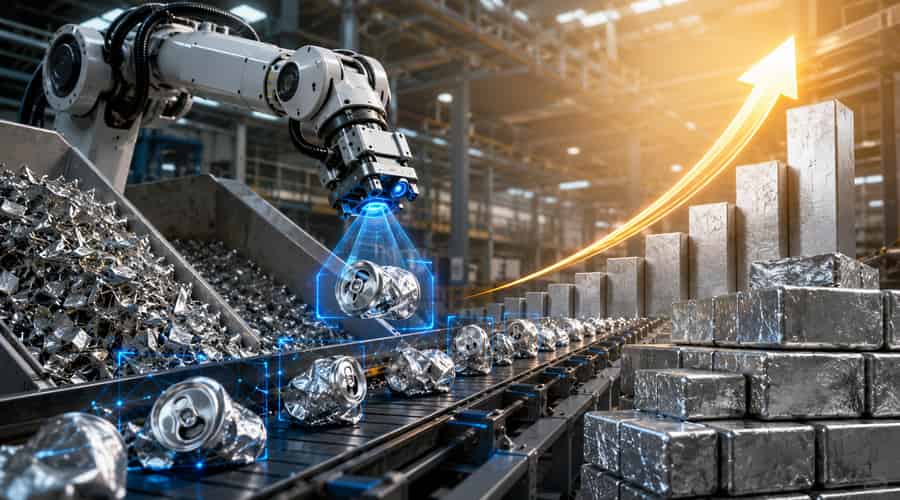
The same argument is playing out in consumer packaging. TOMRA Recycling's GAINnext platform uses deep learning to identify difficult material streams at high speed, including used beverage cans. TOMRA says the system can deliver up to 2,000 ejections per minute depending on the application, and Recycling Today has reported that it can reach more than 98 percent purity for used beverage can recovery without manual sorting.
That kind of performance matters because aluminum cans are one of the few consumer waste streams where the recycling story can work at scale. The metal can be reused repeatedly, and the economics improve when the system can pull clean material from noisy streams. The better the purity, the easier it is for recyclers to sell into higher-value channels instead of accepting lower grades or losing cans to landfill.
TOMRA has also been adding AI analytics through its majority stake in PolyPerception, which helps recycling plant operators monitor material flows and line performance. That is a quieter part of the story, but an important one. Sorting hardware is only useful if operators know whether changes to speed, calibration, or feedstock are improving recovery or just moving the problem further down the line.
The hard part is scale
The opportunity is real, but it is still early. The U.S. consumes millions of metric tons of aluminum a year, so even 240 million pounds of annual capacity is a small slice of the market. AI sorting can lift recovery rates and upgrade scrap, but it still depends on collection systems, logistics, customer contracts, and the discipline to run capital-heavy plants efficiently.
There is also commodity risk. Higher aluminum prices make AI sorting look more attractive today, but startup margins can narrow if scrap costs rise faster than finished alloy premiums. Tariffs, energy prices, and competition from established recyclers can also change the math. Industrial AI companies do not get the same luxury as pure software startups. They have to make the machines work, keep uptime high, and sell physical output into demanding supply chains.
Still, the direction is clear. AI is moving beyond screens and chatbots into the industrial systems that decide whether valuable materials become feedstock or waste. If aluminum prices stay firm, the companies that can turn messy scrap into consistent alloy packages will have more than a climate story. They will have something manufacturers already understand: reliable supply at a price that makes sense.
Also read: Krea 2's open source promise is still just a promise • America's AI boom just hit a wall called local politics • The Path raises $14.3M for safer AI therapy