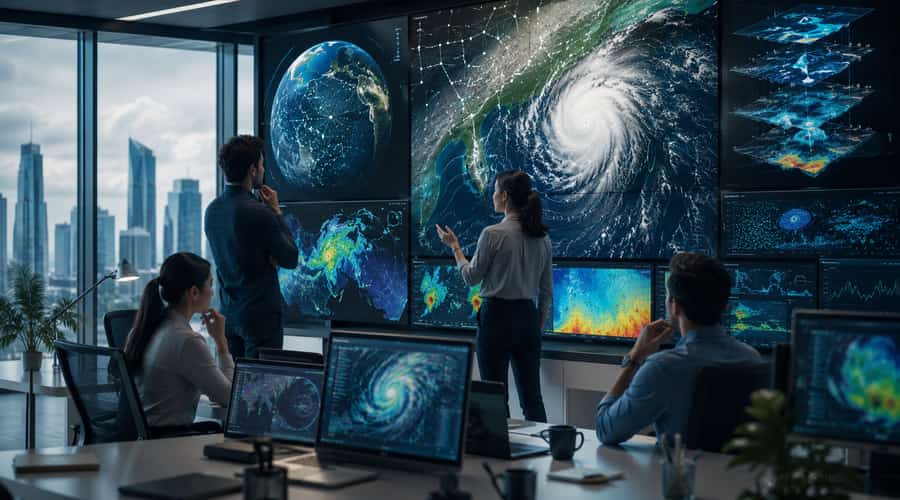
AI weather forecasting is moving from research labs into the market. Startups are now trying to prove that faster, more specialized forecasts can become a serious business.
Weather used to look like a market startups could only circle from the outside. Governments owned the satellites, radar, supercomputers and most of the public trust. Now a new group of AI companies is testing a different assumption: that the forecast itself can be rebuilt with machine learning, cheaper compute and sharper products for industries that lose money when weather calls are wrong.
That matters because weather is not just a consumer app problem. It is a logistics problem, an energy trading problem, an agriculture problem, an aviation problem and an insurance problem. A slightly better short-range forecast can change when a ship leaves port, how a utility balances supply, whether a farmer sprays a crop, or how an insurer prices storm risk. When uncertainty has a dollar value, better prediction becomes a product.
As Fast Company recently noted, companies including Google, Nvidia and startups such as Brightband are pushing AI deeper into weather forecasting while private firms look for openings around NOAA data and public forecasting infrastructure. That does not make the National Weather Service suddenly irrelevant. It does mean the boundary between public weather data and private weather intelligence is getting thinner.
The strongest startup pitch in this market is not that AI can make a prettier seven-day forecast. It is that machine learning can run faster, update more often and specialize around the variables that matter to paying customers. Energy traders care about wind, solar radiation and temperature. Airlines care about turbulence, storms and airport disruption. Agriculture needs local rainfall and heat stress. Insurance wants risk signals before everyone else sees them.
Atmo has been one of the louder companies making that argument. Time described the company in 2024 as using more than 60 years of climate data and live inputs from satellites and sensors to generate forecasts that Atmo says are faster and more detailed than traditional supercomputer-based systems. The company has also worked with governments, including Tuvalu, and has promoted its system as a tool for countries that cannot easily maintain expensive forecasting infrastructure on their own.
Silurian, founded by former Microsoft AI researchers, shows how quickly the field is moving from academic demonstration to commercial product. GeekWire reported that the company released its Generative Forecasting Transformer in 2024 and said the model could outperform NOAA and ECMWF forecasts on numerous parameters. That kind of claim needs careful independent verification, but it is still important. Startups are no longer just selling dashboards on top of public forecasts. They are trying to compete with the model layer itself.
The result is a more serious market than most people realize. Weather forecasts touch trillions of dollars in economic activity, but customers do not buy accuracy in the abstract. They buy fewer missed deliveries, better power bids, lower crop losses and earlier warnings. The winners may not be the companies with the broadest consumer reach. They may be the ones that prove a narrow advantage in a high-value workflow.
NOAA is still the foundation
There is a catch, and it is a big one. Many AI weather systems still depend heavily on the public data ecosystem they are competing against. NOAA, ECMWF and other agencies collect observations, maintain historical datasets, operate satellites and support the basic infrastructure that private models often train on or ingest. A startup can move faster than a government agency, but it usually does not replace the public measurement network underneath it.
This is where the privatization debate becomes more complicated. If public agencies are weakened while private companies grow stronger, the market may gain better premium products but lose some of the shared infrastructure that made those products possible. Weather is not like ride hailing or food delivery. Bad forecasts can cost lives, and the public value of open warnings is not captured cleanly by enterprise software pricing.
That does not make private AI forecasting a threat by default. In many cases it could be a useful complement. A government forecaster looking at several fast AI model runs may have more signal, not less. A grid operator using a specialized model alongside NOAA guidance may make better decisions. The practical question is not whether AI replaces meteorology. It is where AI adds enough measurable accuracy to justify a separate market.
For startups, the lesson is broader than weather. Government-adjacent markets often look slow from the outside because the infrastructure is old, the buyers are cautious and the standards are high. But when AI can demonstrate a measurable performance gap, those markets can open quickly. Defense, climate risk, water management, public health and transportation all have similar patterns.
The next phase will be less about bold claims and more about proof. Customers will want benchmarks by region, variable and time horizon. Regulators and public agencies will want reliability in extreme events, not just average performance. Investors will want to know whether these models can create durable data advantages or whether the field becomes crowded with similar systems trained on similar public inputs.
If AI weather startups can answer those questions, forecasting may become one of the clearest examples of deep tech moving from public infrastructure into private advantage. The market will not reward the company that simply says it can beat NOAA. It will reward the company that proves where, when and for whom that advantage changes the economics.
Also read: AI is forcing economists to recheck the math beneath markets • Nvidia brings RTX Spark to Windows laptops. • Mecka AI turns robot training data into a startup category.