A new UN report puts hard numbers behind AI's physical cost, and they are big enough to change how data centers get funded, permitted and built.
Artificial intelligence is no longer just a model race. It is becoming a power plant, water rights and land-use story, with the same kind of practical constraints that shape factories, mines and transport networks.
The latest signal came Wednesday, June 3, when the United Nations University Institute for Water, Environment and Health published a report calculating the environmental cost of AI and data centers. According to AP's account of the report, global data centers used 448 terawatt-hours of electricity in 2025, more than every country except the world's 10 largest electricity users. That use produced about 208 million tons of carbon dioxide and required roughly 1.2 trillion gallons of water for power generation.
Those figures matter because they turn a vague concern into a balance-sheet problem. For the companies building AI systems, the scarce input is not only Nvidia GPUs or engineering talent. It is grid capacity, cooling infrastructure, water access, local political permission and enough clean power to keep sustainability promises from becoming marketing theater.
By 2030, the UN report projects data centers could consume 935 terawatt-hours of electricity, close to 3% of projected global demand. AI's share of that power use is expected to rise from about 20% today to 40% by the end of the decade. That is the part investors should notice. A technology that was sold as software is increasingly behaving like heavy industry.
Data centers have always needed power, but generative AI changes the scale and intensity of the buildout. Training large models, running inference for millions of users and producing text, code, images and video all depend on facilities that run hot and require constant cooling. The environmental footprint then depends heavily on where those facilities sit and which power sources serve them.
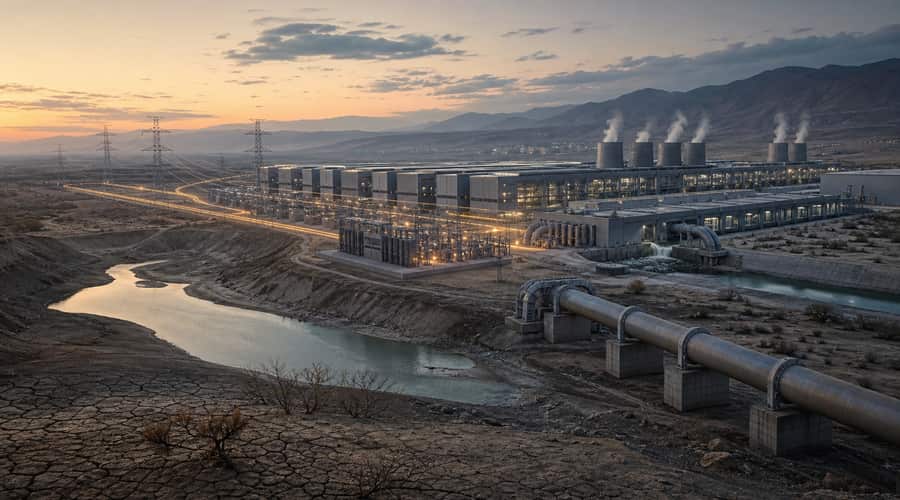
This is why the report's water number is so important. The 1.2 trillion gallons cited for 2025 is not only about water sprayed or circulated inside data centers. Much of the footprint is tied to electricity generation itself, especially in regions where power plants consume water for cooling. In dry or politically sensitive regions, that turns a server farm into a local resource question.
Reuters also reported that the UN researchers warned about land pressure and electronic waste, which expands the discussion beyond carbon. Chips, backup systems, transmission lines, cooling equipment and energy infrastructure all have physical supply chains. If AI demand keeps expanding, the footprint will not remain neatly contained inside the walls of the data center.
For hyperscalers, this creates a disclosure problem. Microsoft, Google, Amazon and Meta can still argue that AI helps customers become more efficient, but they also have to explain why their own electricity and water needs are rising. For startups, the pressure is more indirect but still real. If compute gets more expensive because power is scarce or permitting slows, smaller AI companies will feel it through cloud pricing, availability and financing terms.
Permits may become as important as processors
The AI infrastructure race has encouraged a simple assumption: raise capital, buy chips, lease capacity and scale. That assumption looks weaker when local grids are congested or communities object to water use, noise, land consumption or higher utility bills. A data center cannot move as easily as a software team.
This is already changing the geography of AI. Developers are looking for sites near cheap power, strong transmission lines, tax incentives and reliable water supplies. In practice, that can concentrate projects in areas where local officials want jobs and investment, but it can also create backlash when residents see few direct benefits and real strain on infrastructure.
There is a financing angle here as well. Lenders and infrastructure funds are not likely to stop backing data centers, because demand is too strong. But they may start asking harder questions about power purchase agreements, water permits, community risk and emissions exposure. A project that cannot show credible access to energy and cooling may become harder to underwrite, even if it has a large cloud customer attached.
The better operators will treat sustainability as an execution issue, not a public relations exercise. That means siting facilities where clean power is actually available, using cooling systems that match local water conditions, improving server utilization and giving regulators clear data on peak demand. It also means recognizing that efficiency gains can be swallowed by growth if every saved watt simply makes room for more AI workloads.
None of this means AI development stops. It means the industry is entering a more mature phase, where physical limits start shaping strategy. The companies that win will not only have better models. They will have better infrastructure planning, stronger utility relationships and more honest accounting of the resources their products consume.
The next thing to watch is whether environmental disclosure becomes a real constraint on AI expansion. If regulators, investors and communities begin treating data centers like critical industrial infrastructure, the AI boom will still continue, but it will have to clear a higher bar than hype and capital alone.
Also read: Companies are learning how to game AI search through Reddit • AI data centers are becoming a national resource test • Google makes Gemma 4 12B a local AI bet for startups