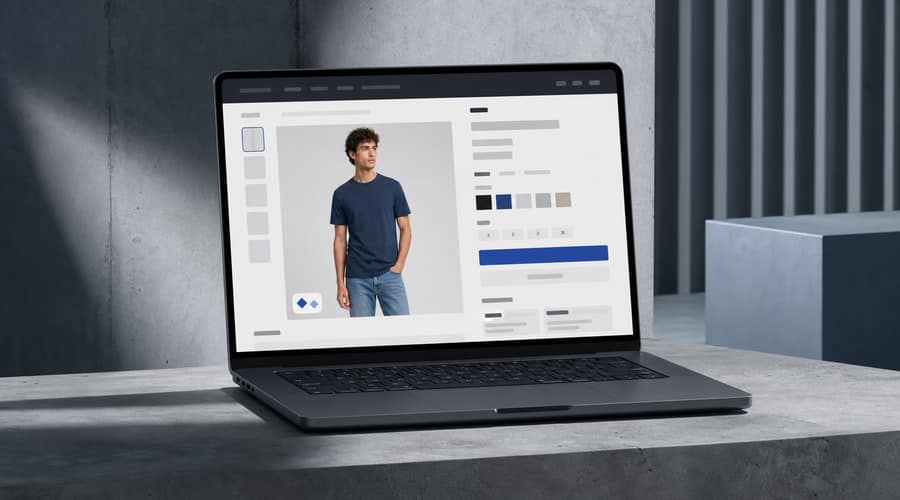
Amazon's AI image checkbox is not a small upload nuisance. New York has turned synthetic models into a disclosure issue, and Amazon is starting to make sellers carry that fact inside the listing workflow.
If you've been using AI tools to generate people for Amazon ads or A+ Content, you now have a record-keeping problem. Not a theoretical one. Amazon's own advertising help page says advertisers who provide creative assets with synthetic performers must mark them during upload by selecting the Contains synthetic performers option, while reports from Amazon seller agencies in June found similar mandatory AI disclosure fields appearing in A+ Content Manager and Brand Stories.
The legal trigger is New York's synthetic performer law, which took effect on June 9, 2026. Governor Kathy Hochul's office described it as a first-in-the-nation disclosure rule for advertisements that include AI-generated synthetic performers. The New York Assembly's bill summary lists the penalty at $1,000 for a first violation and $5,000 for each later violation. That's not a rounding error if the same creative is used across a catalog.
The law is narrower than the panic around it. It doesn't require a label just because a background, product render, or countertop scene was made with AI. It targets a digitally created human likeness that appears to be performing in an ad and is not recognizable as an actual person. A synthetic model wearing a shirt is in scope. An AI-generated kitchen behind a coffee maker isn't.
That distinction matters.
Amazon's policy language also carves out important limits. Its Ads guidance says assets made inside Amazon Ads generative AI tools may be identified automatically when used inside the Ads Console or Amazon API, but creative made elsewhere has to be flagged by the advertiser. For some third-party served video or display ads, Amazon says advertisers are responsible for putting a compliant disclosure directly into the creative. You can't assume the platform will clean up the file for you.
The exceptions are also real. Legal analyses from Honigman and Cooley both point to carve-outs for audio-only ads, AI used solely for language translation of a human performer, and advertisements for expressive works such as films, streaming content and video games when the synthetic performer is used consistently with the underlying work. Minor retouching or color correction of real people generally sits outside the synthetic performer target. Don't stretch that too far. If the person doesn't exist, treat the image differently.
Amazon is turning disclosure into metadata
Here's the thing about platform compliance: it rarely stays confined to the law that started it. New York writes the rule for ads reaching New York audiences. Amazon builds the upload field once. Sellers then meet the platform rule wherever they happen to be based, because Amazon doesn't want every seller deciding how to segment a listing by state.
That is how a state law becomes a marketplace standard. It happened with privacy notices after California pushed the issue. It can happen here too, only faster, because a product image can travel through ads, Store pages, A+ modules and social campaigns before anyone remembers who generated the person in the frame.
For Amazon sellers, the immediate issue is not whether AI product photography is banned. It isn't. Tools such as Claid and Pebblely exist because a small apparel seller or overseas manufacturer may not have the money, samples, studio time, or local model access for a full shoot. If AI gives that seller a usable lifestyle image, there is a real business reason for using it.
But the cheap image now carries a disclosure trail.
Seller agencies Parker-Lambert and WebQuest Digital both reported in June that Amazon A+ and Brand Story uploads were asking two separate questions: whether an image was AI-generated and whether it featured photorealistic AI-generated people. Those reports described the current A+ flow as metadata collection, not a shopper-facing AI badge. That is an important correction to the louder version of the story. A checkbox is not the same thing as a public label on every product page.
Still, metadata has weight. Once Amazon knows which assets contain AI-generated people, it can decide later where to show disclosures, where to block non-compliant ads, or which categories need stricter treatment. Amazon says independent sellers account for more than 60% of sales in its store, according to its 2026 selling partner materials. That is a huge surface area for a rule many sellers didn't help write and may not have noticed.
The seller audit starts with people, not pixels
The right response is plain. Audit every current ad, A+ module and Brand Story that uses a human figure. Separate real model photography from AI-assisted edits, and separate those again from fully synthetic people. If you don't know which is which, ask the vendor who made the asset and keep the answer.
Don't waste time labeling every AI shadow, room, plant, bottle reflection or lifestyle background as if New York banned generated imagery. It didn't. The law is about synthetic performers, and the most defensible compliance work starts by finding the synthetic human beings in your creative library.
There is also a trust question, but it should be handled carefully. Some shoppers won't care that a model was generated. Others will, especially in apparel, beauty, supplements and any category where the image implies fit, skin texture, body scale or product result. Frankly, sellers should want to know which side their customers are on before a regulator or platform policy tells them the hard way.
The FTC piece is broader and less mechanical. The agency's Endorsement Guides were revised in June 2023, not March 2026, and the FTC says endorsements and advertising claims must be truthful and not misleading. That doesn't create a general federal label for every AI image. It does mean a fake person, fake result, or fake testimonial can become a deception problem if the image gives consumers the wrong impression.
So treat Amazon's checkboxes as the start of a file, not the end of the job. Keep source assets, prompts where available, vendor contracts, publication dates and disclosure decisions in one place. A seller with five listings can do this in a spreadsheet. A brand with hundreds of SKUs needs a real content inventory.
The fines are New York's. The workflow is Amazon's. The risk belongs to the seller who uploads the image and hopes nobody asks whether the person in it was ever real.
Also read: China's memory chipmakers are racing to break the Korean stranglehold on AI infrastructure • China's AI cobots are no longer science fiction and millions of factory workers are about to find out • Singapore tightens cybersecurity rules for critical infrastructure after China-linked hack hit all four major telcos