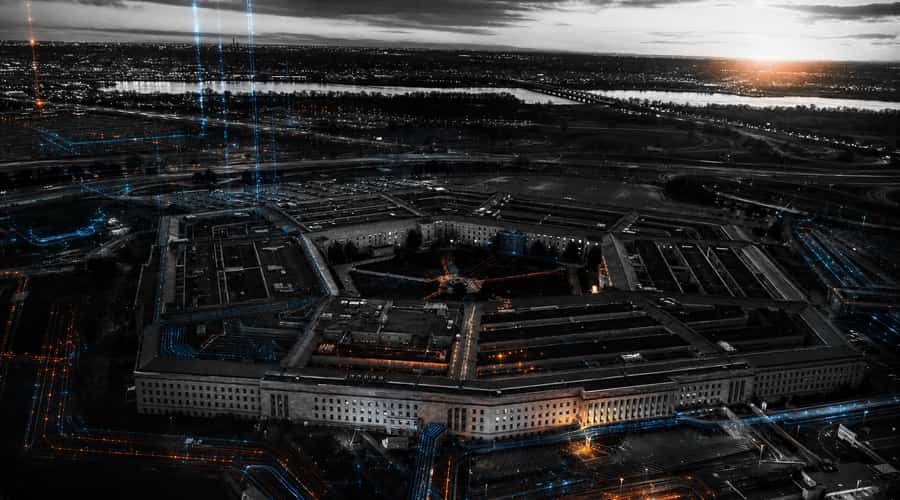
Oracle's nearly $7 billion Pentagon software deal is not the glamorous AI infrastructure story investors usually chase. It is better than that: a 10-year grip on software the military already depends on.
Oracle has just signed the kind of government technology contract that doesn't look flashy until you read the dates. The Department of War awarded the company an enterprise software agreement on July 23, 2026, with a five-year base value of $3.31 billion and a 10-year ceiling of $6.99 billion if the option years are exercised. That is not a pilot. It is a decade-long procurement lane.
Reuters reported that the agreement, negotiated by the Department of the Navy, consolidates the Pentagon's on-premises Oracle software licenses into a single contract covering the Defense Department, the US Coast Guard and the intelligence community. Oracle said the vehicle will let authorized department organizations and contractors buy commercial offerings including on-premises software and support, SaaS applications and professional services, with pricing and deliverables set at the order level. That's the practical detail you should watch. The Pentagon is not only buying software. It is cleaning up how it buys software.
The savings figure is real and specific. According to Reuters and Fox Business, Department of War Chief Information Officer Kirsten Davies said the contract would drive at least $441 million in taxpayer savings by improving how the department procures on-premises Oracle capabilities. Oracle's own announcement put the transition to the new Enterprise Software Initiative vehicle in the summer of 2026 and said it has supplied the department since the 1990s.
Investors liked the news, but not wildly. Fox Business reported Oracle shares were up about 4.6% in the stock table shown with its story, while Reuters-linked market reports put the after-hours move closer to 2% to 3%. For a contract that can run to nearly $7 billion, that reaction tells you something useful: the market still wants to talk about Oracle as an AI cloud capacity story, not as a government software incumbent.
That is a mistake.
The Pentagon still needs software it controls
Here's the thing about military IT: the hardest systems to move are often the ones nobody wants to brag about. Classified workloads, disconnected environments, intelligence systems and tactical operations don't behave like a startup app being pushed to a public cloud region. Some of them need facilities the government controls. Some of them need old integrations to keep working. Some of them simply cannot be broken in the name of modernization.
That is where Oracle has an advantage that is less fashionable than AI chips and more durable than a keynote demo. Its databases and enterprise software have been embedded in government and large-company systems for decades. Replacing that stack inside military workflows is not like switching collaboration tools. It means migrations, retraining, security reviews that take months, and years of accumulated operational risk that nobody wants to carry. You don't take that on unless the reward is obvious.
The department is still moving toward cloud and AI. The 2022 Joint Warfighting Cloud Capability contract gave AWS, Microsoft, Google and Oracle a shared ceiling of up to $9 billion. On May 1, 2026, the Department of War said eight companies, including Oracle, Microsoft, AWS, Google, OpenAI, Nvidia, SpaceX and Reflection, had agreements to deploy AI capabilities on classified IL6 and IL7 networks. TechCrunch reported the same roster and noted that the department said more than 1.3 million personnel had used GenAI.mil.
So don't read the Oracle deal as a retreat from cloud. It is more blunt than that. The Pentagon wants new AI tools, but it also wants the software layer underneath them to be licensed and supported under a single consolidated vehicle. The plumbing matters.
Microsoft has the bigger number, Oracle has the stickier base
Oracle is not alone in this procurement reset. Reuters reported in May that the Pentagon awarded a five-year, $9.69 billion agreement to consolidate Microsoft and other enterprise software licenses across the military services, the intelligence community and the Coast Guard. The official DoD CIO notice described that Microsoft agreement as a Dell Federal Systems blanket purchase agreement covering Microsoft 365, cloud subscriptions and on-premises licensing.
Microsoft's number is larger. Oracle's term is longer. Those are different strengths.
For Microsoft, the Pentagon deal locks in the communications and productivity layer that almost every large organization already runs through. For Oracle, the July agreement protects a deeper operational layer: databases, enterprise applications, maintenance and services that sit closer to legacy systems and mission software. If you're watching Oracle as a business, that distinction matters more than the headline number. That stickiness is the point.
Frankly, this is why Oracle remains harder to dislodge than its critics like to admit. Larry Ellison can talk about AI infrastructure and data center capacity, and that story clearly matters. But a 10-year federal software agreement gives Oracle something more boring and more valuable: contracted demand from a customer that doesn't casually rip out core systems.
The broader defense technology market should take the same lesson. New AI vendors can win pilots and cloud providers can sell capacity into the same networks, but the enterprise incumbents with decades of software already inside the building are not being pushed aside by modernization. In this case, modernization is being routed through them.
Also read: Lightning Finds BARABAS Twice: From a Rolling Stone Photo to the White World Cup Final Suit, China's memory chipmakers are racing to break the Korean stranglehold on AI infrastructure, and China's AI cobots are no longer science fiction and millions of factory workers are about to find out