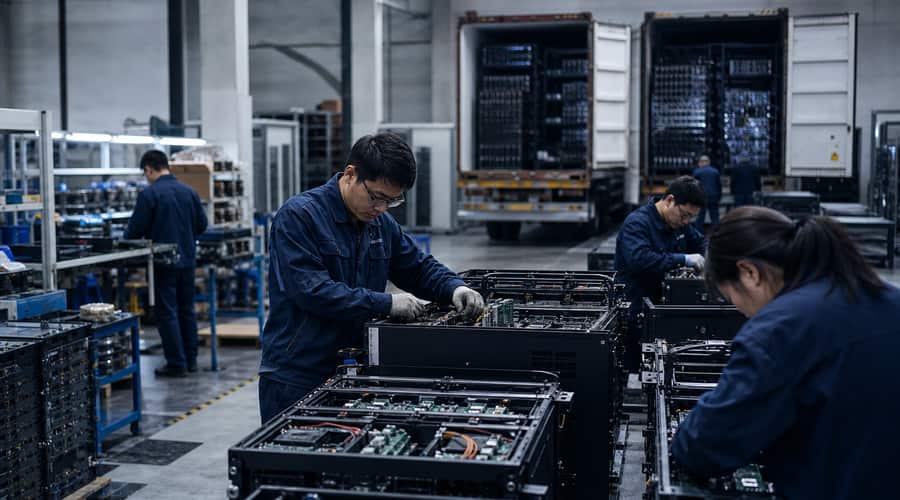

New photos of an AMD in-house Halo Box built around the Ryzen AI Max+ 395 with 128GB of unified memory are circulating today, and for researchers and small teams running large language models locally, the timing could not be more interesting.
The images surfaced on Reddit this week, and while AMD has not made a formal product announcement, the hardware itself is already well understood. The Ryzen AI Max+ 395 officially supports up to 128GB of unified memory, with a substantial portion of that addressable as VRAM for AI inference workloads. What the photos suggest is that AMD may be preparing a compact desktop configuration around this chip, reportedly targeting a June release window. For anyone who has spent the past two years watching cloud GPU costs climb while waitlists for H100 instances stretch into weeks, that is worth paying attention to.
The unified memory architecture is the piece that makes this genuinely interesting rather than just another product rumor. Traditional desktop workstations draw a hard line between system RAM and GPU VRAM. You might have 64GB of system memory and 24GB on your graphics card, but they do not share a pool. The Ryzen AI Max+ 395 blurs that boundary. When a model needs memory headroom, it can pull from the same physical pool the CPU is using. That is how a chip in what appears to be a small form factor box ends up with enough addressable VRAM to load models that previously required a data center card or a very expensive consumer GPU like Nvidia's RTX 4090, which tops out at 24GB.
To put that figure in practical terms, running a 70-billion parameter model like Meta's Llama 3 at full precision requires roughly 140GB of memory, which is still out of reach here. But at 4-bit quantization, the same model compresses to around 35-40GB, sitting comfortably within the 128GB envelope. Models in the 30 to 34 billion parameter range run cleanly without aggressive quantization. For a research team prototyping with open-weight models, or a startup that wants to run inference on sensitive data without shipping it to a third-party API, that headroom changes the calculus considerably.
The competitive context matters too. Apple's M3 Ultra, which also uses a unified memory architecture, supports up to 192GB and has already built a loyal following among developers doing local inference on macOS. AMD entering this space with a Windows-native option running on x86 opens the door for teams whose workflows, tooling, or existing infrastructure are tied to that ecosystem. The software side is still catching up, but frameworks like llama.cpp and Ollama have broadened their hardware support considerably over the past year, and AMD's ROCm platform has made meaningful progress in closing the gap with CUDA for inference workloads specifically.
There is also a cost dimension that deserves an honest look. Cloud GPU rentals on platforms like Lambda Labs or Vast.ai can run anywhere from a few dollars to several hundred dollars per hour depending on the hardware tier. For a small team running regular experiments, those costs accumulate fast. A one-time capital purchase of a local inference box, even at a premium price point, can pay for itself relatively quickly if the alternative is sustained cloud spend. The exact price of the AMD Halo Box has not been confirmed, but given that the Ryzen AI Max+ 395 is a high-end consumer chip rather than a server part, the expectation is that it will land well below workstation GPU territory.
The broader shift in who can afford serious AI compute
What AMD is arguably doing here, intentionally or not, is participating in the gradual democratization of AI infrastructure. The past three years have seen the cost of inference fall dramatically at the software layer, with quantization techniques and optimized runtimes letting smaller hardware do work that once demanded far more. The hardware layer is beginning to follow the same curve. A compact box with 128GB of unified memory that fits on a desk and runs on a standard power outlet represents a meaningful step down in the barrier to entry for teams that want to own their compute.
This matters especially for startups and independent researchers working on applications where data privacy is not optional. Healthcare, legal, and financial applications often involve information that simply cannot leave the organization's control. Running inference locally on capable hardware is not just a cost decision in those contexts. It is a compliance requirement, and one that cloud GPU rentals make structurally difficult to satisfy.
If AMD confirms a June launch and the Halo Box ships close to the specs visible in this week's photos, the more interesting question will be how quickly the developer community builds around it. Apple's local inference ecosystem grew in part because developers trusted the hardware to be consistently available and consistently specced. AMD will need to earn that same confidence. The photos are a promising signal. The product itself will do the rest of the talking.
Also read: KAIST Researchers Found That Teaching AI to Embrace Chaos Before Training Makes It Dramatically More Honest About What It Doesn't Know • Chinese Courts Just Ruled That AI Automation Is Not a Legal Reason to Fire Someone and Every HR Team Needs to Read This • Salesforce Is Letting Its Customers Build the Agentforce Roadmap and the Strategy Is Smarter Than It Looks