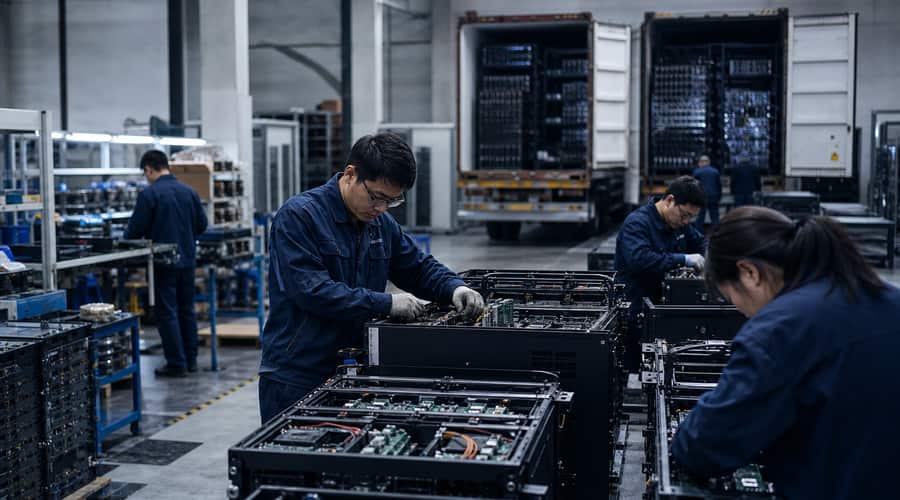

The United States has billions in AI investment lined up, but nowhere near enough skilled tradespeople to wire the infrastructure that makes any of it run.
Every major technology company is racing to construct data centers. Microsoft, Amazon, Google, and Meta have collectively committed tens of billions of dollars to build the computing backbone required for artificial intelligence. The capital flooding into this sector is staggering, dwarfing most countries' entire GDPs. Wall Street analysts project the infrastructure boom will generate trillions in economic activity over the next decade. There is just one complication: someone actually has to build these facilities, and that someone is in critically short supply.
Ford CEO Jim Farley has been vocal about what he terms the "essential economy," the blue-collar sectors responsible for getting things built, moved, and repaired. As Fortune recently highlighted, Farley points out that this segment represents roughly $12 trillion of U.S. GDP, based on figures from the Aspen Institute, yet remains chronically understaffed and undervalued. The country is currently down approximately 600,000 factory workers and 500,000 construction workers, and the gap shows no signs of narrowing.
The irony cuts deep. The very technology promising to transform knowledge work is simultaneously creating massive demand for physical labor. AI might displace significant portions of entry-level white-collar roles in the coming years, jobs like junior programming and administrative support, precisely the positions educators have steered young Americans toward for a generation. Meanwhile, the infrastructure required to run those AI systems demands electricians, pipefitters, and specialized construction workers who simply do not exist in the numbers required.
Goldman Sachs has attempted to put concrete figures on the scale of the problem. Brian Singer, who leads the firm's sustainability research division, recently explained on the Goldman Sachs Exchanges podcast that building and powering the necessary AI infrastructure will require approximately 500,000 new jobs in the United States. That breaks down to roughly 300,000 workers for electricity generation and another 200,000 for grid transmission and distribution work.
The transmission and distribution segment is the real sticking point. Training a qualified electrician takes about four years. The country currently has approximately 45,000 energy apprentices in the pipeline. To meet projected demand, that number needs to increase by 20,000 to 25,000 almost immediately. We are not talking about a gradual shortfall. This is a structural deficit that compounds the longer it goes unaddressed.
Regional concentration makes matters worse. Data center development clusters heavily in a handful of locations. Virginia handles roughly 70 percent of the world's internet traffic and has nearly 35 gigawatts of capacity in development. Texas and the Phoenix metro area rank among the top markets for new builds. As JLL's global data center division president Matt Landek has noted, secondary markets often lack the specialized construction expertise and operational support infrastructure that primary hubs take for granted. The labor crunch is not distributed evenly. It is most acute precisely where construction demand is highest.
A Systemic Misalignment
The broader context here is a decades-long cultural and educational shift. American high schools dismantled vocational training programs throughout the 1990s and 2000s, funneled students toward four-year degrees, and systematically devalued manual trades. The result is a workforce heavily tilted toward services and technology at the exact moment the economy needs people who can pour concrete, bend conduit, and connect high-voltage transformers.
Electrician training programs at community colleges and technical schools have seen enrollment upticks in recent years, but nowhere near enough to close the gap. The average age of a licensed electrician in the United States is now over 40, and retirements are accelerating faster than new entrants are arriving. Labor Department data consistently shows more open electrician positions than qualified applicants.
For startups and investors, the implication is straightforward. Infrastructure constraints will throttle the pace of AI deployment. Companies building data center capacity, power generation, or workforce training solutions are sitting in a supply-demand imbalance that will persist for years. Construction costs are already escalating. Project timelines are stretching. The bottleneck is not chips. It is not capital. It is skilled human labor, and no algorithm can splice a cable.