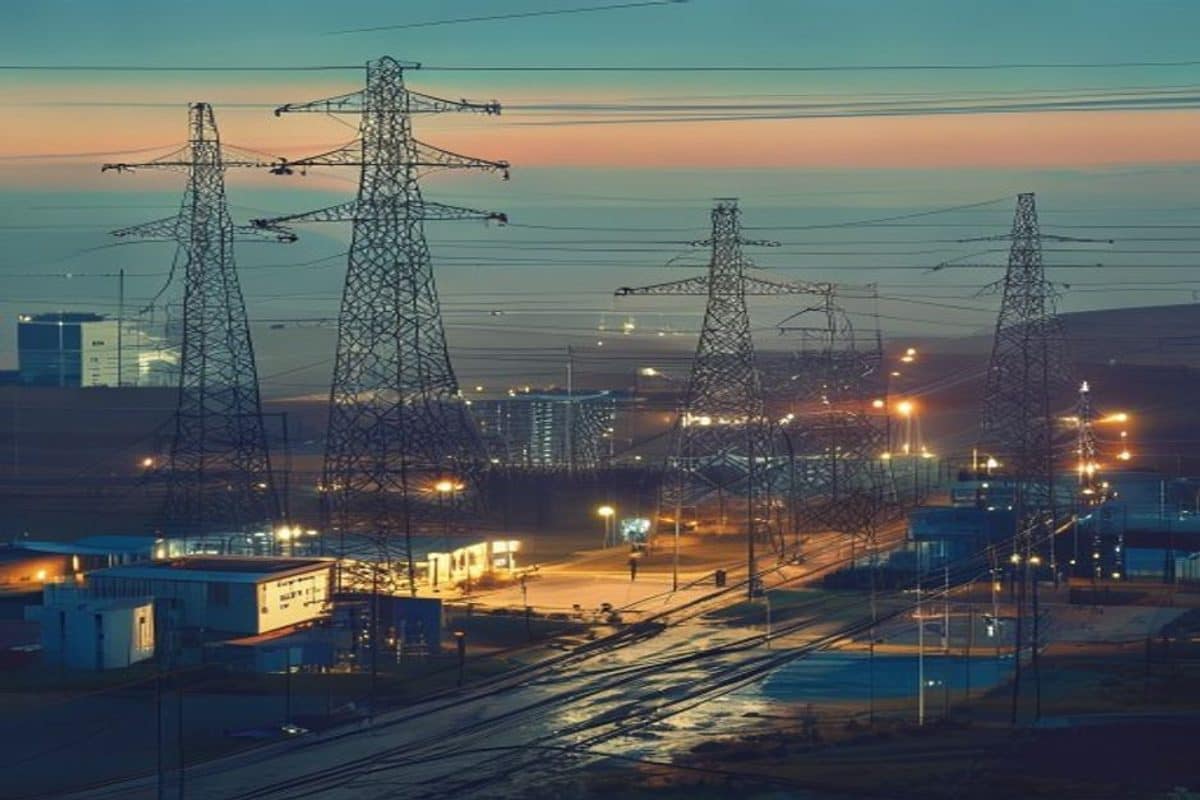
Utility companies across the United States are committing to a $1.4 trillion infrastructure buildout driven by AI's insatiable appetite for electricity, and the cost is already showing up on residential electric bills.
The numbers are staggering but the logic is straightforward. Hyperscale data centers operated by Amazon Web Services, Microsoft, and Google are signing power purchase agreements that dwarf anything the utility sector has seen before. Training and running large language models requires terawatt-hours of electricity at sustained, concentrated loads that existing grid infrastructure was never designed to handle. Utilities are now racing to close that gap, and the bill is being distributed across every ratepayer in the country.
Duke Energy, Southern Company, American Electric Power, and NextEra Energy are among the firms leading the charge, filing for regulatory approval to raise base rates while simultaneously accelerating capital expenditure programs. The investment mix spans natural gas plants, life extensions for aging nuclear facilities, new transmission lines, and large-scale renewable deployments. None of it is cheap, and very little of it was budgeted for even three years ago.
For decades, utilities were the definition of boring in a portfolio. Low growth, steady dividends, regulated returns. The AI buildout has rewritten that profile almost overnight. Analysts are now treating major utility stocks as indirect plays on AI infrastructure spending, a category that barely existed as a conversation in 2022. The structural shift is real: utilities are no longer simply maintaining existing grids but actively building the backbone of the next computing era.
The demand projections are what's forcing everyone's hand. Data centers could account for up to 9% of total U.S. electricity generation by 2030, according to current modeling, compared to levels that were barely a rounding error in national energy consumption a decade ago. Utilities cannot absorb that load with incremental adjustments. They need new generation capacity, hardened transmission corridors, and smarter load management systems, all of which require capital upfront and revenue recovery over time.
What ratepayers are actually facing
Recovery over time, in utility language, means rate hikes. Analysts are projecting average annual increases of 4% to 6% on residential electric bills over the next several years as utilities seek to recover infrastructure costs through their rate base. A 5% annual increase compounds quickly. Over five years, a household paying $150 a month today could be looking at bills approaching $200, with the gap largely attributable to infrastructure that primarily serves corporate hyperscalers rather than residential demand.
That dynamic is where the regulatory friction intensifies. Consumer advocacy groups are already filing objections in multiple states, arguing that residential ratepayers are being asked to subsidize industrial-scale expansion for some of the most profitable companies on earth. Utility commissions in states including North Carolina, Ohio, and Florida are navigating competing pressures between approving the capacity their grids demonstrably need and protecting households from steep bill increases on a compressed timeline.
The tech giants, for their part, are not simply passive recipients of this infrastructure. AWS, Microsoft, and Google are co-investing in specific projects and locking in long-term purchase agreements that provide utilities with revenue certainty. That certainty is what's enabling utilities to justify the capital commitments to their own boards and regulators. The question is whether the financial architecture of these deals adequately insulates ordinary consumers or simply obscures how the cost burden is being distributed.
Grid reliability is the less-discussed risk
Beyond the billing politics, there's a technical reliability dimension that deserves more attention. AI data centers don't just consume large amounts of power. They consume it in dense, geographically concentrated clusters that stress transmission infrastructure in ways diffuse residential load does not. Grid operators in regions with heavy data center development, particularly in Virginia, Texas, and the Carolinas, are flagging congestion and stability concerns that require targeted upgrades beyond what general capacity expansion addresses.
That specificity matters for investors and policymakers alike. The $1.4 trillion headline figure is aggregate, but the bottlenecks are local, and some of the most critical grid vulnerabilities are in corridors that regulators have been slow to prioritize. A single transmission constraint can limit how much power a data center cluster can actually draw regardless of how much generation capacity exists regionally.
The bigger picture here is that the AI trade has moved decisively off the balance sheets of chipmakers and cloud platforms and into the physical infrastructure economy. Utilities are now structurally tied to the trajectory of AI adoption in a way they were not eighteen months ago. For investors, that means reassessing a sector long treated as a rate-of-return story. For consumers, it means watching state regulatory decisions closely, because the outcomes of those proceedings will determine how much of the AI boom's infrastructure bill lands on the household level.
Also read: Mozilla launches Thunderbolt to challenge Microsoft and Google with an open-source enterprise AI client that keeps data on your machine • OpenAI is losing ground to Claude and Gemini as GenAI users start shopping around • Anthropic's new ID and facial scan requirement for Claude is pushing privacy-conscious users toward local AI models