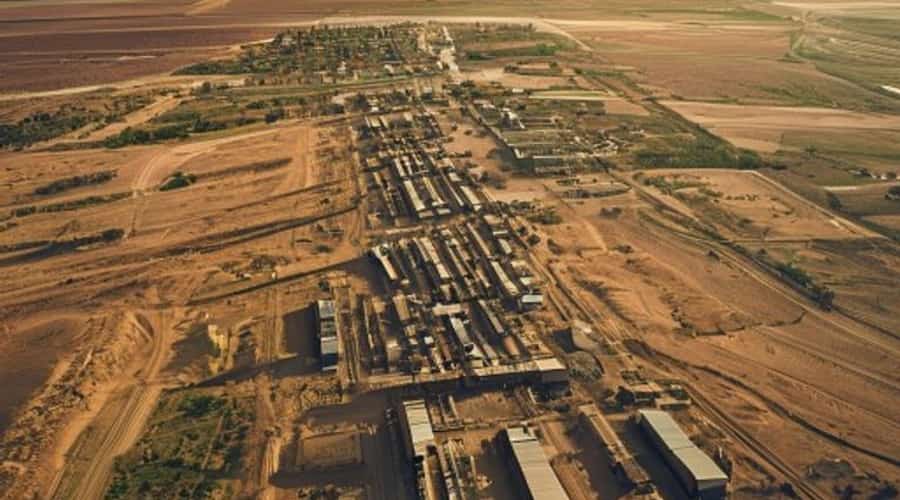
Imperial Valley Computer Manufacturing publicly pledged its planned California AI complex would not draw from the drought-stressed Colorado River. Now it's suing the local irrigation district for exactly that water, and its legal strategy could hand every future data center developer a blueprint to drain the West.
Sebastian Rucci spent months telling anyone who would listen that his company's project wouldn't touch the Colorado River. From December 2025 onward, Rucci and Imperial Valley Computer Manufacturing repeatedly pledged that their planned 330-megawatt AI complex in Southern California's Imperial Valley would rely on recycled wastewater from nearby cities, not the already overtaxed river. It was a clean story. It didn't hold.
After negotiations with the cities of Imperial and El Centro for recycled water agreements fell through, IVCM pivoted. On April 22, 2026, the company filed an application with the Imperial Irrigation District for industrial water service. IID denied it nine days later. IVCM then sued, seeking roughly 260 million gallons of Colorado River water per year, or about 750,000 gallons per day, to cool the proposed 950,000-square-foot campus. As KPBS reported in June, the company described the river water as a "last resort." That framing is doing a lot of work.
The legal argument IVCM is making deserves attention, because it's not just a local dispute over one data center's water bill. Rucci's company leased 160 acres of active farmland adjacent to the proposed site. That land historically received about 804 acre-feet of water annually, which the company says closely matches the data center's projected needs. The argument: idle the farmland, claim the farm's existing water allocation, and redirect it to the server racks. No net new demand on the river. Case closed.
It's clever. It's also a playbook. As inewsource noted, this kind of fallowing arrangement raises questions far beyond whether one California developer gets his data center built. Water advocates and legal experts point out that the arrangement is plainly designed not to use the land for agriculture, but to acquire the water rights attached to it. If the courts accept that logic, every data center looking to plant itself in the arid West has a template: lease a farm, fallow the fields, take the water. The agricultural land base shrinks. The river doesn't get a drop back.
Imperial County supervisors didn't wait for the courts. On June 16, they passed an emergency moratorium on data center development. On July 14, the county extended it for a full year, giving a newly appointed advisory board until January 2027 to develop zoning and building policies. Rucci has already sued over the first moratorium. He's promised to challenge the second. "We will challenge the second one and continue our efforts to protect our rights from arbitrary government action," he told the Calexico Chronicle this month.
There is real money on the table, which is part of why the county has been willing to listen at all. Rucci dangled 1,600 construction jobs, roughly 100 permanent positions, and about $28 million in annual tax revenue. Imperial County is not a wealthy place. Those numbers land differently there than they would in Santa Clara or Austin. But the supervisors appear to have concluded, at least for now, that a year's pause is worth more than a rushed yes.
What "sustainable AI" actually costs
Frankly, the gap between what tech companies say about water and what they actually consume has become impossible to ignore. Major hyperscalers, Microsoft, Google, Amazon, have published sustainability commitments that promise water-positive operations by 2030. The fine print is a different conversation. Data center cooling is water-intensive by design, and as AI workloads grow more computationally dense, the cooling demand grows with them. A 330-megawatt facility is not a small thing. Three hundred thirty megawatts is roughly the output of a mid-sized power plant, and the water required to keep it from overheating is commensurate.
IVCM is a regional developer, not a tech giant with a sustainability report to defend. But the underlying pressure it faces is the same pressure every data center operator faces: the physical infrastructure for AI requires water, and the places where land is cheap and power is available, deserts, river valleys, agricultural margins, are exactly the places where water is scarce. The recycled-water promise was appealing because it offered a way to square that circle. When it didn't materialize, the Colorado River was the only circle left.
The Imperial Irrigation District holds some of the most senior water rights on the Colorado River. Those rights exist to serve agriculture in a region that produces much of the country's winter vegetables. Redirecting them, even through a fallowing offset, sets a precedent that water-rights attorneys and state regulators will be watching closely. The lawsuit is still working through the courts. The moratorium buys time. Whether that time produces a durable policy framework or just delays the same fight is the real question, and the answer matters well beyond Imperial County.
Also read: Nearly 200 startups tell Washington that banning Chinese AI models would hand OpenAI and Anthropic a monopoly • Uncle Bob Martin says he no longer reads AI-generated code and the developer world is split • Samsung and Broadcom's $200 billion chip pact is a direct challenge to TSMC's grip on AI manufacturing