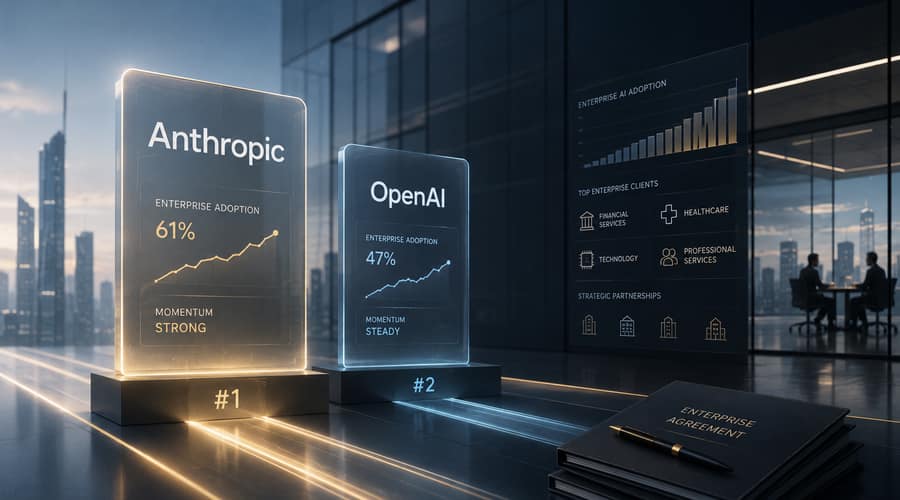
Anthropic has moved ahead of OpenAI in paid business adoption, and the shift says more about enterprise buying habits than consumer AI fame.
OpenAI may still own the public imagination around generative AI, but the corporate wallet is starting to tell a different story. Anthropic has passed OpenAI in paid business adoption for the first time in Ramp's data, a narrow lead that turns Claude from a fast follower into a real enterprise threat.
According to Ramp's May AI Index, Anthropic adoption among businesses using the finance platform rose 3.8 percentage points in April to 34.4%, while OpenAI fell 2.9 percentage points to 32.3%. Overall paid AI adoption also crossed 50.6%, which means this is no longer a debate about whether companies will pay for AI. The question is which model provider becomes the default line item.
That matters because business adoption is where AI companies can build durable revenue. Consumer apps create attention. Enterprise contracts create budgets, renewal cycles, platform dependencies and, eventually, the kind of financial story investors want to hear before a public listing. For Anthropic, the numbers are a sign that safety, reliability and workflow depth can beat first-mover advantage, at least in the parts of the market where companies are paying with intent.
Anthropic's rise has been strongest in the industries that were never going to pick an AI vendor just because it had the best-known chatbot. Finance, technology and professional services have been early areas of strength, according to Ramp economist Ara Kharazian's comments to TechCrunch. These are buyers with long documents, regulated workflows, internal approval chains and a low tolerance for tools that behave unpredictably.
Claude's appeal in those settings is easy to understand. Companies use it to read contracts, draft internal analysis, assist engineers, summarize research and support knowledge workers who deal with dense material all day. The long context windows in Claude Sonnet and Opus made Anthropic especially attractive for document-heavy work, while Claude Code gave technical teams a reason to bring the product into companies from the bottom up.
That path is important. OpenAI entered many companies through general use and executive curiosity. Anthropic has gained ground through teams with specific problems to solve. A software group paying for Claude Code, a legal team testing long-document review, or a finance team using Claude for analysis creates a different kind of adoption. It is less glamorous, but it is closer to how enterprise software actually spreads.
The shift has also been fast. TechCrunch reported that only 9% of businesses in Ramp's data were paying for Anthropic products in May 2025. By April 2026, that figure had climbed to 34.4%. OpenAI, by contrast, has remained a powerful enterprise player but no longer looks untouchable in this dataset. For startups building around model APIs, that is the useful lesson. The market is still open.
The lead is real, but not settled
There are reasons to be careful with the headline. Ramp's index tracks payments from companies on its own platform, including corporate card and invoice data. That is a broad sample, covering more than 50,000 businesses, but it is not the entire enterprise AI market. Large OpenAI contracts may not always show up in the same way, and OpenAI has argued that many of its enterprise deployments are larger engagements rather than simple card payments.
That caveat does not erase the trend. It does explain why this should be read as a strong signal, not a final verdict. AI vendors have low switching costs compared with systems like ERP, CRM or HR software. Ramp noted that 52% of customers using Anthropic or OpenAI use both. In other words, many companies are not married to one model provider. They are testing, comparing and moving spend toward whichever tool works best for a job.
This is where Anthropic's challenge begins. Token-based pricing can become painful when usage scales inside a company. A model that feels affordable during a pilot can become expensive once hundreds or thousands of employees start using it daily. If Claude Code and Claude's larger models keep spreading, Anthropic will need to prove that the productivity gains justify the bills. Enterprise buyers like quality, but procurement teams still count.
OpenAI also has plenty of room to respond. It remains a major consumer brand, has deep developer reach and continues to sell into large organizations. Microsoft, Google and open-source model providers are competing for the same budgets from different angles. Microsoft has distribution through Office, Google has Workspace, and cheaper inference platforms give companies another way to avoid depending too heavily on one frontier lab.
For investors, the practical takeaway is that enterprise AI is becoming less of a single-company story. Anthropic's lead suggests that buyers will reward products that fit real workflows, especially in technical and regulated sectors. But the same data also shows a market with weak lock-in and fast-moving loyalties. The next phase will not be decided by brand awareness alone. It will be decided by cost, reliability and whether AI tools become essential enough to survive the next budget review.
Also read: AI spending looks less like a bubble when earnings keep rising • NuExtract3 gives startups a smaller path to document AI • Schneider Electric says India’s AI data center buildout is now real business