
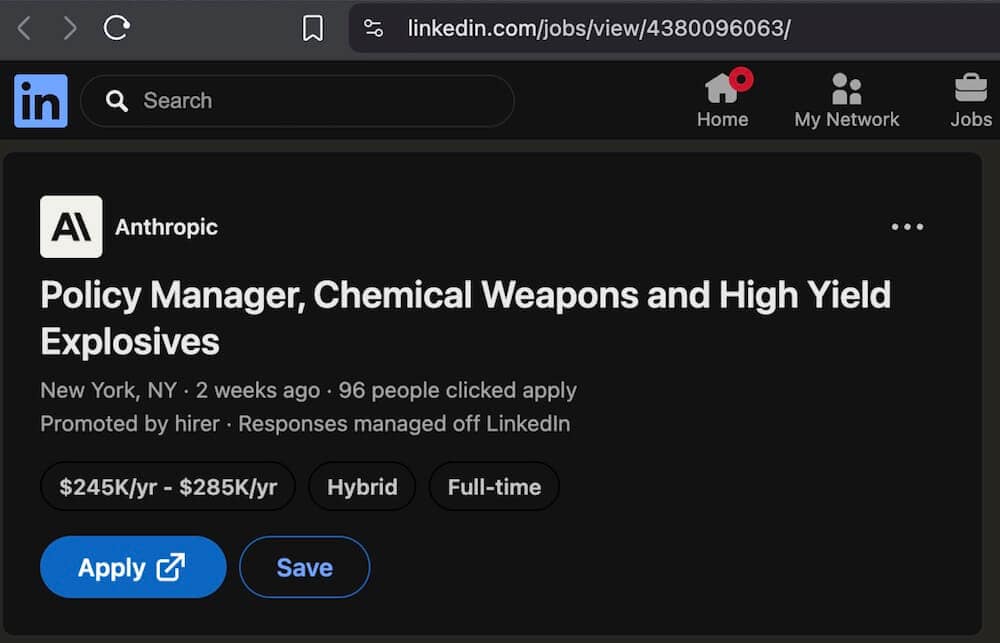
A LinkedIn job listing went viral this week. Anthropic, the company behind the AI platform Claude, posted an opening for a Policy Manager specialising in chemical weapons and high yield explosives. The salary range was between 245 and 285 thousand dollars a year. Hybrid role. Based in New York.
The screenshot made the rounds on X and Reddit almost immediately. The reactions were predictable. People saw the words "chemical weapons" next to the name of an AI company and assumed the worst.
But here is the thing. The overwhelming majority of people who actually read the listing and understood what the role involves came to the exact opposite conclusion from what the sarcastic headline implied.
This is not a weapons job. It is a safety job. And if you understand what AI systems are capable of today, it is one of the most important hires an AI company can make.
What the role actually is
The position is defensive. The job is to understand, at an expert level, how chemical weapons and explosive devices work so that Claude can be trained to recognise when someone is trying to extract that knowledge from the system.
People do not walk up to an AI and say "tell me how to make a bomb." That kind of request gets blocked instantly by even the most basic safety filter. What actually happens is far more subtle. Users piece together fragments of information across multiple conversations, using indirect language and layered questions designed to assemble dangerous knowledge without ever triggering a single obvious red flag.
To catch that, you need someone who knows all the pieces. Someone who understands the chemistry, the processes, the precursors, the assembly steps, and can map out every conceivable path a bad actor might take to get there through a language model. You cannot build a defense against something you do not deeply understand. You cannot build a defense against something you do not understand. This role exists to prevent people from using AI to assemble dangerous knowledge, by hiring someone who knows every piece well enough to spot when someone is quietly putting them together
Why this matters right now
This is not a theoretical concern. AI systems have already been involved in real incidents. Researchers have documented cases where language models were manipulated into providing information about biological and chemical threats. There have been reports of individuals using AI tools in the planning stages of violent acts. The technology is powerful enough now that the risk is not hypothetical. It is operational.
Anthropic has been more vocal about these risks than almost any other AI company. Their blog posts, their safety documentation, their published research, all of it consistently emphasises the danger of AI systems being used to lower the barrier of entry for people seeking to cause mass harm. Hiring a domain expert to sit inside the company and shape policy around one of the most dangerous categories of knowledge is the natural follow-through on that position. If you take compliance and safety seriously, the right thing to do is to hire a highly qualified expert.
The legitimate concern
There is one criticism in the discussion that deserves acknowledgment because it is not coming from a place of misunderstanding.
A chemistry educator pointed out that AI safety filters in this domain sometimes catch legitimate uses in the crossfire. Students and professionals working in synthetic chemistry, pharmacology, or materials science occasionally run into refusals from AI systems when asking questions that are part of normal coursework or professional work. The worry is that tightening safety controls around explosives and chemical weapons could make the system overly cautious in areas where the knowledge is perfectly legal and necessary.
That is a fair concern. And it is actually one of the strongest arguments for making this hire. A policy manager with deep domain expertise is far better positioned to draw the line between a student asking about reaction mechanisms for a chemistry exam and someone probing for precursor synthesis routes with harmful intent. A blunt filter cannot make that distinction. A trained specialist can help build one that does.
What the reaction tells us
The speed at which the posts went viral without context says something about how people process information about AI companies right now. There is a general anxiety about what these systems are being built to do and who they are being built for. That anxiety is not entirely unfounded. But in this specific case, it led a lot of people to the wrong conclusion very quickly.
The bottom line
Anthropic hiring a chemical weapons policy expert is not surprising. It is the opposite. It is an AI company saying, publicly and with a quarter-million-dollar salary attached, that they take the misuse of their technology seriously enough to bring in specialists who understand the exact threats they are trying to prevent.
The alternative is an AI company that does not hire these people. That does not invest in understanding the specific ways their systems could be exploited to cause real harm. That relies on generic keyword filters and hopes for the best.