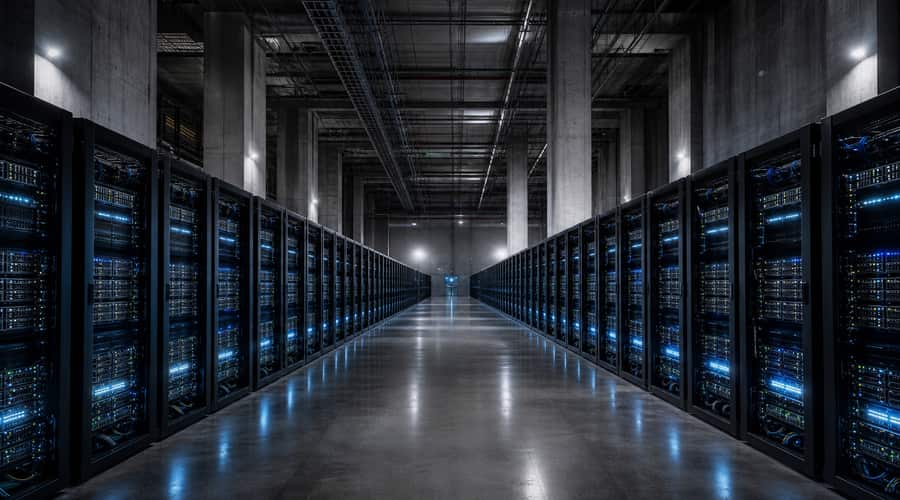

Anthropic's reported $1.8 billion Akamai deal shows how far frontier AI companies are willing to look for compute. The race is no longer just about better models, it is about who can secure enough infrastructure to keep shipping them.
Anthropic is pushing deeper into the AI infrastructure scramble with a reported $1.8 billion computing agreement with Akamai, a deal that gives one of the world's fastest-growing model companies another source of capacity outside the usual cloud giants. For Akamai, it is a chance to prove that its internet backbone and expanding cloud platform can matter in an AI market dominated by Amazon, Google and Microsoft.
The agreement comes at a moment when compute has become one of the defining constraints in artificial intelligence. Talent still matters. Data still matters. But for frontier model companies, access to GPUs, power, networking and reliable cloud capacity increasingly shapes what they can build, how quickly they can serve customers and how much margin they can protect along the way.
Akamai has not named the customer publicly, describing it as a leading U.S.-based frontier model provider. Bloomberg has identified the company as Anthropic, which makes the deal more interesting than a simple cloud contract. Anthropic already has deep relationships with Amazon and Google, yet it appears to be adding another infrastructure partner at serious scale.
The simple reading is that Anthropic needs more capacity. Claude has become a serious enterprise product, not just a research showcase, and that changes the economics of the business. Every new customer using AI coding tools, document analysis, customer support automation or internal assistants adds inference demand that has to be served quickly and reliably.
Training bigger models gets most of the attention, but inference can become the more persistent cost center as usage grows. A model company that wins enterprise accounts cannot ask customers to wait because GPU clusters are full or a preferred cloud partner is expensive. Capacity planning becomes part of product strategy.
That is why the Akamai deal should not be read only as a defensive move. It may help Anthropic reduce dependence on AWS, Google and Microsoft, but diversification also gives the company more negotiating leverage. If you have only one or two meaningful compute suppliers, pricing pressure flows in one direction. If you can place workloads across more infrastructure partners, the conversation changes.
There is also a practical risk-management angle. The biggest AI companies are building systems that customers want to treat as dependable business utilities. Outages, latency problems and regional capacity shortages become commercial problems, not just technical ones. Spreading workloads across more providers can make the product more resilient, provided the engineering work is handled well.
Akamai Wants A Bigger AI Role
For Akamai, the deal is a major signal to investors and customers that it can move beyond its traditional identity as a content delivery and security company. According to Reuters, Akamai disclosed the $1.8 billion long-term cloud deal while also noting that component prices for memory and infrastructure remain under pressure across the industry.
That tension matters. AI infrastructure is a huge opportunity, but it is not an easy business. The capital costs are heavy, margins can be squeezed by hardware shortages, and the biggest customers tend to have enormous bargaining power. A frontier model provider can validate Akamai's cloud ambitions, but it can also demand performance and pricing that leave little room for mistakes.
Akamai does have a credible starting point. Its global edge network was built to move traffic efficiently, protect applications and place compute closer to users. That does not automatically make it a training powerhouse, because frontier model training depends on dense GPU clusters, high-speed networking and specialized data center design. Still, AI is not one workload. Some parts of inference, routing, security and regional deployment may fit Akamai's distributed infrastructure better than the old cloud narrative suggests.
The company has also been working to expand its cloud infrastructure business, and the market reaction shows how hungry investors are for any sign that a non-hyperscaler can capture AI demand. That is understandable. The first phase of the AI boom enriched Nvidia and the largest cloud platforms. The next phase may create room for more specialized infrastructure providers, especially if model companies want alternatives.
The risk is that every infrastructure vendor now wants to describe itself as an AI platform. Customers will not care about the label. They will care about cost per token, latency, uptime, security, data controls and whether capacity actually arrives when promised. Akamai's challenge is to show that this contract is not a one-off trophy deal, but the beginning of a durable AI cloud business.
The Startup Lesson Is Clear
For startups, the broader message is uncomfortable but useful. AI economics are being shaped upstream. If frontier labs are still scrambling for capacity, smaller AI companies have to think carefully about how dependent their own products are on expensive model access and cloud infrastructure they do not control.
That does not mean every startup needs to train its own model or sign a billion-dollar compute agreement. It does mean infrastructure choices are becoming core business decisions. A company building on Claude, GPT, Gemini or open-source models has to understand latency, vendor concentration, pricing exposure and what happens if demand spikes faster than expected.
Anthropic's reported Akamai deal is another reminder that the AI market is not settling down. It is spreading out. Model companies are looking beyond the obvious suppliers, infrastructure companies are trying to reposition around AI workloads, and the balance of power between software and compute is still being negotiated.
The next thing to watch is whether Akamai can turn this commitment into repeatable business with other AI customers. If it can, the cloud market becomes less neatly divided between the hyperscalers and everyone else. If it cannot, the deal will still tell us something important: even the strongest AI labs are not comfortable relying on the same few infrastructure partners forever.
Also read: DGX Spark developers are trying to rescue Nvidia's awkward AI box • Figure AI's bedroom demo turns chores into a startup test • OpenAI is turning GPT-5.5 into a gated cybersecurity product