
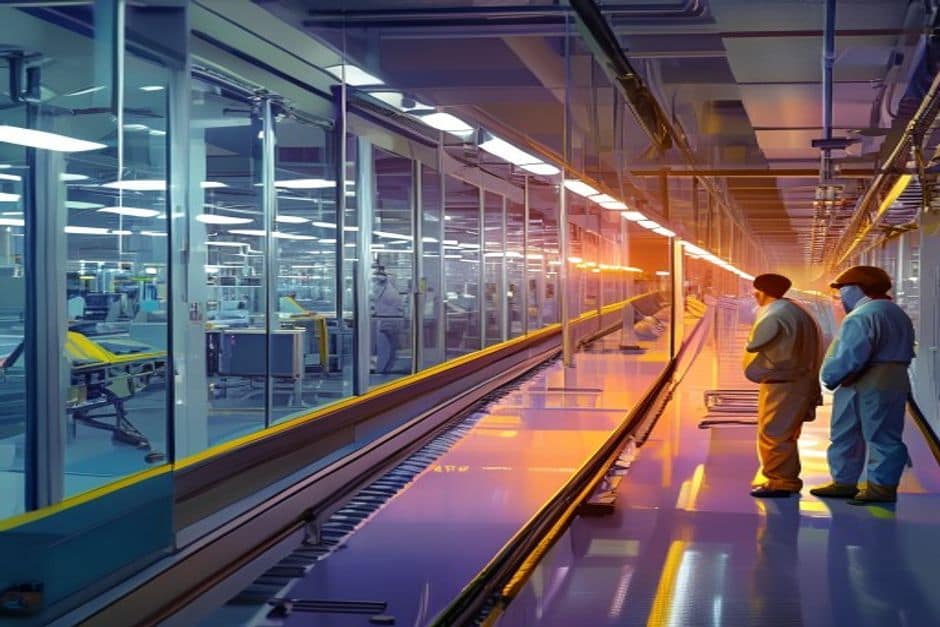
Bloomberg reported that Apple is in preliminary discussions with Intel Foundry and Samsung's US fabrication operations about potentially manufacturing Apple's main device processors domestically, conversations that Apple and its advisers are treating seriously enough to evaluate yield targets, node capabilities, and packaging compatibility rather than dismissing as exploratory, in a development whose significance extends well beyond semiconductor geopolitics: Apple's chip roadmap directly determines the on-device AI capabilities of over a billion active devices, and any foundry diversification would have downstream effects on edge-AI performance, developer tooling assumptions, and the US semiconductor industrial policy case for CHIPS Act-funded capacity.
The supply chain context requires stating clearly before the strategic implications can be evaluated. TSMC manufactures essentially all of Apple's A-series and M-series processors at its most advanced nodes, currently 3-nanometer with 2-nanometer volume production ramping in 2025 and 2026. Apple is TSMC's single largest customer by revenue, representing approximately 25% of TSMC's annual wafer revenue at the most recent public estimates. That concentration is mutually significant: TSMC has structured capacity, packaging lines, and process development priorities around Apple's roadmap for years, and Apple has depended on TSMC's leading-edge process technology to deliver the chip performance gains that have defined iPhone and Mac competitive positioning through successive product cycles. The relationship is not simply a supplier-customer arrangement. It is a co-development partnership where Apple's process requirements and volume commitments have directly funded the research that produced the 3-nanometer and 2-nanometer nodes that Apple now ships in its devices. Diversifying away from that relationship is technically and commercially complex in ways that discussing alternative foundries in the abstract does not capture.
Intel Foundry's current position in the 18A process node, which Intel has described as competitive with TSMC's 2-nanometer offerings, is the technical baseline for evaluating whether the discussions Bloomberg describes are credible or aspirational. Intel delivered its first 18A test wafers to external customers including Microsoft and Nvidia in early 2026 and has reported yield milestones that suggest the node is progressing toward commercial production readiness. The Apple-specific question is whether Intel 18A can produce Apple silicon at the defect density, parametric yield, and packaging integration quality that Apple requires for a product category where any performance regression relative to the TSMC-manufactured version would be unacceptable. Apple's chip tolerances are set by the expectation that each product generation will exceed the previous one on performance per watt, which is the metric that directly determines on-device AI inference speed, battery life during AI tasks, and the capability envelope for Apple Intelligence features. A foundry that cannot match TSMC's yield on Apple's most performance-sensitive designs is not a credible alternative for Apple's flagship processors, regardless of its domestic location or its CHIPS Act subsidies.
Samsung's US fabrication footprint, centred on its Taylor, Texas fab, is further behind Intel Foundry on advanced node readiness for the current generation. Samsung has faced yield challenges on its 3-nanometer GAA process that caused several high-profile customers including Qualcomm and Google to shift volume to TSMC, and the Taylor facility is not yet operating at the production scale that Apple's annual chip volumes would require. Samsung's longer-term position in Texas depends on the additional capacity phases currently under construction, which are being partly funded by CHIPS Act awards, and on whether Samsung's 2-nanometer and beyond process development recovers the yield competitiveness that its 3-nanometer generation did not achieve. For Apple, Samsung's primary value in a diversification scenario may be as a second-source for older-node or less yield-sensitive components rather than as a primary manufacturer of leading-edge Apple silicon, which preserves TSMC's position on the most advanced designs while giving Apple some domestic manufacturing credibility in policy conversations.
The edge-AI hardware angle is the dimension that most directly affects software developers and AI startup founders building on Apple's platform. Apple Intelligence, the on-device AI framework Apple shipped in iOS 18 and macOS Sequoia and is expanding through 2026, depends on the Neural Engine integrated into each generation of Apple silicon. The Neural Engine's capabilities, specifically its matrix multiplication throughput and on-chip memory bandwidth, determine which AI models can run efficiently on-device versus which require Private Cloud Compute offload. The gap between what runs on-device and what requires the cloud determines user privacy, latency, and the range of AI features available without an internet connection. Each new Apple silicon generation has expanded the on-device AI capability envelope significantly: the A17 Pro's Neural Engine enabled on-device image diffusion, the A18 generation improved large language model inference speed sufficiently to run GPT-class models locally for specific tasks, and the A19 family expected in 2026 devices is expected to continue that progression. Any foundry transition that slowed Apple's process node advancement, reduced the Neural Engine performance gains possible within the thermal envelope of a mobile device, or introduced yield-related compromises in chip design would slow that capability progression and directly affect the AI features available to iPhone and Mac users in the product cycles when the transition occurs.
Whether the Bloomberg report reflects serious procurement planning or leverage in Apple's TSMC negotiations is the question that most analysts are treating as open, and the honest answer is that it is probably both simultaneously. Apple has a documented history of using supplier diversification exploration as a negotiating mechanism: its discussions with Samsung and later with LG Display on OLED panels created competitive pressure on pricing and capacity allocation years before any supplier diversification actually occurred. The same dynamic is plausible with foundry diversification: Intel Foundry's and Samsung's capabilities have improved enough that Apple's expressions of interest are credible rather than theatrical, which gives them negotiating value that would not exist if both alternative foundries were clearly uncompetitive. The CHIPS Act political dimension adds a layer that did not exist in previous Apple supply chain negotiations: the current administration has made domestic semiconductor manufacturing a stated policy priority, and Apple's $500 billion US investment pledge made in February 2026 creates a political context in which domestic chip manufacturing exploratory discussions serve Apple's relationship with the administration independently of their procurement outcome. The Apple chip supply chain is now simultaneously a technology decision, a negotiating instrument, an industrial policy signal, and a strategic hedge, and understanding it as any one of those things in isolation produces a systematically incomplete picture of what the Bloomberg report actually means.
Also read: Alvarez and Marsal Wants $3.5 Billion From AI Services by 2028 and Its Growth Plan Is a Map of Where Enterprise AI Money Is Actually Going • Davidson Kempner Is Warning That AI Could Impair Private Debt Recovery on Software Companies and the Implications Run Through Every Layer of Enterprise Software Financing • Developers Are Reporting Claude Opus 4.7 Coding Regressions and the Complaint Pattern Points to a Deeper Problem Than One Model Version