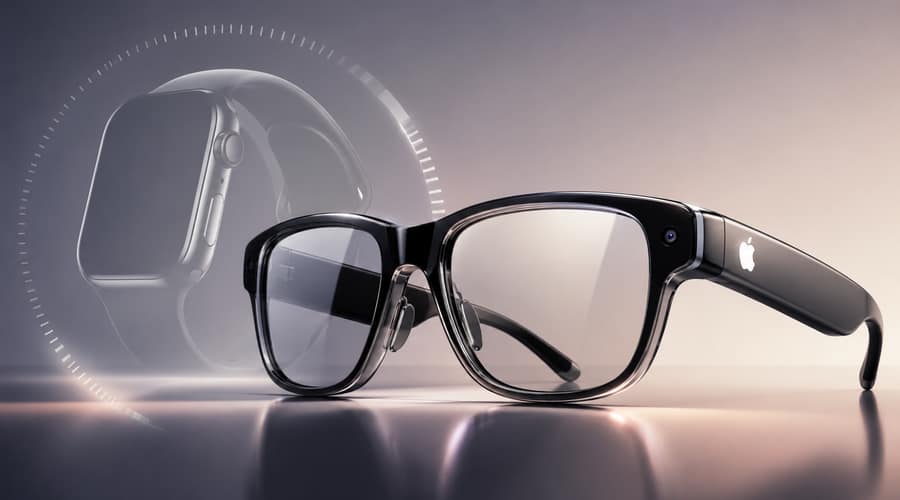
Apple is reportedly preparing smart glasses for 2027, and the target is bigger than Meta. The company wants eyewear to become its next everyday computing platform.
Apple's smart glasses plan is starting to look less like a rumor and more like a strategy. According to Bloomberg's latest reporting, Apple is aiming to sell its first smart glasses in 2027, with a possible unveiling before then, and the pitch sounds familiar: take a category that already exists, make it easier to live with, then let the ecosystem do the rest.
That is what happened with the Apple Watch. It did not invent the smartwatch, and it did not arrive in a mature market. But over time, Apple turned the wrist into a health, fitness and notification platform that developers, insurers, accessory makers and consumers could all understand. The comparison matters because smart glasses are now where watches once were: interesting, awkward and not yet essential.
Meta has the early lead. Bloomberg reported earlier this year that Meta and EssilorLuxottica sold more than 7 million Ray-Ban and Oakley AI frames in 2025, helped by new models introduced in the second half of the year. That is no longer an experiment. It is a real consumer hardware line with fashion distribution, camera capture, audio, calls and Meta AI built into a familiar shape.
Apple's problem is not that it is too late. Apple's problem is that Meta has already proved the category can work without a display, without full augmented reality and without asking buyers to wear something that looks like a developer kit. That changes the bar. Apple does not need to explain why smart glasses exist. It needs to explain why iPhone users should wait.
The latest reports suggest Apple is not trying to launch a full Vision Pro for the face. TechCrunch, citing Bloomberg's Mark Gurman in April, noted that Apple has been testing multiple frame designs, including rectangular and oval styles, different colors and oval camera lenses. The glasses are expected to be closer to Ray-Ban Meta than to a display-heavy augmented reality headset.
That is the practical move. Vision Pro showed what Apple can build when price, weight and mass-market demand are secondary. Smart glasses require the opposite discipline. They need to look ordinary, feel light, last long enough and do a few useful things quickly. Take a photo. Answer a call. Play music. Ask Siri what you are looking at. Get a reminder before you forget why you walked into a room.
This is where on-device AI becomes more than a slide in a keynote. A pair of glasses can see and hear the world from the user's point of view, but that only becomes valuable if the assistant is fast, private and useful in short bursts. Apple's delayed Siri overhaul has therefore become part of the glasses story. If Siri cannot become more conversational and context-aware, the hardware will not matter as much.
There is also a deeper ecosystem play. Apple already has the iPhone, AirPods, Apple Watch, Health, Maps, Photos, Apple Pay and a developer base trained to build for tightly controlled platforms. Glasses could sit between all of them. They could become the quick-capture device for Photos, the voice interface for apps, the workout companion for Watch users and the first natural home for everyday AI.
The startup window is narrowing
For startups building wearable AI devices, Apple's entry cuts both ways. On one hand, it validates the market. Investors are more willing to fund a category when Apple, Meta and Google are all circling it. On the other hand, the room for standalone hardware gets smaller once Apple turns the iPhone into the anchor for glasses.
We have already seen how this can play out. Fitness trackers did not disappear after Apple Watch, but many lost the high end of the market. Wireless earbuds did not vanish after AirPods, but the best consumer distribution shifted quickly toward ecosystem products. If Apple gets glasses right, startups may have to move away from general-purpose AI eyewear and toward narrower areas such as enterprise workflow, accessibility, sports coaching, industrial safety or medical support.
Meta will not stand still. Google used I/O 2026 to push Android XR eyewear with Samsung, Gentle Monster and Warby Parker, and Google says Gemini-powered intelligent eyewear is coming this fall. That gives the market a useful tension. Meta has social hardware and eyewear partnerships. Google has Gemini and services such as Maps, Gmail and Calendar. Apple has the most valuable consumer device ecosystem in the world, but it still has to prove its AI can keep up.
Privacy could become Apple's best opening. Smart glasses with cameras make people uncomfortable for obvious reasons, and recent criticism of Meta's reported facial recognition plans shows how quickly the social license can weaken. More than 70 advocacy groups have urged Meta not to release facial recognition features on Ray-Ban and Oakley glasses. Apple will almost certainly lean into privacy controls, visible recording signals and on-device processing, because that is both its brand and a competitive weapon.
The bigger question is whether consumers want another device on their face. Some people wear glasses every day and may welcome smarter frames. Others will see the camera and walk away. Apple solved a version of that problem with the Watch by making it useful before it became ambitious. If it repeats that lesson here, smart glasses may not need to replace the phone. They only need to make the phone feel a little less central.
That is what the next two years are really about. Meta has shown there is demand. Google is trying to make the assistant more useful. Apple is trying to turn eyewear into a platform. The winner will not be the company with the flashiest demo, but the one that makes people forget they are wearing a computer.
Also read: Wix cuts 1,000 jobs as AI changes the software company playbook • MiniMax is bringing its AI listing story back to Shanghai • StepFun proves efficient AI models are becoming serious competitors