Munich drone maker Helsing is nearing a $1.2 billion round at an $18 billion valuation, one of the largest defense tech raises in European history.
Helsing is closing in on a $1.2 billion round that would value the Munich drone maker at $18 billion. That's one of the largest defense tech raises in European history.
Dragoneer Investment Group, a U.S. growth investor, is leading it. Existing backer Lightspeed Venture Partners is co-leading. Together they'd push Helsing's valuation up nearly 30% in dollar terms from the $14 billion it carried after last year's Series D. The Financial Times reported the round was oversubscribed several times over. Bloomberg reported on July 9 that the deal still hadn't formally closed. Helsing wasn't waiting around: it had already begun retooling its internal employee share program ahead of it.
Torsten Reil, Gundbert Scherf and Niklas Köhler founded Helsing in Munich in 2021. Reil is a computational biologist: he sold his last company, the gaming studio NaturalMotion, to Zynga. Scherf came out of Germany's Ministry of Defence. Five years on, they run a defense contractor with roughly 761 employees as of May, chasing a price tag most publicly traded German industrials never reach.
Five years is not a long runway for that.
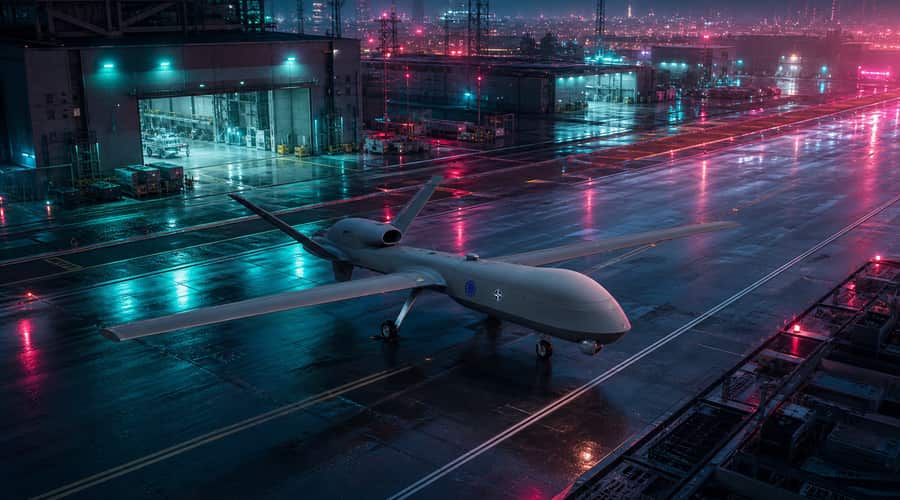
What the new money actually buys is autonomy at scale. Helsing's HX-2 loitering munition drone flies at up to 250 km/h and carries up to 5 kilograms of payload. It navigates using stored map data instead of GPS, so jamming doesn't blind it. The company's bigger bet is the CA-1 Europa: a four-tonne uncrewed combat aircraft built at Grob Aircraft's factory in Tussenhausen, with a range of up to 1,800 kilometers. Helsing unveiled it last September. In June it signed a partnership with EURENCO to build warheads for the HX-2 line, and it's leading a new space venture with OHB, called KIRK, aimed at satellite based reconnaissance.
The Anduril Gap
Anduril is bigger. Much bigger. The Palmer Luckey founded rival raised $5 billion in May at a $61 billion valuation, led by Thrive Capital and Andreessen Horowitz. That's more than three times what Helsing is now worth. Anduril builds the American equivalent of what Helsing is selling in Europe: autonomous drones, strike systems and battlefield software pitched directly at defense ministries rather than consumers.
Helsing's last round, the €600 million Series D in June 2025, was led by Daniel Ek's investment vehicle Prima Materia and valued the company at roughly €12 billion. A year on, Dragoneer and Lightspeed are writing a bigger check into a company that hasn't shipped a fraction of what Anduril has. What changed is the buyer, not just the product. The European Commission's ReArm Europe plan aims to unlock up to €800 billion in defense spending through 2029. NATO members have separately committed to lifting outlays toward 5% of GDP. Every euro of that is a reason for Dragoneer to bet that Helsing becomes the continent's default contractor for AI-defined weapons, rather than a distant number two to Anduril.
Frankly, the gap says less about the technology than about where the money already lives. The U.S. defense tech ecosystem built around Anduril, Palantir and SpaceX has a decade's head start. Its Pentagon writes nine figure checks without blinking. Europe is only catching up.
Untested in a Real War
Helsing's technology hasn't been proven in a shooting war the way some of its backers imply. Its systems have been tested in Ukraine. But the company itself has acknowledged that its autonomous targeting software has not yet operated in full combat conditions. That's the gap nobody's pricing in. It sits underneath this whole round, more than the number on the term sheet.
Helsing also converted its legal structure from a German GmbH to a European SE entity last year. That's the kind of move companies make on the way to a public listing. If the $18 billion round closes as reported, Helsing won't need Wall Street's money for a while. But it will still need to prove that the systems it's selling actually work. On the ground, not on a term sheet.
Also read: Anthropic's Billing System Just Failed Two Different Ways in One Week • TSMC's June Sales Jump 68 Percent as AI Chip Demand Keeps Climbing • China's Export Data Will Show How Much of Its Growth Now Runs on AI Chips