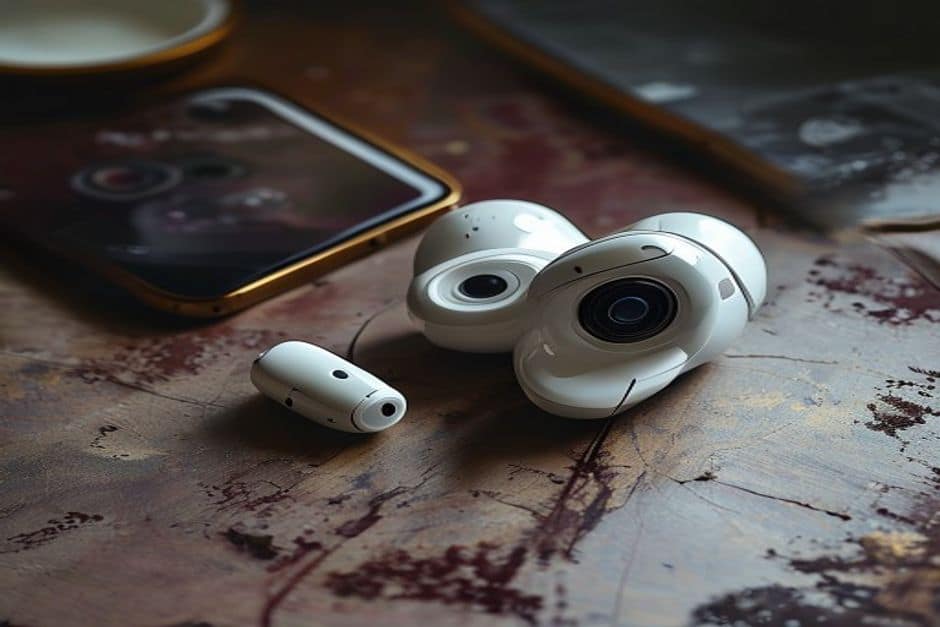
Apple's AirPods with built-in cameras have reportedly entered late testing, with Bloomberg describing functionality that extends visual sensing to ear level alongside features like infrared sensors for head tracking, adding a spatial and environmental awareness layer to Apple's ecosystem that could feed multimodal AI experiences across accessibility, navigation, fitness, and real-time assistance.
The specification context matters. These are not cameras designed for photography. They are sensors designed for situational awareness. Infrared proximity detection already exists in AirPods Pro for head gestures. Adding optical cameras allows the earbuds to perceive the user's environment: what they are looking at, the ambient context around them, hand signals in their field of view, and physical space in ways that extend Siri beyond voice input. The reported integration with Apple Intelligence gives the camera output a processing pathway, connecting raw visual data to on-device models that can interpret, annotate, and respond without sending video to the cloud.
The use cases are real and well-tested in adjacent hardware. Meta's Ray-Ban smart glasses with cameras enabled hands-free identification, navigation prompts, real-time translation, and object recognition through its Meta AI integration. Humane's Ai Pin tried the same idea at chest level and failed on execution, not concept. The difference with AirPods is distribution: Apple ships hundreds of millions of audio accessories annually. Camera AirPods inherit that install base. A vision-capable wearable that 50 million people buy because they want better audio and spatial audio features is categorically different from a product people buy specifically for AI.
Accessibility applications are the most defensible entry point. AirPods already power the Hearing Aid feature for mild to moderate hearing loss, approved by the FDA in 2024. Camera-equipped earbuds could read signs, menus, and labels aloud for visually impaired users. They could track head orientation for people with motor impairments who rely on head gestures. They could identify faces, products, or environments and provide audio descriptions. Apple has built accessibility credibility over decades, and camera earbuds extend that credibility into spatial awareness for users who cannot rely on visual interfaces.
For SF readers, the bigger story is Apple building the hardware layer for ambient AI while the assistant layer remains contested. Apple Intelligence is improving but still trails ChatGPT, Gemini, and Claude on complex reasoning. The camera earbuds, combined with Apple Watch sensors, iPhone cameras, and eventually Vision Pro, create a continuous multimodal data stream about the user's physical world. That sensor layer is harder to build than any software model. Amazon tried it with Alexa and Echo hardware. Google tried it with Glass. Neither built the density of sensors across form factors that Apple deploys through AirPods, Watch, and iPhone simultaneously.
The privacy risk is serious and Apple knows it. Always-available cameras at ear level capture incidental video of everyone around the user, not just the user themselves. Public spaces, private conversations, and third-party faces all enter the sensor stream. Meta's Ray-Ban glasses already face criticism for covert recording enabled by minimal indicator lights. AirPods are even less conspicuous than glasses. Apple will need indicator lights, strong on-device processing that avoids cloud transmission of environmental video, and clear user controls that establish when the camera is active. The regulatory dimension is equally real: GDPR Article 9, CCPA, and biometric data laws in Illinois and Texas could treat continuous environmental video capture as sensitive data requiring explicit consent from third parties who never agreed to be photographed.
The startup implication is direct. Every company building ambient AI assistants, from context-aware productivity tools to real-time coaching to spatial computing apps, will face the same question: where does the sensor data come from? Today the answer is usually the iPhone camera, AirPods microphone, or Watch heart rate sensor. Camera AirPods add a new input type that is passively captured, ear-level, and continuous. Startups that build on HealthKit, SiriKit, and the Core ML stack will gain access to that data through Apple's frameworks. Those building outside Apple's ecosystem, or trying to replicate the sensor layer with independent hardware, face a steeper climb as Apple integrates more sensing capability into accessories people already own.
The platform dynamics push in Apple's direction in almost every scenario. The sensor layer becomes more valuable as the AI models processing it improve. The AI models improve faster when they have richer sensor data. Apple controls both. Independent assistant apps that rely on Apple's sensors to generate their context face the same risk that every third-party Siri extension faced: Apple can change what data is accessible, how it is routed, and which assistants get preferred integration. The camera AirPods are not just a product announcement. They are a statement about where the ambient AI hardware race is heading, and who is already winning it.
Also read: OpenAI's new audio models unlock voice-native agents with realtime reasoning and translation • ChatGPT's Trusted Contact feature turns AI assistants into safety infrastructure for the first time • DeepMind's AlphaEvolve uses Gemini to optimise its own infrastructure and rediscover mathematics