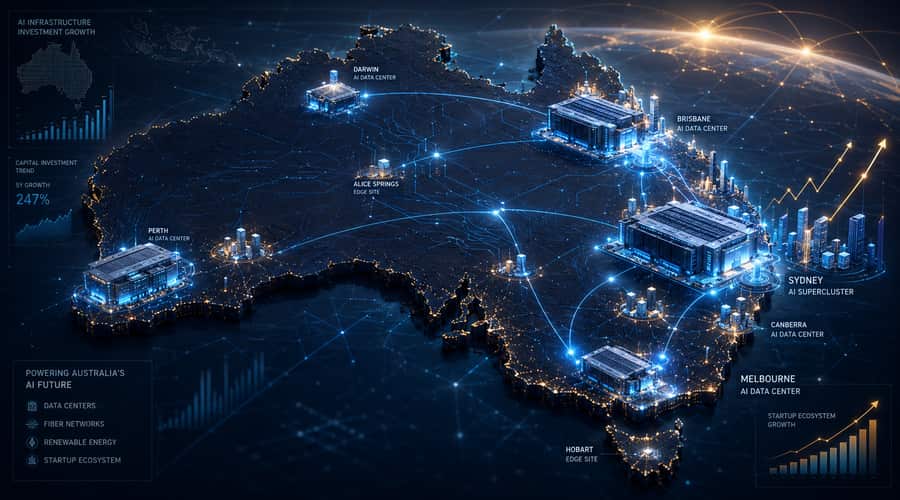
Australia's record data center spend is more than a local infrastructure story. It is a sign that AI compute is becoming a global race, and that founders can no longer think of the US as the only serious market for capacity.
Australia's data center boom has moved from industry chatter into the national accounts. Australian Bureau of Statistics data cited by ABC News showed spending reached $2.6 billion in the September 2025 quarter, up more than 60 percent from the prior quarter and more than 140 percent from a year earlier. The timing matters because AI workloads need far more power, land, cooling and network access than the old cloud era ever demanded.
What makes this moment different is that the buildout is not just about adding racks. It is about securing regional compute close to enterprise customers and government buyers that do not want every sensitive workload routed through a distant US hub. As BloombergNEF noted in March, the 14 largest publicly owned data center operators globally were on track to spend close to $750 billion in 2026, with more than 23 gigawatts of capacity under construction around the world.
Australia has become one of the clearest beneficiaries of that shift. AWS said in June 2025 that it would invest A$20 billion, or about $13 billion, in Australian data-center infrastructure through 2029, citing rising demand for cloud computing and AI. Microsoft followed with a larger April 2026 commitment, saying it would invest A$25 billion in Australian AI infrastructure, security and skills by the end of 2029. The hyperscaler race is not theoretical. It is already being funded.
The operators leading the Australian push are familiar names, but the scale is getting bigger. Local and regional capacity is being driven by AirTrunk, NEXTDC, Canberra Data Centres, Equinix, Macquarie Technology Group and large global cloud providers, according to market summaries and industry tracking. Knight Frank's 2025 market work said Sydney supply had risen sharply, Melbourne's planned capacity had expanded quickly, and AirTrunk remained one of the country's most important hyperscale platforms.
That matters because Australia is no longer just a back-office hosting market. Sydney is increasingly treated as a regional anchor, while Melbourne is emerging as a second growth center for cloud and AI workloads. The shape of the market suggests operators are chasing a mix of enterprise demand, sovereign resilience concerns and the higher margins that come with AI-ready facilities.
For startups, the practical takeaway is straightforward. If a company needs low-latency inference or local data handling for customers in Australia or nearby Asia-Pacific markets, the country is becoming a credible place to build. That is especially true for AI-native products sold into regulated sectors, where data residency and response times can shape procurement decisions as much as price.
Sovereignty is speeding things up
The other force behind the boom is policy. On March 23, 2026, the Australian government released expectations for data centres and AI infrastructure developers, and the framework makes clear that national interest, energy transition, water use, local jobs and research capability will shape how projects are assessed. The government said the expectations are meant to support investment that aligns with those goals, not simply reward the fastest bidder with the biggest site.
That is where sovereign AI starts to matter for procurement timelines. Federal and state buyers want more onshore control, and the framework gives them a vocabulary for asking for it. A May 2026 report on Australian government tech procurement argued that sovereign capability is now being scored more heavily, with onshore delivery, Australian-cleared personnel and Australian-controlled data carrying more weight in sensitive workloads. In practice, that can favor operators already invested in local regions and compliance pathways.
There is a second-order effect here that founders should not ignore. When government procurement shifts toward sovereign capacity, the vendors that can host, secure and service workloads locally gain an advantage. That can accelerate buying cycles for AI tooling, managed services and infrastructure software, especially when the buyer wants fewer cross-border complications. The result is not just more data center capex, but a broader domestic market for AI companies that can meet local requirements from day one.
Australia's advantage is not only policy. It also has the ingredients operators want: a relatively stable regulatory environment, strong connectivity and a power system that can support large-scale industrial projects better than many smaller APAC markets. The pressure point is energy. A May 2026 Greenpeace-backed report warned that data centers could account for 13 percent of national electricity demand by 2040 under a high-growth scenario, which means approvals will increasingly turn on credible power, water and grid plans.
For founders and investors, the message is simple. AI infrastructure is no longer concentrated in a handful of US corridors, and the next wave of regional champions may be built around places like Sydney and Melbourne rather than Northern Virginia or Silicon Valley. That widens the map for companies selling into the AI stack, while making energy discipline and local compliance part of the product strategy rather than an afterthought.
Also read: Gold's inflation hedge is losing its grip as U.S.-Iran tensions raise rate fears • Jensen Huang's Beijing board role puts Nvidia's China strategy under a sharper lens • Cardano's treasury vote shows decentralized capital allocation can actually work