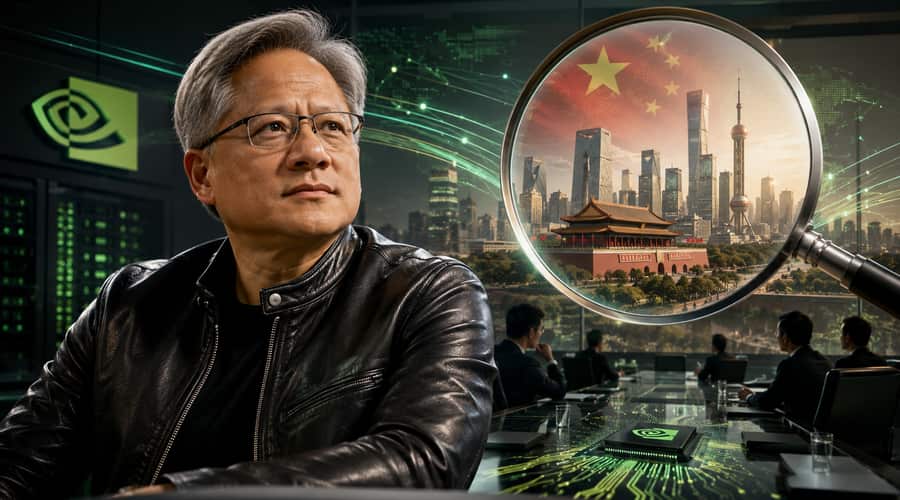
Jensen Huang's reported move onto a Beijing university board is small on paper and politically large in practice.
Nvidia chief executive Jensen Huang has reportedly agreed to join the advisory board of Tsinghua University's School of Economics and Management in Beijing, a development that lands squarely in the middle of the company's most delicate geopolitical balancing act. Nvidia is still trying to reopen parts of the China market while keeping Washington convinced that it understands where the national-security lines are.
That is why a university board seat, which might normally read as a routine academic honor, now looks more consequential. Tsinghua is one of China's most prestigious institutions, and its business school advisory board has long drawn global corporate leaders, including Apple chief executive Tim Cook as chair. In a calmer era, this would look like corporate diplomacy. In this one, it becomes part of the evidence set that lawmakers, regulators and investors may use when judging how far Nvidia is willing to go to keep one foot in each camp.
Nvidia has spent the past year trying to thread a very narrow needle. Reuters reported in May 2025 that Huang called US export controls on artificial intelligence chips to China a failure, saying they had cost American companies billions in lost sales. Nvidia had already disclosed a $5.5 billion charge tied to restrictions on the H20 chip, a China-focused processor designed to comply with earlier rules. That dispute has not faded. It has moved into a more complicated phase, where licenses, delayed shipments and political optics now matter almost as much as raw demand.
The latest developments make the timing more sensitive. Reuters reported this month that Huang believes China's market will open over time to US chip suppliers, and later reported that his forecast for a $200 billion CPU market includes China. At the same time, reports have said US approvals for some H200 sales have not translated into meaningful deliveries, while Chinese buyers are being pushed toward domestic alternatives. Put simply, Huang is still telling the market that China belongs inside Nvidia's long-term map, even as both governments make that map harder to follow.
The practical question is not whether a university board seat automatically violates export-control law. The sharper issue is whether it adds another layer to the compliance and reputational review process surrounding Nvidia's China ties. US lawmakers have already shown they are willing to examine whether American technology leaders are giving Beijing too much room to shape the terms of competition. A formal role at a Chinese academic institution does not look like a chip shipment, but it does look like another signal of engagement at precisely the moment Washington wants leverage, clarity and discipline.
For Nvidia, that distinction matters because the company's business depends on staying useful to both sides without becoming captive to either. China remains too large to ignore, particularly for data center infrastructure, CPUs and future generations of AI hardware. Yet Nvidia's most valuable products sit inside a policy category that the US government now treats as strategic infrastructure. That means the company cannot separate commercial presence from political interpretation. Every public gesture gets read through the export-control debate.
The signal to the market
There is another audience here, and it may be the more important one. Other AI hardware executives are watching how Nvidia handles the collision between market access and national-security politics. If Huang can accept a visible role in Beijing while still maintaining Nvidia's standing in Washington, that sets a precedent for a certain kind of corporate diplomacy, one built around access, patience and selective visibility. It also suggests that the biggest players in AI hardware may continue to treat China as too large to exit, even as the West tightens the rules around what can be sold.
That approach is not without risk. China has become harder to read, not easier. Domestic chipmakers such as Huawei are gaining ground, Chinese regulators have questioned the security of some foreign chips, and US policy can change quickly when AI hardware becomes part of a broader trade negotiation. Nvidia's upside in China is still real, but it is no longer straightforward. Huang's public posture says the relationship is not over, only constrained. The Tsinghua role fits that pattern. It says Nvidia still wants influence, still wants access and still thinks the relationship is worth managing in public.
For readers, the deeper point is simple. Nvidia is no longer just selling chips. It is selling a geopolitical posture. Every meeting, every public statement and now every board seat gets read through that lens. The company remains the most important AI infrastructure player in the world, but that position brings a problem as much as a prize: once your technology sits at the center of the US-China contest, even a university advisory role can feel like a strategic decision rather than a ceremonial one.
Also read: Cardano's treasury vote shows decentralized capital allocation can actually work • Ryan Sean Adams' ETH exit marks a turning point for Ethereum • Italy's 200% data center tax puts farmland politics ahead of AI expansion