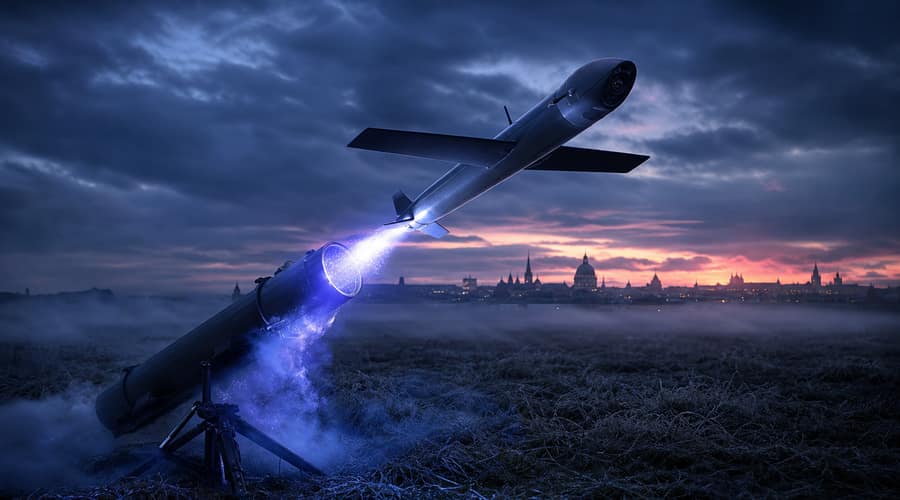
Stark is chasing a €300 million round at a valuation near €2.5 billion, but the real test is still brutally simple: its next drones have to hit their targets.
There is a version of the Stark story that reads as a clean triumph. An 18-month-old Berlin startup, founded by Uwe Horstmann, Florian Seibel and Johannes Schaback, becomes one of the fastest-growing defense companies in Europe, crosses the unicorn mark earlier this year and then starts talks on a new round that the Financial Times says could value it at about €2.5 billion.
The investor list is the kind that makes founders pay attention. Sequoia led Stark's $62 million round in 2025. The Financial Times reported that Peter Thiel has backed the company, while In-Q-Tel, the NATO Innovation Fund and other defense-minded investors have been tied to Stark's cap table. Germany has also moved toward contracts with Stark, Helsing and Rheinmetall for loitering munitions, part of a wider European scramble to build domestic strike drone capacity after Russia's invasion of Ukraine.
Then there is the other version. In October 2025, the Financial Times reported that Stark's Virtus drone failed four strike attempts during trials with British and German forces. In Germany, one aircraft lost control and crashed into a forest. In Kenya, another drone's battery caught fire after impact. Stark disputed parts of the reporting and said crashes are part of development, but the central problem was plain enough: the product did not deliver the result military buyers wanted to see.
You should not wave that away because the funding number is large. A weapons startup is not a SaaS company with a rough beta and a forgiving user base. When the product is a loitering munition, a miss by a wide margin is not a product blemish. It is the product failing at the job it exists to do.
Germany's procurement push continued anyway. The Financial Times reported in late 2025 that Berlin was preparing contracts worth up to €900 million across Stark, Helsing and Rheinmetall for about 12,000 kamikaze drones. That says something useful about the moment. European governments want domestic weapons capacity quickly, and they are willing to accept more technical risk from startups than they would have accepted before the war in Ukraine.
Frankly, that bargain only works if the testing gets harder, not softer. If Stark receives public money and military trust after a failed trial, the next proof point cannot be another investor deck. It has to be a live demonstration that leaves much less room for explanation.
Stark has not been sitting still. The company has pushed beyond Virtus with newer systems, including Cascade and Gambit, according to product details circulated around its June 2026 defense show activity. Cascade is described as a tube-launched loitering munition with a 40 to 100 kilometer range depending on battery configuration, a payload of up to 4.5 kilograms and a launch-to-ready time of less than one minute. Gambit is a six-kilogram man-portable quadcopter offered in strike and reconnaissance versions, with a stated range of 25 kilometers and an optional fiber-optic guidance cable designed to work even when radio links are jammed.
Those details matter because they answer the obvious question after Virtus: what changed? A recoverable quadcopter with fiber-optic control is a different bet from a more autonomous strike drone asked to solve targeting and navigation under battlefield conditions. The design sounds more practical. That is not the same as proven.
The funding backdrop helps explain why investors are still crowding in. According to data cited by the Financial Times from the NATO Innovation Fund and Dealroom, European defense and related technology startups drew a record $8.7 billion in 2025, up 55 percent year on year. Defense is no longer a side room in European venture capital. It is becoming one of the main rooms.
Sequoia backing a Berlin company that builds strike drones would have sounded strange not long ago. Silicon Valley capital has usually preferred businesses that scale through software, subscriptions and global distribution. Stark is almost the opposite. It sells into governments, faces export controls and depends on procurement cycles that can move slowly until they suddenly do not. The bet is that Europe's defense market has changed enough to make that awkward model worth the trouble.
The €2.5 billion question is whether investors are pricing Stark as a proven weapons company or as a company that might become one. Right now, the honest answer is the second. Stark has serious backers, founders with drone and venture experience, a place in Germany's defense procurement conversation and new hardware it says is built for the conditions modern armies face. It also has a very public failed trial sitting in the middle of the story.
If you are watching Stark, that is the tension to keep in view. The company does not need another clean narrative. It needs Cascade, Gambit or whatever comes next to do in front of military buyers what Virtus did not do in October 2025.
Also read: Allium raises $40 million to become the Bloomberg terminal of blockchain data as regulators close in • Revenue Based Financing for Startups Is Often Smarter Than Raising Equity • Bending Spoons is heading to Nasdaq at a $19 billion valuation and its turnaround math is hard to argue with