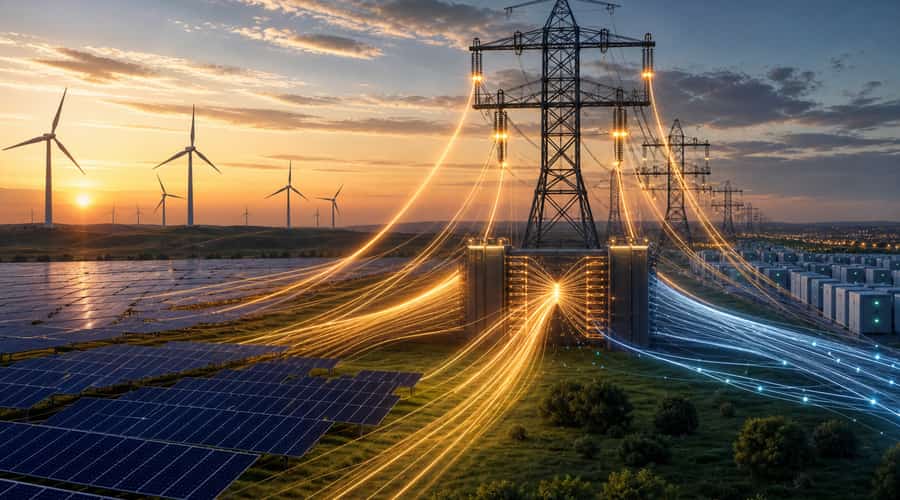
Atlas Renewable Energy has frozen about $1 billion in Brazil projects because clean power is being built faster than the grid can use it. That is a warning for investors and AI power buyers who think supply alone solves the energy problem.
BlackRock's renewables bet in Brazil has run into a problem that should worry anyone building around cheap clean electricity: the power is there, but the grid is not always ready to take it.
Atlas Renewable Energy, owned by BlackRock unit Global Infrastructure Partners, has put about $1 billion of planned Brazilian renewable investments on hold after repeated curtailment made new projects harder to justify. According to a Reuters report, CEO Carlos Barrera said roughly 1.5 gigawatts of projects that were expected to begin construction are now paused, while existing Atlas projects faced curtailment of 15% to 25% in the June quarter.
This is not a story about weak demand for power. It is about market design, transmission capacity and the less glamorous parts of the energy transition. Brazil has plenty of renewable resources, especially solar and wind. What it does not always have is the grid flexibility to move that electricity from where it is generated to where it is needed, at the exact moment it is produced.
Curtailment sounds technical, but the business effect is simple. A solar or wind farm produces less sellable power than expected because the grid operator rejects some output for system reasons. In some cases, generators that have already promised electricity to customers may then need to buy replacement power in the market at higher prices. That turns a clean-energy asset from a predictable infrastructure investment into something much harder to finance.
For years, the renewables story has been built around falling generation costs. Solar panels got cheaper. Wind turbines improved. Capital flowed into projects that looked increasingly competitive against fossil fuels. But once renewable penetration rises, the constraint moves from the plant to the system around it.
Brazil is now showing that shift in real time. S&P Global recently reported that energy companies have been re-evaluating Brazilian renewable investments because curtailments accelerated in April and May 2026. PV Magazine also highlighted data from Volt Robotics estimating that Brazil curtailed about one-fifth of solar and wind output in 2025, causing roughly BRL 6.5 billion, or about $1.23 billion, in losses.
Those figures matter because infrastructure investors do not price projects only on sunshine, wind speeds and power purchase agreements. They price grid access, settlement rules, dispatch risk and the probability that expected output will actually turn into revenue. If those assumptions break, the cheapest power on paper can become expensive capital in practice.
Atlas is a useful signal because it is not a marginal player. It is one of South America's largest clean power generators and sits inside the orbit of BlackRock, the world's largest asset manager. When a platform with that backing pauses construction plans, smaller developers and lenders will pay attention. Banks may ask harder questions. Buyers may demand different contract terms. Equity investors may wait for regulation to catch up.
AI power buyers should pay attention
The timing is important for another reason. AI data centers have made electricity supply a boardroom issue. Developers, cloud companies and investors are looking for places where they can secure large amounts of low-carbon power without waiting years for new capacity. Brazil, with its renewable base and industrial ambitions, should look attractive in that world.
But a data center does not run on theoretical megawatts. It needs deliverable power, firm contracts and a grid that can support heavy, constant demand. If renewable output is being rejected in one region while industrial loads sit elsewhere, the opportunity is not simply to build more generation. The opportunity is to build transmission, storage, demand response and smarter commercial structures around the load.
This is where entrepreneurs and infrastructure builders should look past the headline. Curtailment creates pain for generators, but it also creates openings for businesses that can absorb excess power, shift demand, place loads near constrained generation or finance batteries that turn wasted electricity into usable capacity. The hard part is that these models depend on regulation as much as engineering.
Brazil is not alone. Curtailment has become a recurring issue in markets including Australia, Chile, India and parts of Europe. The pattern is familiar: renewable buildout moves quickly because developers can raise capital and build projects, while transmission planning, permitting and market reform move slowly because they require political coordination.
That gap is now large enough to freeze real money. For BlackRock and Atlas, the Brazil pause is about protecting returns. For the wider market, it is a reminder that the energy transition is no longer just a generation race. It is a systems race.
The next thing to watch is whether Brazil can turn the pressure into reform. Better compensation rules, faster transmission buildout and storage incentives could bring paused projects back into the pipeline. Without that, more capital will sit on the sidelines, even as demand for clean power keeps rising. The lesson for AI companies is just as direct: do not buy a power story. Buy proof that the power can actually arrive.
Also read: A new U.S. tariff proposal puts Indian supply chains on startup watch • Cigna is making GLP-1 coverage a harder sell for employers • Coinbase brings stablecoins closer to everyday checkout