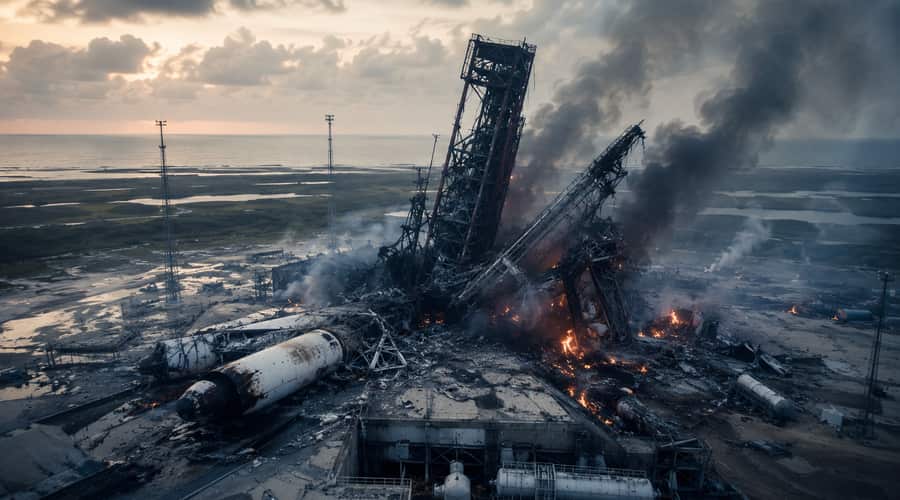
Blue Origin's New Glenn explosion has turned a rocket setback into an infrastructure problem. The real damage is not only the lost vehicle, but the launch schedule now sitting behind one damaged pad.
Blue Origin needed New Glenn to prove it could move from impressive engineering project to dependable launch business. Instead, the rocket exploded during a ground engine test at Cape Canaveral on May 28, destroying the vehicle and damaging Launch Complex 36, the only pad currently available for New Glenn missions.
That detail matters more than the fireball. Rockets fail, especially early in a program. What investors, customers and competitors watch next is whether the company has enough launch infrastructure, operational rhythm and customer confidence to recover without losing the market it has been chasing for years.
According to a Reuters report published on May 30, company and industry sources now expect a months-long setback after damage to the pad, with one person familiar with the matter describing the site as practically destroyed and saying disruption could last at least six months. Blue Origin has said personnel were safe and that it is investigating the anomaly, but the commercial consequences are already visible.
New Glenn is not a side project for Jeff Bezos' space company. It is Blue Origin's heavy-lift answer to SpaceX, built to carry commercial satellites, national security payloads and future lunar hardware. The vehicle is designed to be partially reusable, with a large first stage powered by BE-4 engines and a payload capacity that makes it relevant for the next wave of broadband constellations.
The rocket was being prepared for a satellite launch planned for the following week. Reuters and other reports said that mission involved 48 Amazon low Earth orbit satellites, part of the broader effort to build a broadband network that can compete with SpaceX's Starlink. The satellites were not on board during the test, which avoids one kind of loss, but not the larger scheduling problem.
Amazon has regulatory deadlines tied to deploying a large share of its constellation, and New Glenn was expected to help create the launch tempo needed to get there. A six-month interruption at Blue Origin's only New Glenn pad would compress that schedule and push more pressure onto alternative launch providers. In this market, delays do not stay inside one company. They move across customer roadmaps, insurance assumptions, manufacturing plans and spectrum obligations.
This is where SpaceX gains without doing anything dramatic. Starlink already has the operating satellite network, the launch cadence and the reusable Falcon fleet. Blue Origin has the capital and ambition, but the market rewards repetition. Every missed launch window gives customers another reason to favor the provider with the proven calendar.
Infrastructure can be the weakest link
The New Glenn explosion also shows why launch pad capacity is a strategic asset, not just a piece of ground equipment. SpaceX has lived through this before. Its Falcon 9 accident at Cape Canaveral in 2016 damaged a launch site and forced months of recovery work, but the company had other pads and an increasingly mature rocket program to lean on.
Blue Origin is earlier in that cycle. New Glenn has flown only a handful of times, and its April mission suffered an upper-stage problem that left an AST SpaceMobile satellite in the wrong orbit. The company had recently been cleared to fly again after that mishap. The May 28 explosion therefore landed at a difficult moment: just as New Glenn needed reliability evidence, it produced a new investigation and a damaged ground system.
For a startup-minded reader, this is the lesson hiding inside the aerospace drama. A product can be ambitious, well-funded and technically impressive, but the business still depends on the boring parts working repeatedly. In rockets, that means pad hardware, range approvals, engine tests, supply chains, customer sequencing and recovery procedures. If one of those fails, the market does not wait politely.
The pressure is not limited to Amazon. New Glenn is also part of Blue Origin's wider pitch to NASA and national security customers, including lunar logistics connected to the Artemis program. Those customers are used to delays, but they are also trained to care about redundancy and demonstrated execution. A launch vehicle that depends on a single damaged pad has a weaker hand in those conversations until it proves otherwise.
None of this means Blue Origin is finished. Bezos has the money, the patience and the strategic reason to keep pushing. The company can rebuild the pad, identify the cause and bring New Glenn back. But the commercial space market has become less forgiving because customers now have real alternatives. A decade ago, a heavy-lift rocket delay might have been treated as the normal cost of innovation. Today, it is a direct opening for the company already launching every few days.
The next signal to watch is not a dramatic statement from Blue Origin. It is the recovery timeline for Launch Complex 36, the root-cause finding and whether Amazon shifts more near-term satellite launches elsewhere. If New Glenn returns quickly with a credible fix, this becomes a painful early failure. If the pad work stretches deep into 2027, Blue Origin's challenge becomes bigger than one explosion. It becomes a question of whether the company can build a launch business at the speed its customers now require.
Also read: A new switching device points to cooler and faster AI chips • BNB rally shows how Binance still moves crypto markets • Euro-Office gives Europe a sovereign office suite to test Microsoft