Two cortical vision projects show why neurotechnology is moving from laboratory promise to a serious hardware race. The important part is not perfect sight, but useful sight.
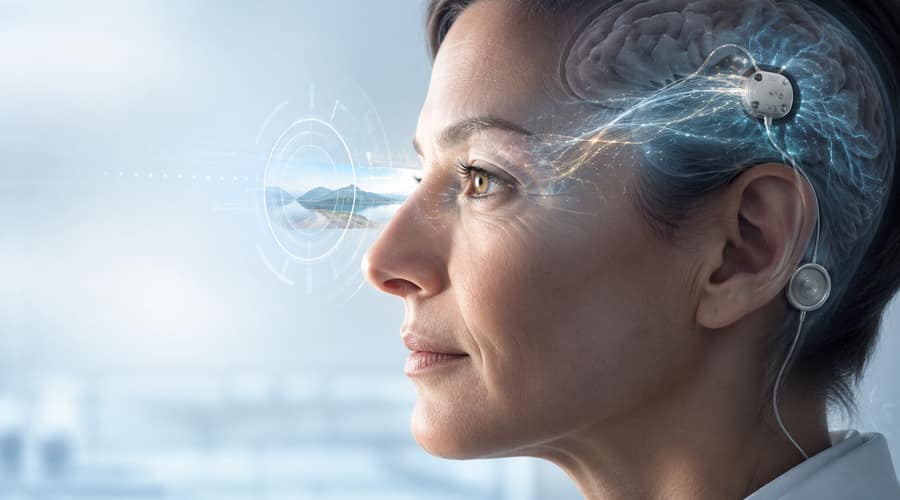
The newest signal comes from Chicago, where researchers have implanted a wireless visual prosthesis in a third blind participant, adding fresh momentum to a field that has spent decades trying to bypass damaged eyes altogether. The Intracortical Visual Prosthesis, or ICVP, does something simple in concept and difficult in practice: it sends visual information from an external camera system directly to electrodes in the visual cortex, the part of the brain that normally receives signals from the eyes.
According to Illinois Tech's May 7 update, the surgery was performed at Rush University Medical Center and involved 34 implanted stimulators with 544 electrodes. The project is led by Philip R. Troyk at Illinois Institute of Technology and is supported by the NIH BRAIN Initiative under award UH3NS095557. Testing is expected to begin after a four-week recovery period at The Chicago Lighthouse, where researchers will study whether the participant can use artificial vision for navigation and basic visually guided tasks.
That makes this more than another interesting medical device experiment. It is a reminder that some of the most important deep-tech companies of the next decade may not look like software companies at all. They will look like teams that understand microelectronics, neurosurgery, rehabilitation, signal processing, clinical trial design and patient trust. That is a harder company to build. It is also harder to copy.
Most vision-restoration work has historically started in the eye, especially the retina. That makes sense when retinal cells are damaged but the optic nerve and downstream visual pathway still work. Systems such as retinal implants try to stimulate remaining retinal circuitry so information can continue toward the brain.
Cortical implants take a different route. They bypass the retina and optic nerve and go straight to the visual cortex. That matters because blindness can come from trauma, eye disease, optic nerve damage, glaucoma, diabetic retinopathy or other conditions where the eye-to-brain link is no longer usable. If the visual cortex can still process visual information, direct stimulation may offer a path that eye-based devices cannot.
The tradeoff is complexity. The brain is not a screen waiting for pixels. Electrical stimulation can produce phosphenes, or perceived spots of light, but turning those spots into something a person can use for movement, object detection or reading large characters takes training and careful encoding. The patient has to learn the system, and the system has to be tuned to the patient.
This is where the second project becomes important. Researchers at Miguel Hernández University of Elche in Spain have developed a bidirectional cortical visual prosthesis that both stimulates and records brain activity. In a Science Advances study involving two blind volunteers, the team implanted a 100-microelectrode array in the visual cortex and showed that neural responses could help predict whether stimulation would produce a visual percept, including its brightness and number of perceived spots.
The practical difference is important. Older systems were mostly open loop, meaning they sent stimulation into the brain without adjusting to how neurons responded. The UMH system moves toward closed loop stimulation, where the device reads nearby neural activity and fine-tunes the signal. In plain English, it is less like shouting instructions at the brain and more like listening while talking.
The startup lesson is patience
There is a temptation to put this story into the same bucket as Neuralink and call it another brain-chip race. That misses the real lesson. Neuralink's Blindsight effort has helped draw attention to visual cortex stimulation, but the work now being reported by Illinois Tech and UMH is still careful clinical research, not a consumer product roadmap.
That distinction should matter to investors. The ICVP program is rooted in nearly three decades of academic research and institutional collaboration, including Illinois Tech, Rush, The Chicago Lighthouse, Johns Hopkins, the University of Texas at Dallas, Microprobes for Life Science, Sigenics and the University of Chicago. UMH's work has also been supported by public research funding and European programs, which is exactly what you would expect for a field where the science, surgery and hardware all have to mature together.
In other words, this is not a quick venture story. It is translational science slowly crossing the line into practical neurotechnology. The opportunity is large because blindness affects independence, work, mobility and safety. But the bottlenecks are equally real: surgical risk, electrode longevity, signal stability, patient selection, training burden, reimbursement and the uncomfortable history of vision implants that reached patients before long-term commercial support was certain.
The most interesting hardware-AI angle is also narrower than the hype suggests. These systems clearly depend on advanced signal processing, and the UMH approach uses brain feedback to adapt stimulation. But there is not yet enough public evidence to say these devices rely on edge AI inference in the way investors might use that phrase for chips in phones, cars or robots. The stronger claim is that cortical vision will need adaptive computing close to the body, because every brain responds differently and changes over time.
That is why the next milestones matter more than the headlines. Watch whether the third ICVP participant can use the system outside narrow lab tasks. Watch whether closed loop stimulation improves consistency over months, not just sessions. And watch whether companies can build support models that last as long as the implants themselves. Partial vision may sound modest, but for a person with total blindness, even reliable light, motion and shape perception can change daily life. For entrepreneurs, the message is just as clear: in neurotechnology, the prize belongs to builders who can turn fragile signals into durable systems.
Also read: A $4,000 bounty shows DeFi still prices security too cheaply. • Uber and DoorDash are testing a new delivery merger playbook • Megalodon shows startups must treat CI pipelines as production assets