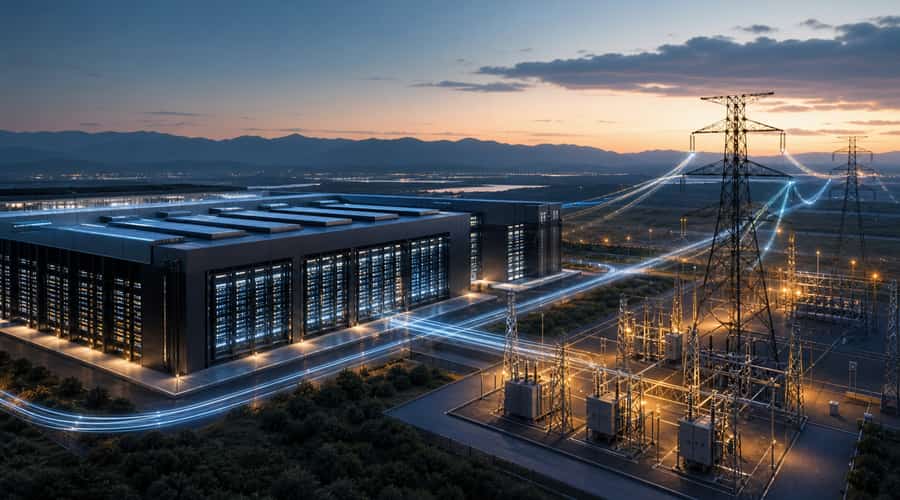
Brookfield is pushing AI investing out of the software story and into the harder world of power, land, data centers and private capital.
Brookfield’s $100 billion AI infrastructure program is a sign that the market has entered a more serious phase. The easy headlines are still about chips and models, but the next test is whether anyone can build the physical system needed to keep those models running at scale.
That is where Brookfield wants to sit. The firm has spent decades buying and operating infrastructure assets, from renewable power to transmission, real estate and private credit. Now it is applying the same playbook to AI, treating data centers and the power behind them less like speculative technology and more like airports, pipelines or utility networks.
As Bloomberg recently reported, the ambition is large enough to matter even in a market already used to enormous AI numbers. Brookfield has framed the buildout as a multitrillion-dollar capital cycle, and its own materials describe AI infrastructure as a more than $7 trillion opportunity over the next decade, spread across AI factories, compute infrastructure, power, transmission and adjacent services.
The numbers behind the firm give that strategy more weight. Brookfield reported $67 billion of capital raised so far this year and $53 billion invested across the platform in its first-quarter 2026 update. It also manages more than $1 trillion in assets, giving it the kind of balance sheet relationships that can turn a theme into financed projects.
For much of the last three years, the AI trade has been easy to recognize. Nvidia sold the chips. Cloud giants bought the chips. Software companies promised to turn those chips into revenue. Investors followed the chain and rewarded the companies closest to visible demand.
That story is no longer enough. A modern AI campus needs land, permits, cooling, fiber, backup power and long-term electricity contracts. It also needs customers willing to commit to capacity before the site is fully built, because few investors want to finance billions of dollars of specialized infrastructure on faith alone.
Brookfield is trying to reduce that risk by bundling pieces that many companies still treat separately. Its AI infrastructure strategy includes data center development, renewable power, energy storage, private credit and partnerships with companies that need compute. That is a practical advantage if the bottleneck is not demand, but coordination.
The firm has already shown how it wants to operate. It launched a $100 billion AI infrastructure program with Nvidia and the Kuwait Investment Authority, formed a $20 billion AI infrastructure partnership with Qatar’s Qai, and agreed to invest up to $5 billion with Bloom Energy to supply fuel cells for AI data centers. In May 2026, Brookfield also announced a $500 million investment in The OpenAI Deployment Company.
These are not small side bets. They show how private capital is trying to become the financial plumbing of AI. If the hyperscalers and model companies need to keep expanding, Brookfield wants to own the long-duration assets underneath them.
Power may decide the winners
The hard question is whether Brookfield is de-risking the AI boom or simply financializing it. Infrastructure finance can make the buildout more disciplined by forcing projects to match capital with long-term contracts. It can also push more money into an industry before anyone fully understands utilization, depreciation or power constraints.
That distinction matters because AI infrastructure is not like ordinary cloud capacity. GPUs age quickly. Model architectures change. Inference demand can rise in different locations from training demand. A data center built for one customer’s assumptions may not be as flexible as investors hope five years later.
Brookfield’s answer appears to be contract structure. In its Ori Industries deal earlier this year, Bloomberg reported that Brookfield was looking to lock in rents over the estimated life of AI chips, with investment-grade customers taking the usage risk. That sounds like classic infrastructure discipline, but it also shows how much depends on the credit quality and spending appetite of AI customers.
The bigger constraint may be electricity. Brookfield’s own May 2026 commentary on data infrastructure said power, land, permitting and connectivity are increasingly deciding where projects can actually be built. That is a useful way to read the whole market. Capital is abundant. Suitable sites with power are not.
This creates a different map of AI winners. Chip supply still matters, but so do utilities, grid operators, data center developers, equipment providers and energy companies that can deliver reliable power at acceptable prices. A model company without access to power is just a tenant waiting for capacity.
Brookfield’s bet is that AI will become an industrial buildout, not just a technology upgrade. If it is right, the profits will not only go to the companies with the best models, but also to the owners of the assets that let those models run. If it is wrong, the market will discover that even patient infrastructure capital can overbuild when everyone is underwriting the same future.
For investors and operators, the takeaway is simple. The AI boom is moving from imagination to construction. The next phase will be measured less by demos and more by megawatts, leases, grid queues and financing terms. That is less glamorous, but it is where the real test begins.
Also read: Coralogix raises fresh funding as AI agents reshape observability • Sitecore is buying Scrunch as AI search becomes a marketing budget • India is turning drone warfare into an industrial test