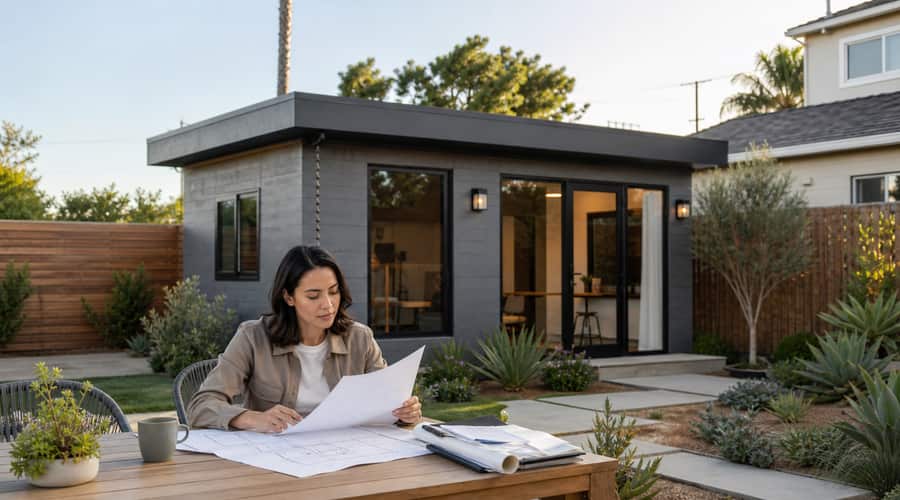
A California city planner turned her backyard into a $3,000-a-month rental unit using a second mortgage, proving that adding housing can be both a civic gesture and a financial win.
Elaine Yang spent most of her adult life in a room smaller than 120 square feet, sharing a kitchen shelf and a bathroom with strangers. Buying a house felt out of reach. When she finally purchased a home in Irvine, California, her parents pushed an idea she initially dismissed: build an accessory dwelling unit in the backyard. Yang, a 42-year-old strategic area and infrastructure planner, knew the regulations inside out. What she didn't know was how to afford it. Traditional construction quotes came back steep. Prefabricated options looked more promising, and she eventually landed on Samara, a company that handles design, permitting, and contractor management in a single contract. They also offered a financing structure that made the project viable: a second mortgage.
The math works cleanly. Yang pays roughly $1,600 a month on the second mortgage for the 540-square-foot, one-bedroom unit. It rents for $3,000. That spread covers the debt service and generates positive cash flow, even at 2025's higher interest rates. The unit features high ceilings in the bedroom and living area, making the compact footprint feel considerably larger. Comparable small rentals in Irvine are scarce, which supports the premium pricing.
California has spent years dismantling regulatory barriers to ADU construction. State laws passed between 2016 and 2020 stripped away many local restrictions that previously made backyard units impractical or illegal. Homeowners can now build ADUs in most residential zones without discretionary reviews, and setback requirements have been relaxed significantly. These changes opened the door for companies like Samara, which standardize the process and reduce the friction that deters most homeowners from building.
Financing remains the real bottleneck. Home equity lines of credit are the traditional route, but they carry variable rates that make budgeting unpredictable. Fixed-rate second mortgages, like the one Yang secured, offer stability. The tradeoff is a higher interest rate than a primary mortgage, but as Yang's numbers demonstrate, strong rental demand in tight housing markets can absorb that premium comfortably.
The Bigger Housing Equation
Yang frames her decision as a small contribution to California's housing shortage rather than a purely financial calculation. That perspective matters because it highlights a shift in how homeowners think about their property. Instead of viewing a backyard solely as private amenity space, a growing number are treating portions of their lots as potential housing supply. The California Department of Housing and Community Development reported that ADU permits surged past 20,000 annually in recent years, a dramatic increase from the roughly 1,200 permitted in 2016. That trajectory suggests the regulatory and cultural shift has real momentum.
For entrepreneurs and investors watching this space, several signals stand out. Companies that streamline ADU design, permitting, and financing are capturing demand that traditional contractors often overlook. The prefabricated model scales differently from custom construction, with potential for standardized units that reduce build times and costs over time. Meanwhile, homeowners in high-demand markets gain access to a relatively low-risk income stream that appreciates with property values.
The question worth watching is whether other states follow California's regulatory lead. Oregon, Washington, and parts of Texas have already begun loosening ADU restrictions. If financing products continue evolving alongside these policy changes, backyard units could become a meaningful feature of housing supply in metropolitan areas across the country. Yang's project, one 540-square-foot unit at a time, is a working proof of concept.