China's aggressive push into artificial intelligence infrastructure and talent development is rapidly narrowing the gap with Western competitors, forcing startups and enterprises worldwide to reassess their strategic positioning.
Something shifted in the global AI race over the past eighteen months, and not enough people outside China are talking about it with the seriousness it deserves. While Silicon Valley has been locked in its increasingly expensive duel over large language model supremacy, Beijing has been quietly executing a coordinated industrial policy that treats artificial intelligence the way the United States once treated the space race: as a matter of national destiny.
A recent analysis that circulated on Hacker News, drawing from a piece titled "The AI Great Leap Forward," lays out the scale of what is happening. The author tracks how China has moved beyond merely catching up in AI research output and is now building the foundational infrastructure, from semiconductor fabrication plants to massive computing clusters, that could sustain technological leadership for decades. This is not speculative futurism. It is happening now, with real money, real policy, and real consequences for every startup founder and technology executive reading this.
Consider the numbers. China accounted for roughly 61 percent of global AI patent filings in 2024, according to figures referenced by the World Intellectual Property Organization. Its Ministry of Industry and Information Technology has committed over $50 billion in state and provincial funding specifically for AI-related hardware and compute capacity through 2027. The country now graduates more STEM doctoral candidates annually than the United States, and a growing share of them are specializing in machine learning and related fields. These are not incremental advantages. They compound.
If you are building an AI company in the United States or Europe, the implications are uncomfortable but necessary to confront. The assumption that Western teams will maintain a permanent qualitative edge in model development is no longer a safe bet. Chinese research teams from institutions like Tsinghua University and companies such as Baidu, Alibaba, and the relatively young but formidable Zhipu AI have already demonstrated competitive or superior performance on several open benchmarks. When a model from a Chinese lab matches or exceeds GPT-4 class performance on coding tasks or mathematical reasoning, the competitive moat shrinks from technology to distribution, trust, and regulatory access.
For startups, this creates a dual pressure. On one side, you face the enormous capital advantages of American hyperscalers like Microsoft, Google, and Amazon, all of which are spending tens of billions on NVIDIA chips and custom silicon. On the other, you now face a well-funded, state-backed ecosystem in China that can produce capable models at a fraction of the cost, unencumbered by Western data licensing norms or the same level of copyright scrutiny. Companies like 01.AI, founded by Kai-Fu Lee, have openly discussed building models that achieve strong performance while dramatically reducing training costs, a strategy that could flood the market with cheap, capable AI infrastructure.
The Infrastructure Question Nobody Is Asking
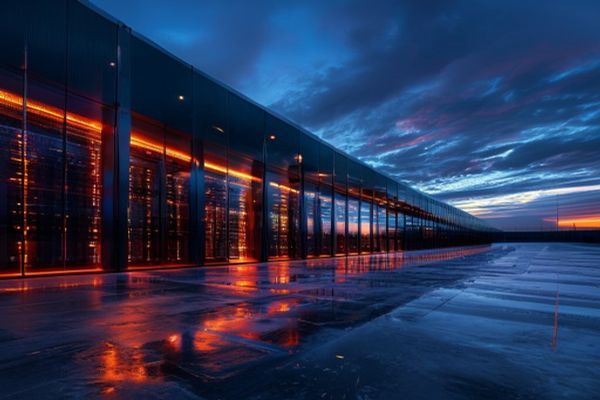
The most important part of this story may not be the models themselves but the physical infrastructure required to build and run them. As Bloomberg recently noted, China's domestic semiconductor production capacity has grown significantly despite US export controls on advanced chips. Companies like SMIC have found workarounds to produce chips at smaller nodes than many Western analysts believed possible under sanctions. Huawei's Ascend series of AI accelerators, while not yet matching NVIDIA's H100 or B200 in raw performance, are being deployed at scale inside Chinese data centers. When you combine domestic chip production with state-subsidized electricity and land for data center construction, you get something the United States currently struggles to deliver: a unified, centrally planned compute infrastructure designed for the AI era.
This matters because the next phase of AI competition will not be won by whoever has the cleverest algorithm. It will be won by whoever can train and inference models most cheaply and at greatest scale. If China can provide compute at half the effective cost of American providers, every AI company in the developing world, and plenty in the developed world, will face a powerful incentive to build on Chinese infrastructure regardless of political concerns.
None of this means Western AI companies are doomed. The United States still leads in fundamental research, attracts top global talent, and benefits from a venture capital ecosystem that can mobilize billions for unproven ideas. Europe is carving out a niche in AI safety and regulation that could become a competitive advantage as governments worldwide seek trustworthy AI partners. But the comfortable narrative that China is years behind, hamstrung by chip sanctions, and incapable of original innovation, is a story that needs to be retired before it does real damage to strategic decision making.
Watch what happens at the next major AI conference when Chinese researchers present their latest work. Look at the pace of infrastructure buildout in cities like Guiyang, which has positioned itself as China's data center capital. Track the movement of ethnic Chinese AI researchers who spent years at Stanford, MIT, or DeepMind and are now returning home in growing numbers. The signals are there, and they all point in the same direction: a genuinely multipolar AI world is arriving faster than most people expected.