
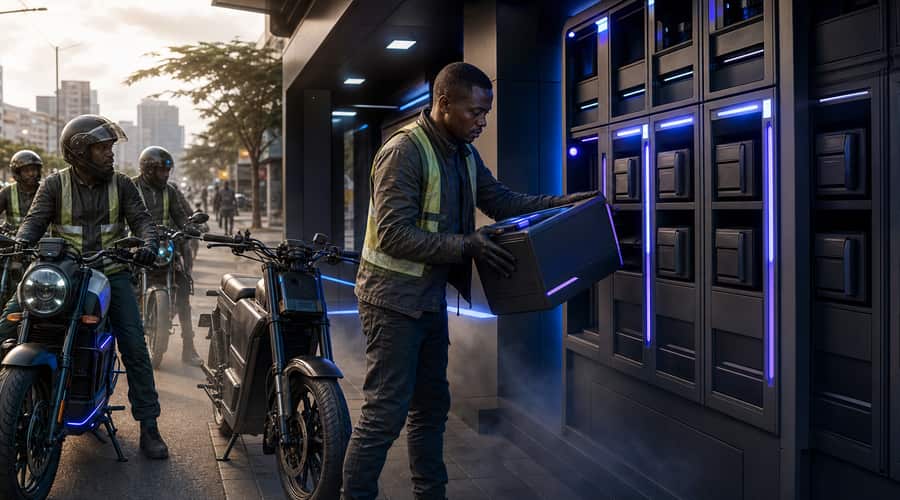
Spiro's latest $55M raise from NewTrails Capital puts the African electric motorcycle operator near a $1 billion valuation, and it says something blunt about the market: Chinese growth capital is seeing an infrastructure business where many Western VCs still see risk.
The numbers are hard to dismiss. As Bloomberg reported on June 22, Spiro now has 100,000 electric motorcycles on the road and 2,500 battery-swap stations across Kenya, Rwanda, Uganda, Togo, Benin, Nigeria, and Cameroon. Riders have completed more than 30 million battery swaps. The company sits just under a $1 billion valuation, after NewTrails Capital, a Shanghai and Shenzhen-based growth fund with a Lagos presence, added a $55M tranche to bring Spiro's total raise to $270M.
If you want to understand why this matters, start with the investor, not the bike. NewTrails founding partner Yufan Zhang called Spiro part of an "energy revolution" in African mobility. That's not the language of a small impact bet. It's the language of infrastructure scale. It also shows the split now opening between Chinese growth funds willing to back physical networks in African markets and Western venture firms still nursing bruises from the 2023 and 2024 pullback.
The usual EV playbook says you build chargers first. Spiro has gone somewhere more practical. Motorcycle taxi riders, known as boda bodas in much of East Africa, don't have spare hours to sit beside a plug. They earn by keeping the bike moving. A battery swap takes minutes, costs less than refueling a petrol bike, and leaves the rider paying for energy as a service instead of buying the battery outright.
That last detail is the business. Spiro sells the motorcycle separately and runs the battery network itself, with riders paying per swap. According to the company's own figures cited in the Bloomberg report, its electric motorcycles cut daily transport costs by 40% against petrol equivalents and reduce climate impact by 72%. New CEO Anant Badjatya, who joined on June 9 after building Indofast Energy's Indian swap network to more than 1,800 stations serving roughly 90,000 vehicles a day, said riders can save up to $3 daily.
Three dollars isn't decorative in Nairobi, Kigali, Cotonou, or Kampala. For a rider working on thin daily margins, it can become the difference between buying fuel forever and putting money toward a second bike, school fees, or a small side business. Spiro's argument is not that African riders need a cleaner version of the same transport economics. It is saying the economics themselves can change.
The China-Africa VC dynamic
NewTrails Capital describes its focus around "global growth corridors" across Africa, the Middle East, Southeast Asia, and Latin America. Its Spiro investment follows a $215M equity round closed on June 1, led by Impact Fund Denmark and Equitane, with the Fund for Export Development in Africa also participating. Since 2023, Spiro has disclosed more than $415M in total funding. For an electric two-wheeler company operating in African markets, that is a serious war chest.
Set that against what has happened to Western venture appetite. African startup funding was hit hard after the easy-money cycle ended, and the highest-profile fintech disappointments made many investors more cautious about growth stories without obvious profitability. Spiro doesn't fit the familiar software pattern anyway. It is factories, depots, batteries, mechanics, grid access, government relationships, and thousands of riders who need the system to work every day.
Frankly, that is why a lot of Western investors may look back at this moment with regret. Spiro's model works because it was built around the constraints in front of it, not around an imported picture of how EV adoption is supposed to happen. Founder Gagan Gupta started the company in 2022 with operations in Benin and Togo. It now manufactures bikes locally in Kenya, Rwanda, and Uganda, runs a battery-recycling facility in Nigeria, and recently added Cameroon. The Democratic Republic of Congo and Ethiopia are next on the list.
Badjatya's appointment as Group CEO is a signal in the same direction. His background is in dense, operationally difficult swap networks, not consumer app growth. That matters because Spiro is past the stage where a good deck and a few pilots prove much. The hard part now is running a network with thousands of physical touchpoints across countries where roads, regulations, power reliability, and rider behavior don't line up neatly.
At just under unicorn status, Spiro has one obvious test ahead. The DRC has one of the continent's largest motorcycle taxi markets and very little formal EV investment by comparison. If Spiro can make the swap model work there at scale, $1 billion will not look like an aggressive valuation. It will look like the price investors paid before the infrastructure became obvious.
Also read: Sakana AI launches Fugu Ultra and its orchestration model matches Fable and Mythos without training a single frontier model • Lime's IPO prospectus reveals a micromobility survivor with a $845 million debt problem and Uber riding shotgun • TikTok's algorithm is surfacing AI slop to new users at three times YouTube's rate and advertisers should be paying attention