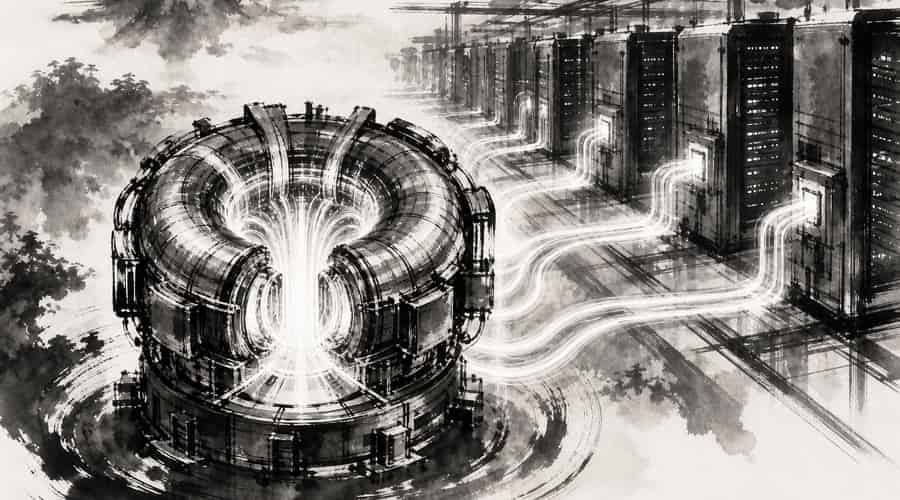
Commonwealth Fusion Systems has put its 400 MW ARC plant through peer-reviewed scrutiny, and that matters because AI power buyers are already acting like fusion belongs in the infrastructure queue.
Commonwealth Fusion Systems is no longer asking the market to judge ARC only as a promise. The company has published five peer-reviewed physics basis papers for its planned commercial fusion power plant, giving investors, utilities and power-hungry technology companies a more serious document to examine than the usual optimistic slide deck.
The headline number is simple enough. ARC is designed to produce about 1.13 GW of deuterium-tritium fusion power and deliver at least 400 MW of net electricity to the grid. That is the size of a real power station, not a laboratory milestone. For a startup backed by venture capital and strategic energy investors, the difference matters. Science can attract attention. Grid-scale electricity attracts buyers.
As the Journal of Plasma Physics collection published by Cambridge University Press makes clear, the papers are not a victory lap. They lay out the physics case for the ARC V3A design, including plasma performance, transport, heat exhaust, disruption strategy and magnetohydrodynamic stability. They also identify where SPARC, the demonstration machine CFS is building in Devens, Massachusetts, still has to reduce uncertainty before ARC can become a final power plant design.
Fusion has always had a credibility problem because the promise has been so large and the delivery dates have moved so often. CFS is trying to change that by making its assumptions inspectable. The company says 58 scientists worked on the ARC papers, with authors from institutions including MIT, Columbia University, UC San Diego, KTH Royal Institute of Technology, Chalmers University of Technology and the Max Planck Institute for Plasma Physics.
That does not mean ARC is built. It does mean the project is becoming easier to diligence. The papers show a high-field tokamak design with an 11.4 tesla magnetic field, a 12 megaamp plasma current and a major radius of 4.62 meters. Those details matter because this is where fusion moves from broad ambition into engineering choices that can be challenged, modelled and priced.
The most useful part is the honesty around risk. One performance paper found that integrated modelling supports ARC performance near the 1 GW fusion power range, while higher-fidelity gyrokinetic modelling produced a lower result under nominal assumptions. That is not a detail to hide. It is exactly the kind of uncertainty that SPARC is supposed to test, and it is why the ARC design remains tied to what CFS learns from the smaller machine.
The disruption strategy is just as important. Tokamaks can suffer rapid plasma terminations that stress internal components, and the ARC papers discuss both mitigated and unmitigated disruption loads. The stated ambition is disruption-free operation, but the pragmatic design target is to handle one mitigated disruption per day and restart quickly enough to avoid interrupting power output. That is the language of a power plant operator, not just a plasma physicist.
Why AI buyers care
The timing is hard to ignore. AI data centers are turning electricity procurement into a strategic constraint, especially in regions where grid queues are long and local demand is climbing. A 400 MW clean, firm power plant in Virginia is exactly the sort of asset a hyperscaler would rather reserve early than chase later.
Google has already signed a power purchase agreement for 200 MW from the first ARC plant in Chesterfield County, Virginia, and also increased its investment in CFS. Eni followed with an offtake agreement worth more than $1 billion for power from the same 400 MW project. These commitments do not prove fusion will work, but they do show that serious buyers are willing to underwrite the possibility before the first commercial plant exists.
CFS has also pushed the project into the less glamorous machinery of the power business. In April 2026, the company applied to connect its Fall Line Fusion Power Station to PJM Interconnection, the largest U.S. competitive wholesale electricity market. PJM serves more than 65 million customers and about 182,000 MW of capacity across 13 states and Washington, D.C. Entering that queue early matters because interconnection studies and grid upgrades can take years.
This is where the startup story becomes more interesting. Deep-tech companies often win attention by announcing breakthroughs, but infrastructure companies win trust by surviving boring processes. Permits, grid studies, customer offtake, supply chains, modelling tools and operating plans are not glamorous. They are what turn a science project into something a utility, lender or data center planner can put into a forecast.
CFS is also using Siemens and Nvidia to build a digital twin of SPARC, using Siemens Xcelerator tools and Nvidia Omniverse libraries with OpenUSD. That fits the broader pattern. Fusion is being developed at the same moment AI is creating both new energy demand and new engineering tools. If the digital twin helps CFS compare SPARC experiments with simulations faster, it could shorten the learning loop between demonstration and commercial design.
The next thing to watch is not another grand claim about limitless energy. It is whether SPARC produces the data ARC needs, whether PJM studies keep the Virginia project on schedule, and whether more buyers follow Google and Eni. If those pieces continue to line up, fusion will start to look less like a distant scientific prize and more like an infrastructure asset being reserved before it exists.
Also read: Justin Ernest is showing how venture access is moving beyond funds • ASML's record run still leaves investors arguing it looks cheap • Orbital raises $5 million to test AI data centers in space