
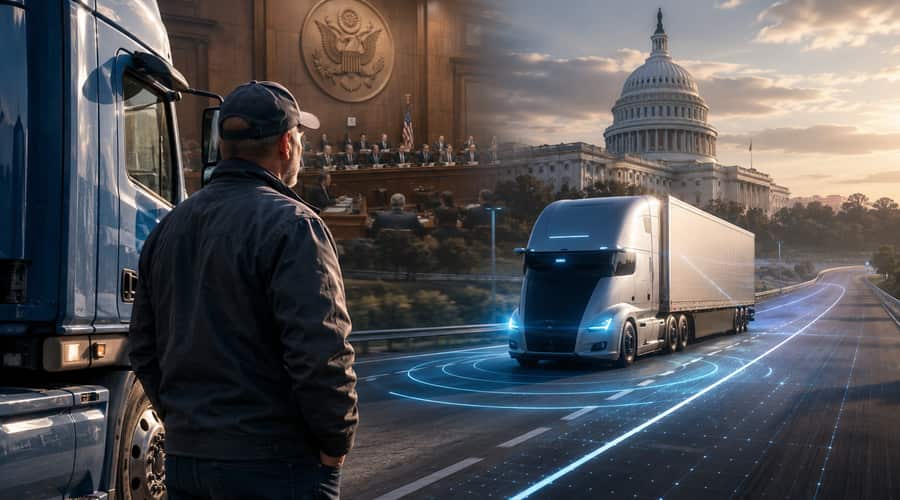
Washington is beginning to treat autonomous trucking as a labor issue, not just a safety experiment. A new House transportation bill would set federal rules for driverless commercial vehicles while putting money behind workers who may have to adapt.
The trucking automation debate has moved from tech demos in Texas to the committee rooms of Congress. That matters because self-driving freight is no longer a distant pitch from startups trying to impress investors. It is becoming a policy question tied to jobs, liability, interstate commerce and who gets to control the next version of America’s supply chain.
The bill at the center of the fight is the BUILD America 250 Act, a five-year surface transportation package advanced by the House Transportation and Infrastructure Committee in May. The proposal was led by Committee Chairman Sam Graves of Missouri and Ranking Member Rick Larsen of Washington, and it includes what the committee describes as the first federal framework for autonomous commercial motor vehicles. That is a big sentence with a simple meaning: Washington wants one rulebook for driverless trucks before states create 50 different versions of the future.
According to House Transportation and Infrastructure Committee materials, the broader package authorizes about $580 billion for fiscal years 2027 through 2031 and covers highways, bridges, transit, rail, safety and motor carrier programs. Inside that larger infrastructure bill is a section that could shape the deployment path for companies building autonomous freight systems, including Aurora, Kodiak AI, Bot Auto and others trying to move from limited routes to wider commercial service.
The legislation would not immediately put fleets of unmanned trucks on every interstate. The Department of Transportation would have to establish safety standards, create reporting rules for crashes and incidents, and form a rulemaking committee that includes technology providers, truck makers, law enforcement, insurers, traffic safety professionals, labor groups, shippers and carriers.
That structure is important because autonomous trucking is not just a vehicle problem. It is an operating model. A driverless truck needs a manufacturer, a motor carrier, software, remote support, dispatch procedures, inspection rules, cybersecurity controls and a clear answer to who is responsible when the automated driving system is engaged. The bill tries to pull those pieces into the federal motor carrier safety framework instead of leaving them to be argued one exemption at a time.
There are also real limits in the text. A human operator would still be required inside autonomous commercial vehicles carrying primarily minors, such as school buses, or placarded hazardous materials. Remote assistants, remote drivers and driverless operations dispatchers would have to be physically located in the United States or a U.S. territory. Time spent monitoring certain autonomous commercial vehicles would count as driving time under federal hours-of-service rules.
For startups, that is both useful and uncomfortable. A national framework can reduce uncertainty, especially for companies that need interstate routes to make the economics work. But the same framework also adds compliance costs, workforce requirements and public reporting obligations. Investors who assumed federal rules would simply unlock deployment may have to price in a slower and more supervised path.
The worker language is the real signal
The most telling part of the bill is not the technology language. It is the workforce section. The legislation would create a commercial motor vehicle workforce development grant program within one year of enactment, with $27.5 million authorized for fiscal year 2027 and rising to $29.8 million by fiscal year 2031.
Those grants could train current commercial driver’s license holders to operate and maintain vehicles equipped with automated driving systems. They could also support apprenticeships, internships, scholarships, vehicle maintenance technician programs, labor partnerships and efforts to help the current workforce adapt to new technology in transportation, transit and logistics.
That is not enough money to protect every job in an industry with more than 3.5 million professional truck drivers, a figure the American Trucking Associations has long used to describe the scale of the workforce. But the dollar amount is less important than the admission. Congress is acknowledging that autonomous freight may change work faster than the existing training system can handle.
The politics are already showing up at the state level. On May 29, Colorado Governor Jared Polis vetoed a Teamsters-backed bill that would have required a licensed human driver in automated commercial vehicles over 26,000 pounds. That veto came as labor groups continue pushing for state-level protections, while autonomous vehicle companies argue that a patchwork of state rules will make national freight deployment nearly impossible.
Texas shows why the issue is moving quickly. Aurora has been running driverless commercial freight operations in the state and announced a May deal with McLane Company for autonomous trucks on long-haul routes, with a human observer still expected in the cab under its current arrangement with Paccar. Kodiak AI said this month it had begun hauling freight autonomously with Roehl Transport between Dallas and Houston. Bot Auto has also claimed a fully humanless paid commercial truckload in Texas, with no safety driver, in-cab observer or remote operator.
These are still early deployments, not a full labor replacement cycle. Long-haul highway driving is easier to automate than dense urban delivery, loading docks, bad weather, inspections, customer interaction and the messy judgment calls that drivers make every week. But the direction is clear enough that lawmakers are no longer waiting for the market to sort it out alone.
For autonomous logistics companies, the next phase will be about more than proving the truck can drive. They will have to prove they can operate inside a federal safety regime, train or hire the new categories of workers around the vehicle, and answer labor concerns without sounding as if workers are an afterthought. For trucking companies, the practical question is where automation enters first: a replacement for long highway segments, a tool for driver productivity, or a new compliance burden layered on top of an already difficult business.
The bill still has to move through Congress, and its final form could change. But the market should pay attention to the direction of travel. Autonomous freight is being pulled into the same political reality as every other major labor-saving technology: the deployment window will be shaped not only by engineering progress, but by worker protections, federal rulemaking and the states that refuse to wait quietly.
Also read: Meta is preparing an AI pendant for the wearable race • DuckDuckGo is gaining as Google pushes AI deeper into search • DuckDuckGo turns Google's AI search push into an opening