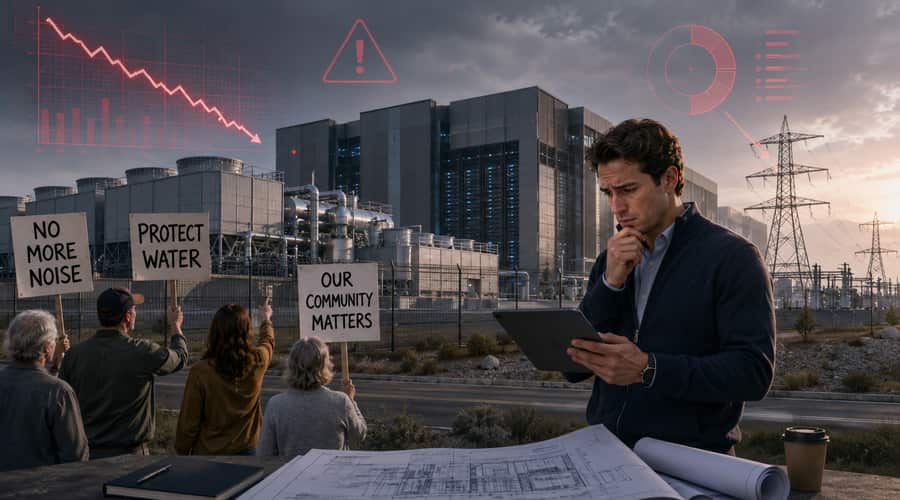
Americans are not just uneasy about AI data centers, they are turning local approval into a serious infrastructure risk.
The next bottleneck for AI may not be chips, models or capital. It may be the town meeting. A new wave of national polling shows that data centers, once treated as dull but necessary real estate, are becoming one of the hardest local projects to defend.
That matters for founders and investors because the AI economy is being built on physical places. Servers need land. Land needs permits. Permits need elected officials willing to stand in front of residents who are worried about water use, power bills, noise, traffic and whether the promised benefits will actually show up where they live.
As Gallup reported in its first poll on local AI data center construction, 71% of Americans oppose building one in their area, including 48% who strongly oppose it. Barely a quarter favor the idea. Women register the strongest resistance, with 55% strongly opposed compared with 43% of men. That is not a small gap, but the larger point is harder for the industry: opposition is broad, intense and not neatly contained inside one party or one region.
This is where the politics become uncomfortable for technology companies. Data centers have been sold as economic development projects, and in some places they are exactly that. They can bring construction work, new tax revenue, upgraded power infrastructure and a reason for state leaders to boast that they are part of the AI buildout. But many residents hear a different pitch. They see an industrial facility that may consume large amounts of electricity and water while employing relatively few people once construction is finished.
For years, developers could treat community pushback as a project-management problem. Hold a hearing, adjust a buffer, offer a road improvement, move on. That approach looks weaker now because the objection has become structural. Gallup found no meaningful differences in total opposition by age, race, education, income or urbanicity. Opposition was a little lower in the West and East than in the Midwest and South, but it remained high everywhere.
That finding should change how site selection is done. If resistance is not limited to one political identity or one kind of neighborhood, then developers cannot simply avoid the loudest markets and assume another county will quietly welcome the same proposal. They need to underwrite local approval with the same seriousness they bring to power availability and fiber access.
Recent local moves show what that looks like in practice. Denver's City Council approved a one-year moratorium on new data center development this week. Hill County, Texas, also moved to pause data center projects in rural areas for a year. Those are not isolated symbolic fights. They are signals that communities are learning how to translate concern into zoning delays, moratoriums and political pressure.
The timing is awkward for AI infrastructure investors. The industry is still racing to secure compute capacity, while states are competing for the projects that promise to make them important in the next technology cycle. But speed creates its own problem. When residents feel a project is being pushed through before they understand the costs, the debate stops being about AI and starts being about trust.
The benefits case needs to get sharper
The public is not blind to the upside. A separate Redfin-commissioned Ipsos survey found that 38% of U.S. residents support an AI data center in their neighborhood, with younger Americans more likely to support them than older residents. People who favor these projects often point to jobs, investment and tax revenue. That is the case developers want to make.
But it cannot be made in generic terms anymore. A promise of economic growth is too vague when the opposing side is talking about monthly utility bills, local water supplies and the value of nearby homes. If a project will create jobs, communities will want to know how many are permanent. If tax revenue is the argument, they will want to know where it goes. If power demand is the concern, they will want to know who pays for grid upgrades.
For startups building around AI infrastructure, this is a practical lesson. Community relations is not a glossy add-on after financing closes. It is part of the operating model. The founders who understand that will design projects with clearer local benefits, better disclosure and fewer surprises. The ones who treat permitting as a paperwork exercise may discover that opposition can move faster than capital.
There is also a gender signal here that should not be reduced to a headline trick. If women are more likely to express strong opposition, and if women are often central decision-makers in households and local civic networks, then public concern may show up forcefully in school boards, county commissions, neighborhood groups and local elections. Developers ignore that at their own risk.
The AI boom has trained investors to look for constraints in chips, power and talent. Now they need to add local consent to the list. The data center race is still moving, but the communities hosting that race are beginning to ask who wins, who pays and who gets listened to before the concrete is poured.
Also read: Polymarket’s wallet breach tests its credibility as it pushes abroad • Howie Liu is backing founders building AI agent companies • Europe is turning Lightning compliance into a startup problem