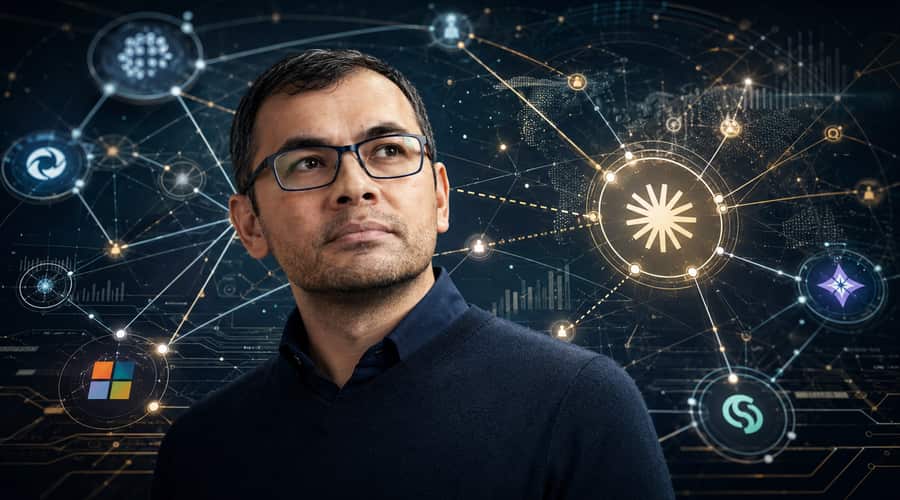
Google DeepMind chief Demis Hassabis was an early investor in Anthropic, a disclosure that makes the AI industry's web of competition and cooperation look even tighter.
Google DeepMind's chief executive has long sat at the center of the AI race. Now a Financial Times report has added a less visible but more revealing detail: Demis Hassabis was an early personal investor in Anthropic, the startup behind Claude and one of Google's fiercest frontier model rivals.
That matters because the relationship between the two companies is already unusually tangled. Google is both a competitor to Anthropic and a major backer through cloud and infrastructure ties, while Anthropic has also drawn capital and compute commitments from other large technology groups. Hassabis's personal stake, first reported by the FT and later picked up in market coverage, adds another layer to a sector that already runs on overlapping incentives, shared talent and strategic hedging.
The disclosure lands while Anthropic is attracting some of the largest checks in private technology. Reuters reported in February that the company raised $30 billion at a $380 billion valuation, led by GIC and Coatue, after demand for Claude surged across enterprise customers and software developers. Reuters later reported that venture investors had offered to buy into Anthropic at valuations as high as $800 billion, although those offers were not the same as a priced company financing.
The significance is not just that Hassabis backed Anthropic early. It is that the person running Google's most important AI lab had, at some point, a direct financial interest in a company that helps define the competitive field his own lab must beat. That kind of overlap is familiar in Silicon Valley, where founders, executives and investors often sit inside the same small network. In frontier AI, it carries more weight because the same group of people, models, chips and cloud contracts now shapes an entire market.
Google's corporate relationship with Anthropic makes the question sharper. In April, Reuters reported that Alphabet would invest up to $40 billion in the company, with $10 billion committed in cash at a $350 billion valuation and a further $30 billion tied to performance targets. That investment deepens a partnership that gives Anthropic access to capital and infrastructure while giving Google exposure to a rival that could help define the next generation of AI demand.
For startups, the lesson is straightforward. Early capital often buys access, intelligence and credibility, but in frontier AI it can also create uncomfortable questions about governance and competitive boundaries. If the same leaders who direct one lab's strategic priorities also profit from another lab's rise, investors and founders have reason to ask where loyalty ends and portfolio logic begins.
That does not mean the arrangement is illegal or even unusual by Silicon Valley standards. It does mean the sector is moving into a stage where disclosure matters more, not less. The more the AI race turns into a contest over compute, model quality and enterprise distribution, the harder it becomes to separate pure rivalry from financial entanglement.
The bigger industry pattern
Anthropic's rise has been powered by exactly the kind of partner stack that defines this era. Google supplies capital and cloud capacity. Amazon has also committed billions to the company and made Anthropic's models a central part of its AI push. Nvidia sits in the background of nearly every frontier model story because the industry still depends on scarce chips and accelerated infrastructure.
That structure creates a strange but increasingly familiar market. Big tech firms want exposure to the most promising AI startups because those companies can shape future demand for cloud services, developer tools and enterprise software. At the same time, the startups need the incumbents to supply the compute, distribution and balance sheet strength required to keep training larger models. Hassabis's early Anthropic bet is a clean example of how those incentives can bleed into one another.
It also helps explain why AI governance is becoming a harder question than many expected. When financial relationships, technical collaboration and competitive pressure all sit in the same room, simple rules about conflicts of interest start to look thin. The industry is not only building models. It is building a power structure around them.
That is the real story here. Not just that one prominent executive invested early in a rival. It is that the AI market now operates through a dense network of personal stakes, corporate partnerships and strategic dependency, and that network is becoming more valuable as valuations climb and the race for compute intensifies.
Also read: Meta shifts 7,000 workers into AI as it tightens its grip on the future • Google and Blackstone Bet Big on AI Infrastructure with TPU Cloud Venture • DeepMind employee signals Gemini 3.5 ahead of Google I/O 2026 launch