Enigma has come out of stealth with a $71 million seed round and a bold claim: the next robotics company to matter may be the one that makes robots easier for ordinary people to control.
Jonathan Jacobi and Gal Niv are not selling you a humanoid helper for the kitchen. Not yet. They're selling the layer above the machine: AI models and interfaces that can sit across different kinds of robots and make them feel less like industrial equipment and more like tools a human can actually use.
The company launched on July 27, 2026, with a $71 million seed round led by Index Ventures and Ribbit Capital, according to Enigma's announcement. Conviction Partners also participated, along with angels from OpenAI, Anthropic, DeepMind, xAI, Cognition and Wiz. TechCrunch put the round at about $70 million in its report the same day. Either way, that's a very large seed check for a company founded less than a year ago and still proving its central claim in public.
Jacobi's biography is part of the pitch, and it's unusually specific. Enigma says he began a computer science degree at 13, finished it while still in high school, and became the youngest employee at Microsoft and Check Point at 17. Niv, his co-founder, started hardware hacking at 10, joined a cybersecurity startup at 17, and later became Unit 8200's youngest cyber-operations manager. The two met in Israel's Unit 8200, where Enigma says they shared a bunk bed.
Pedigree helps. It doesn't solve robotics.
That's where Enigma's argument gets more interesting. The company isn't trying to win by building one perfect robot arm, one warehouse system, or one humanoid body. It says it's training robot-agnostic AI models and building interfaces that make machines easier to control across different hardware. TechCrunch reported that Enigma wants controlling a robot to feel as easy as adjusting the volume. That line is doing a lot of work, but the underlying point is fair: most robots still demand too much from the person trying to use them.
The demo is doing real work
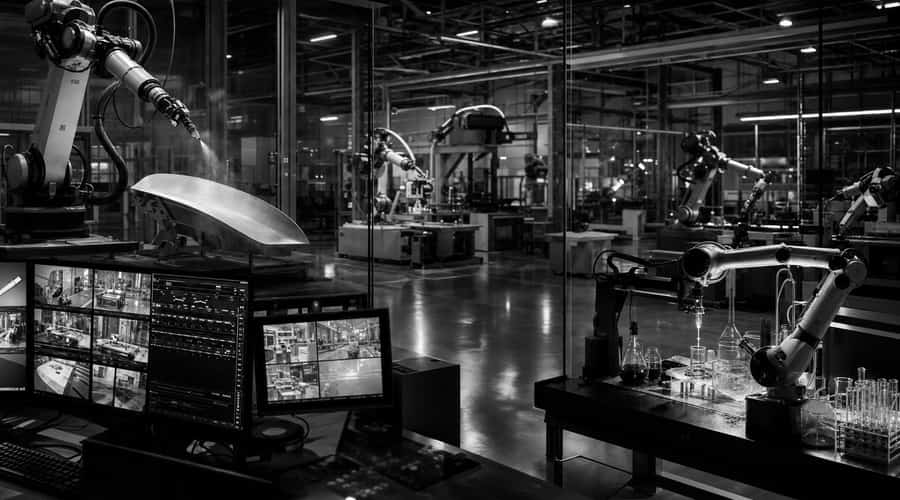
Enigma's launch came with a public robotics experiment at robots.online. More than 100 real AI-powered robots, housed in hangars in Israel and California, are being made available online for people to control in real time, according to both Enigma's announcement and TechCrunch's report. The tasks are deliberately strange and simple: drawing with a paintbrush, sword-fighting, picking up flasks and mixing liquids in basic chemistry setups.
Don't skip past that.
This isn't only a press demo with a neat video and a founder quote. It's also a way to collect data on how untrained users actually try to direct machines. Enigma says those interactions will feed back into its models and interfaces. If you're trying to build software that makes robots intuitive, that's the right test. A lab operator can make almost anything look smoother than it is. A bored person online will find the confusing parts fast.
That public experiment also gives Enigma a sharper story than most robotics startups have at launch. Plenty of companies can say physical AI is hard. Enigma can point you to a browser window and say: try it yourself. The robots may still be limited, and the tasks may be closer to a controlled playground than a factory floor, but live access is a more honest signal than another glossy render of a machine doing chores in a spotless apartment.
The software bet is the risky part
Here's the thing: the phrase "intelligence layer" sounds clean because it pushes the mess below the surface. Real robots live in messy rooms, bright warehouses, cramped labs and fields where the ground itself won't cooperate. A model that works across Enigma's own hardware in two hangars still has to prove it can travel across robot types, environments and customer workflows without needing a custom engineering project each time.
That's why the funding matters less as a victory lap than as runway. Enigma has bought itself time to answer a hard question: can software become the control layer for robotics before hardware companies lock users into their own systems? The cloud analogy is tempting. AWS became infrastructure because developers could build on it without caring where the servers sat. Robotics won't be that clean, because the physical world keeps pushing back.
Still, Enigma is right to focus on usability. If a robot takes 15 minutes of explanation to do a two-minute job, most people will give up and do the job themselves. Jacobi told TechCrunch much the same thing, using dishes as the example: once setup takes too long, the robot has already lost. That's not a small interface problem. It's the difference between a machine people admire and a tool they actually use.
The strongest version of Enigma's case is not that it has already built the operating system for every robot on earth. It hasn't. The case is that robotics may be stuck less on spectacle than on control, and Enigma is willing to test that idea in public on day one. For a $71 million seed company, that's both the promise and the pressure.
Also read: Washington threatens to sanction Chinese AI firms over distillation theft as Beijing fires back • Nvidia takes a stake in Safe Superintelligence and gets access to Ilya Sutskever's research in return • Brian Armstrong tells crypto founders who pivoted to AI they got it backwards