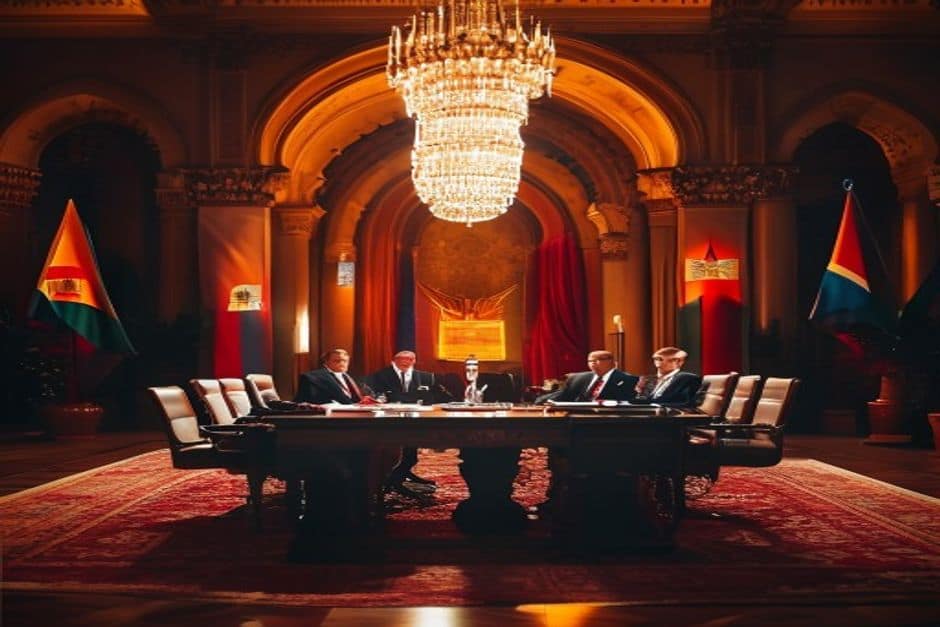
Saudi Foreign Minister Prince Faisal bin Farhan met French counterpart Jean-Noel Barrot in Riyadh on Thursday and spoke by phone with EU foreign affairs chief Kaja Kallas on Friday, the latest in a sustained series of high-level European contacts with the Kingdom as the region's security architecture undergoes its most significant stress test in decades.
French Foreign Minister Jean-Noel Barrot arrived in Riyadh as part of a deliberate Gulf tour that included Doha, Abu Dhabi, and Muscat. He did not come for a courtesy round. France and the UK have been coordinating a multilateral naval initiative involving 51 states designed to provide defensive coverage in the Strait of Hormuz under a longer-term ceasefire framework. The ceasefires currently holding in both the Iran and Lebanon theatres following the joint US-Israeli strikes in February are fragile. Barrot came to test whether Saudi Arabia, the Gulf's most consequential diplomatic actor, will actively support the political architecture those ceasefires require or wait to see what Washington decides first. The readout from the Riyadh meeting was substantive enough to signal the former. France pledged military support for Saudi defence if needed, called for the immediate and unconditional reopening of the Strait of Hormuz, and committed to continued close coordination on diplomatic efforts in both Lebanon and Iran. That is not standard diplomatic language. It is a specific set of commitments that indicates Paris has made a strategic calculation about where its interests lie and communicated that calculation directly.
Kaja Kallas calling Prince Faisal the same day as the Barrot meeting is not coincidence in the coordination sense. It reflects the pace at which European diplomatic engagement with Riyadh has accelerated since February. This was not the first call between the two in recent months. Kallas met Prince Faisal in Riyadh in early April to review the Saudi-EU strategic partnership, which covers energy, trade, and security cooperation. She spoke with him in March following the Iranian attack on the Port of Salalah in Oman. The frequency is the signal: Brussels is treating Saudi Arabia as a co-architect of regional stability, not a peripheral party to be updated after decisions are made elsewhere. That is a meaningful shift from how European diplomacy in the Gulf has typically operated, where the US-Saudi bilateral relationship set the framework and European actors operated within it.
The economic stakes driving that shift are straightforward. Approximately 20% of global oil transits the Strait of Hormuz. The extended disruption since February has pushed energy prices above comfort levels in European economies that spent two years bringing inflation down. The European Central Bank's monetary policy has had to absorb repeated commodity price shocks at precisely the moment it was managing a delicate easing cycle. The disruption also affects European industrial supply chains that depend on Gulf-origin petrochemicals and materials. For Germany, France, Italy, and the Netherlands, stability in the Strait of Hormuz is not a foreign policy abstraction. It is a direct economic condition. That is why Kallas and Barrot are both in this sequence rather than leaving the Gulf track to Washington.
Saudi Arabia's own incentives for engaging so actively with European counterparts are also concrete. Vision 2030 requires sustained foreign direct investment from multiple geographies. The Kingdom's economic transformation plan cannot be funded exclusively from domestic oil revenues or a single bilateral relationship with the United States. European capital, European technology partnerships, European tourism infrastructure and entertainment investment are all part of the Vision 2030 capital stack. The Gulf-Europe investment corridor that has been developing since 2022, when energy prices created enormous sovereign wealth capacity in the Gulf, depends on a stable security environment. Prolonged conflict in the region does not just increase insurance and logistics costs. It raises risk premiums on every investment decision in the corridor. Prince Faisal's active diplomacy with both Barrot and Kallas is, among other things, economic statecraft in support of the investment flows that Vision 2030 depends on.
The Lebanon file adds a distinct dimension to the Saudi-European conversation that does not reduce to energy or investment. France maintains historically deep ties with Lebanese political institutions and has positioned itself as a guarantor of Lebanese sovereignty since the 2020 Beirut port explosion. The ceasefire currently holding in Lebanon requires both Hezbollah's financial networks to remain under pressure and Iran's resupply operations to stay constrained. Saudi Arabia's influence over the first condition and France's diplomatic presence in Beirut are both necessary inputs to the ceasefire's durability. Their coordination is not incidental. It reflects a genuine area of aligned interest between two actors who disagree on many other questions in the region but share a stake in Lebanese stability.
For businesses monitoring the Middle East as an investment environment, the intensity of this diplomatic sequence carries a specific implication. The Gulf is not retreating from its global economic integration agenda under regional pressure. Saudi Arabia is simultaneously managing a serious security environment and conducting the kind of high-frequency diplomatic engagement that signals confidence in its own institutional stability and long-term trajectory. The meetings are about security and they are also about ensuring that the economic architecture built over the past five years survives whatever political settlement eventually emerges from the current cycle of conflict. Prince Faisal meeting Barrot in person and calling Kallas the same day is statecraft executed at a pace and intensity that reflects how consequential the current moment is and how seriously Riyadh is taking its role in shaping what comes next.
Also read: Waymo's robotaxis are passing safety tests while failing a different kind of exam on the streets of San Francisco • Local AI has crossed a threshold that startup founders can no longer afford to ignore • The software engineer is not disappearing but the job description is being rewritten faster than most hiring managers realize