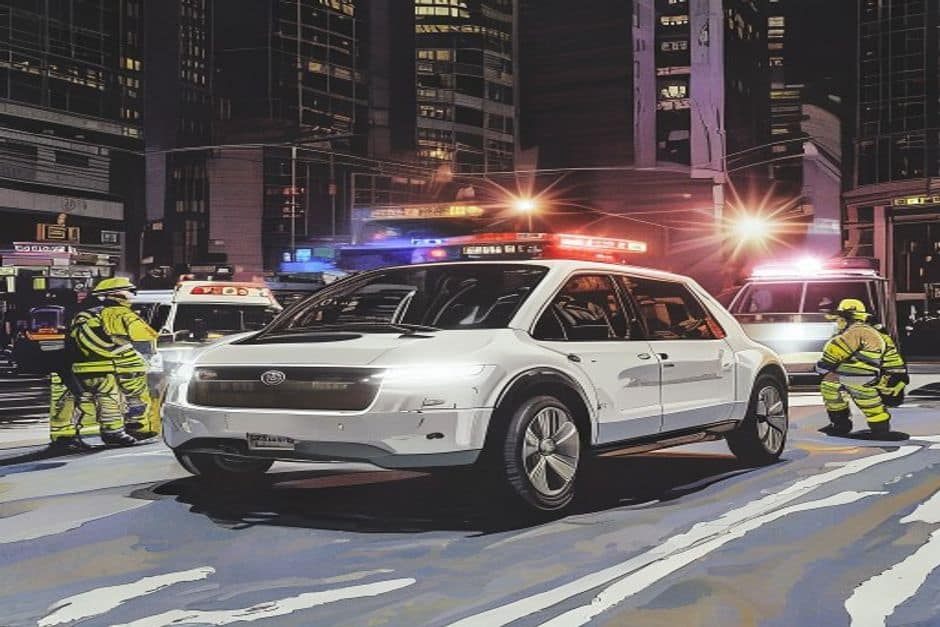
Emergency first responders are raising operational complaints about Waymo's autonomous vehicles that do not show up in collision statistics, and the tension is becoming a test of whether autonomous vehicle companies have built civic relationships to match their technical ambitions.
The safety narrative around Waymo has been carefully constructed and, on its own terms, reasonably well supported. The company has published data suggesting its vehicles are involved in fewer injury-causing crashes per mile than human drivers, and that record has formed the backbone of its case to regulators and the public. What is harder to capture in those numbers, and what is now surfacing more visibly as Waymo's San Francisco deployment has expanded, is a different category of friction: the one that emerges when a vehicle that cannot be reasoned with, overridden by hand, or moved by a phone call ends up in the middle of an active emergency scene. Fire departments, police officers, and paramedic crews have been documenting incidents where Waymo vehicles stopped in ways that complicated access, blocked lanes needed for emergency equipment, or resisted the kind of informal human direction that responders rely on when a situation is moving quickly.
The complaints are not new in kind. San Francisco emergency services raised concerns about autonomous vehicle behavior during road incidents as far back as 2022 and 2023, when the city's robotaxi experiment was still in earlier phases. What appears to have changed is frequency and visibility. As Waymo has expanded its operational footprint, the number of interactions between its vehicles and emergency scenes has grown proportionally, and the incidents that were occasional friction points have become a more regular feature of responder experience. Several fire department officials have been quoted in recent reporting describing situations where a stopped Waymo vehicle could not be quickly cleared from a scene and required contacting the company's remote operations team, a process that introduces delay in environments where seconds carry real consequence.
The underlying problem is structural rather than a product of any single incident. Autonomous vehicles are designed and tested against a model of normal traffic and predictable road conditions. Emergency scenes are, by definition, outside normal parameters: ad hoc lane closures, responders standing in traffic, hand signals from personnel who are not traffic cops, apparatus parked in ways that would be illegal under normal circumstances. Human drivers navigate these situations through a combination of visual reading, informal communication, and the kind of contextual inference that comes from understanding what a fire engine blocking an intersection actually means. Current autonomous vehicle systems handle these scenarios less fluidly, and the gap between what the system was designed for and what it encounters at an active incident is where the complaints are concentrated.
Waymo has consistently disputed the framing that its vehicles are becoming harder to manage rather than easier, pointing to improvements in its remote assistance protocols and its work with city agencies to develop response procedures. The company has also argued that its vehicles stop in place rather than making potentially dangerous evasive maneuvers, which is a legitimate safety design choice even if the outcome is frustrating for a paramedic trying to reach a patient. Both characterizations can be true simultaneously, and the fact that they are is what makes the issue difficult to resolve through technical iteration alone.
The data access question is where the regulatory dimension sharpens. Cities that host Waymo operations have limited visibility into the real-time behavior of the fleet and limited ability to impose operational requirements beyond what state regulators and the NHTSA framework allow. That asymmetry has been acceptable to local officials while robotaxi deployment remained modest and incidents were rare enough to handle case by case. As the fleet scales, the political tolerance for that asymmetry is diminishing. Officials in San Francisco and other cities where autonomous vehicle expansion is on the agenda are beginning to ask more specific questions about what data they can access, what operational controls they can require, and what permitting leverage they retain if performance against emergency coordination standards deteriorates.
What this means for the broader AV investment thesis
Autonomous vehicle startups and their investors have long defined success in terms of technical milestones and commercial expansion. Miles driven, cities entered, revenue per vehicle, collision rates versus human baselines: these are the metrics that shape funding narratives and valuation conversations. The Waymo friction story adds a different set of variables that are harder to quantify but increasingly hard to ignore. Civic integration capacity, the ability to work constructively with emergency services, city governments, and the informal systems of coordination that urban infrastructure depends on, is becoming a constraint on deployment permission in ways that pure safety statistics do not capture.
For founders building in the AV adjacent space, whether in fleet operations, AV software, sensor systems, or the logistics applications that autonomous vehicles enable, the lesson is that the regulatory and civic relationship is not a post-product problem to be handled by a government affairs team after technical validation. It is a design variable that needs to be built into the system architecture, the operational model, and the stakeholder engagement strategy from the start. The companies that treat city governments and emergency agencies as partners in deployment rather than permit-granting obstacles will have a meaningfully smoother expansion path than those that optimize only for the metrics that appear in a safety filing.
Watch for whether San Francisco or another major city moves toward formalizing AV operational requirements around emergency coordination specifically, either through new permitting conditions or through state-level regulatory proposals. That would represent a concrete escalation of the current friction into something with binding commercial consequences, and it would set a precedent that every autonomous vehicle operator expanding into dense urban markets would need to plan around.
Also read: Local AI has crossed a threshold that startup founders can no longer afford to ignore • The software engineer is not disappearing but the job description is being rewritten faster than most hiring managers realize • Big Tech is paying up to a million dollars for people who can steer AI and that changes everything about startup hiring