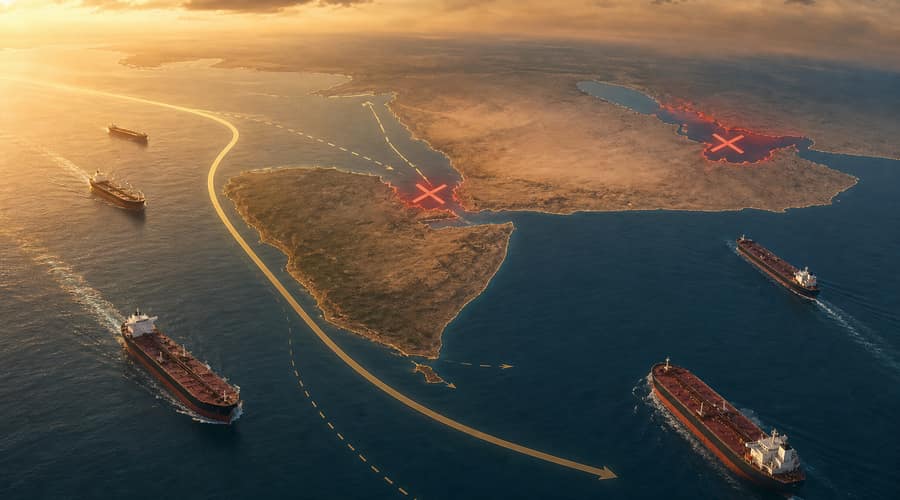
The Houthis did not need to defeat Saudi Arabia to shake the oil market. They only needed to make the Red Sea feel unsafe again.
On July 20, Yemen's Houthis declared a maritime embargo against Saudi Arabia and warned shipping companies not to load or discharge cargo at Saudi ports. Reuters reported that a Houthi email to maritime companies said violators could face sanctions and be targeted in any location within the group's reach. That is not a normal rebel threat. It is a direct challenge to the route Saudi Arabia has been using to keep crude moving while the Strait of Hormuz remains under severe pressure from the US-Iran war.
The timing matters. According to The National, using Kpler data, weekly crude loadings from Saudi Arabia's Red Sea terminals fell 36 percent in two weeks, from 9.5 million barrels per day on June 29 to 6.1 million barrels per day in the week of July 13. The National also reported that more than 70 percent of Saudi exports have been rerouted through Yanbu since Hormuz became effectively shut. If you want to understand why the Houthi announcement moved markets so quickly, start there. Yanbu is not a spare outlet anymore. It is the kingdom's working exit.
That exit is exposed.
Saudi Arabia's East-West Pipeline runs about 1,200 kilometers from the Gulf side of the country to Yanbu on the Red Sea. Al Jazeera reported in March that Saudi flow through the line had risen sharply after the US-Israeli war on Iran began on February 28, with Kpler data showing an increase from about 770,000 barrels per day in January and February to about 2.9 million barrels per day by late March. A Reuters-syndicated market report last week put recent Yanbu shipments at about 4 million barrels per day, compared with 973,000 barrels per day in the same period last year. That is a huge operational shift, and it leaves Saudi Arabia leaning on a route that passes near Houthi reach at Bab el-Mandeb.
The original Houthi threat was not empty for long. AP reported that the Houthis later claimed attacks on two Saudi oil tankers, Encelia and Layla, in the Red Sea, and UK maritime monitors confirmed that one tanker was hit, causing a fire but no reported casualties. So the blockade is no longer just an insurance story or a line in a statement from Sanaa. It has moved into the water.
The Cheap Weapon Problem
The cost imbalance is the part Washington still has not solved. Former Navy Secretary Carlos Del Toro told US lawmakers in 2024 that the Navy had expended close to $1 billion in missiles in the Red Sea, including SM-2s, SM-6s and SM-3s. CSIS has also warned that simple comparisons between cheap drones and expensive interceptors can be misleading, because defending a ship and its crew is not the same as balancing a spreadsheet. Fair enough. But the maths is still ugly.
A Standard Missile can cost millions of dollars. A Houthi drone can cost a small fraction of that. The US can win every individual intercept and still lose the cost curve if the Houthis keep forcing it to fire high-end weapons at low-cost threats. The Houthis have also shown they can impose costs beyond munitions. CNN reported in 2025 that Houthi shootdowns of US MQ-9 Reaper drones had hampered American operations against the group, with each aircraft commonly valued around $30 million.
War-risk insurance tells the same story in commercial language. Reuters reported that indicative premiums for Red Sea transit rose to about 0.75 percent of a vessel's value from 0.3 percent before the Houthi announcement. That can add hundreds of thousands of dollars to a seven-day voyage. You do not need every ship to be hit for trade to change its behaviour. You only need owners and insurers to decide the route is no longer worth the risk.
Sanaa Now Has Leverage
The Houthis are often described too simply as an Iranian proxy. That misses the point. Al Jazeera's April analysis described a relationship in which Tehran provides support and political cover while the Houthis retain room to act according to their own calculations inside Yemen. That distinction matters now because the blockade helps Iran, but it also helps the Houthis. It puts Sanaa into any serious conversation about Gulf energy security.
Frankly, that is the real shift. For years, the Houthis were treated as a Yemen problem with regional consequences. Now they are a regional power problem with Yemeni territory. They control no global oil field. They do not need to. Their geography gives them a pressure point at Bab el-Mandeb, a strait AP notes carries about 12 percent of world trade in normal times. When Hormuz is constrained, that pressure point becomes far more valuable.
For Saudi Arabia, the risk reaches beyond one week of oil loadings. Vision 2030 depends on export revenue and investor confidence - the belief that the kingdom can keep building while conflict stays at the edges. A threatened Yanbu route challenges that belief directly. The UAE, Bahrain and other Gulf economies face a smaller version of the same question: how do you plan around trade corridors that can be repriced overnight by a group operating from northern Yemen?
There is no tidy ending here. Saudi Arabia can retaliate. The United States can expand strikes, and Iran can keep using maritime pressure as bargaining leverage while denying full control over every allied actor. None of that removes the core fact. The Houthis have found a way to make themselves expensive to ignore, and the market has already started paying attention.
Also read: Trump's Saudi nuclear deal hands a tinderbox region the tools for an arms race • UK Parliament opens inquiry into banks blocking crypto payments as £1 billion in transactions gets rejected • STMicroelectronics posts 25% revenue growth as its AWS deal turns data centers into its fastest-growing business