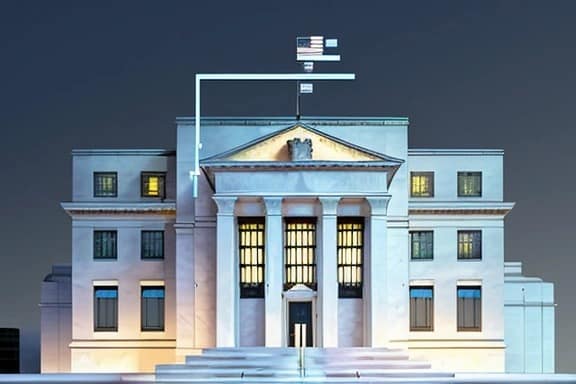
Federal Reserve Governor Michael Barr is ramping up pressure for tighter anti-money-laundering controls on stablecoins, arguing that the rapidly growing market poses systemic risks that current oversight cannot adequately address.
Federal Reserve Governor Michael Barr wants stablecoin issuers held to the same anti-money-laundering standards as traditional banks, and he is not waiting for Congress to act. Speaking at a financial regulation event, Barr made clear that the explosive growth of dollar-pegged digital tokens demands immediate regulatory attention, particularly around illicit finance. His remarks signal that the Fed views stablecoins not as a niche experiment, but as a parallel banking system operating with insufficient guardrails.
The stablecoin market has ballooned to roughly $160 billion in total capitalization, with Tether's USDT and Circle's USDC accounting for the vast majority of daily volume. That scale matters. As Decrypt reported, Barr specifically highlighted money-laundering risks associated with stablecoins, emphasizing the need for tighter controls to prevent bad actors from exploiting the speed and borderless nature of blockchain transactions. For regulators, the core concern is straightforward: when billions of dollars can move across jurisdictions in seconds with minimal identity checks, the system becomes an attractive target for laundering proceeds from fraud, sanctions evasion, and organized crime.
Barr's position is not new, but his willingness to push forward without waiting for comprehensive legislation is notable. He has previously argued that poorly regulated stablecoins could undermine the credibility of the U.S. central bank and the dollar itself. The logic is that if a privately issued token pegged to the dollar fails catastrophically, confidence in the underlying currency could take collateral damage. This concern is amplified by the fact that stablecoin reserves, the assets backing the peg, are often held in commercial paper, Treasury securities, and other short-term instruments that are not always transparent to regulators or the public.
From an enforcement perspective, the Financial Crimes Enforcement Network, or FinCEN, already requires crypto exchanges and money services businesses to comply with Bank Secrecy Act obligations. The challenge is that stablecoin issuers themselves sometimes operate in a gray area. Some are registered offshore. Others structure their operations in ways that arguably fall outside traditional money transmitter definitions. Barr's comments suggest the Fed wants to close those gaps by treating stablecoin issuers as de facto financial institutions, regardless of how they classify themselves.
What This Means for Founders and Investors
For crypto entrepreneurs building stablecoin products or payment infrastructure, this regulatory direction carries real operational weight. Compliance costs will rise. Know-your-customer and transaction-monitoring systems will need to match or exceed banking standards. Issuers who have relied on lighter regulatory regimes in offshore jurisdictions may find that U.S. market access increasingly depends on meeting American AML benchmarks, no matter where they are incorporated.
For investors, the implications are more nuanced. On one hand, regulatory clarity could legitimize stablecoins as a settlement layer for institutional finance, driving adoption and liquidity. On the other hand, compliance-heavy frameworks could squeeze out smaller issuers who lack the resources to build robust AML programs, concentrating the market further among a handful of well-capitalized players like Circle and Tether. That concentration carries its own systemic risks, a dynamic that regulators including Barr have acknowledged but have yet to resolve convincingly.
The broader trend is unmistakable. Global regulators are coordinating more closely on crypto oversight. The European Union's Markets in Crypto-Assets regulation, known as MiCA, already imposes strict reserve and transparency requirements on stablecoin issuers operating in Europe. The United Kingdom is developing its own stablecoin framework under the Financial Services and Markets Act. The United States, despite congressional gridlock on comprehensive crypto legislation, is clearly moving toward stricter enforcement through existing regulatory channels. Barr's latest remarks confirm that the Fed intends to use every tool at its disposal to bring stablecoins into the traditional regulatory perimeter.
What to watch next: whether the Fed begins issuing formal guidance that explicitly extends BSA requirements to stablecoin issuers, and how Congress responds to the growing calls for legislation that creates a dedicated federal framework. Until then, the message from the Fed is consistent and increasingly firm. If you want to issue a dollar-pegged digital currency at scale, expect to play by the same rules as a bank.