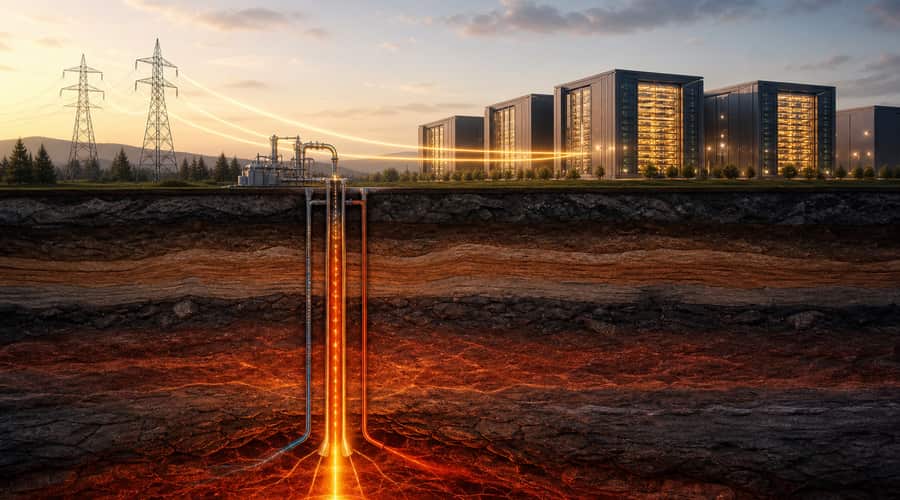
Fervo Energy has become a rare clean-tech IPO with a very modern tailwind: AI data centers need power that does not disappear when the sun sets.
Fervo Energy did not come to the public market as another speculative climate story looking for patience. It arrived as investors are trying to put a price on something AI companies suddenly need badly, steady electricity that can run every hour of the day without leaning on fossil fuels.
The Houston geothermal developer priced an upsized IPO of 70 million Class A shares at $27 on May 12, raising $1.89 billion at first. The offering then closed with underwriters exercising their full option, bringing the total to 80.5 million shares and about $2.174 billion in gross proceeds. Its Nasdaq ticker is FRVO, and the market treated the debut like an infrastructure answer to the AI boom.
According to Reuters, Fervo shares rose 33.3% in their first day of trading on May 13, giving the company a valuation of about $10.21 billion. Axios later noted that the stock was up more than 50% from its IPO price by May 15. That is a big reaction for a company building power plants, not software, and it tells you where public market attention has moved.
Geothermal has never had the marketing glamour of solar panels or the political weight of nuclear plants. Its advantage is simpler. If it works at scale, it can provide clean electricity around the clock. That matters because AI infrastructure does not behave like a normal office building. Data centers want constant power, predictable contracts and locations where grid capacity will not become the limiting factor.
Fervo is trying to make geothermal less dependent on rare natural reservoirs. The company uses enhanced geothermal systems, borrowing horizontal drilling, hydraulic fracturing and fiber optic sensing from the shale industry. Instead of hunting only for naturally convenient underground steam, it drills into hot rock, creates pathways for water, then brings heat back to the surface to generate power.
That is why Tim Latimer, Fervo's co-founder and chief executive, has become part of a broader story about oilfield skills being redirected into clean power. The shale playbook created a class of engineers, service companies and drilling practices that know how to operate underground at industrial scale. Fervo's argument is that those same methods can turn heat beneath the earth into a repeatable power business.
The company already has a proof point in Nevada, where its Project Red development has supplied carbon-free power for Google's data center operations. The larger test is Cape Station in Utah, a project designed to reach 500 megawatts. Fervo says the first phase is expected to begin delivering power by the end of 2026, with the full project aimed at the scale that utilities and large corporate buyers can actually plan around.
The Market Is Paying For Scarcity
The important question is not whether geothermal is useful. It is whether public markets are rewarding Fervo for real infrastructure capacity, or for being one of the few public ways to buy into the power bottleneck behind AI. Right now, both things are happening at once.
AI has made electricity feel like a growth asset. Chips, cloud campuses and model training get most of the attention, but none of it works without transmission, generation and long-term power procurement. That has pushed investors toward anything that looks capable of delivering firm clean energy. Nuclear developers, grid equipment makers and advanced geothermal companies have all benefited from the same logic.
Fervo's IPO also matters because clean-tech listings have been scarce. Many climate companies from the last cycle struggled with high capital costs, slow permitting, weak public comps and investors who lost patience with long buildout timelines. Fervo is different in one respect: it is selling into a market where demand is no longer theoretical. The customers are utilities, large power buyers and technology companies that can see load growth arriving faster than the grid can comfortably absorb it.
Still, building geothermal is not the same as selling software subscriptions. Wells have to be drilled, reservoirs have to perform, costs have to come down and projects have to connect to the grid. Cape Station is the proof case investors will watch. A strong IPO can fund ambition, but it cannot replace execution in the field.
That is why the stock's early surge should be read carefully. The market is not simply saying Fervo has already solved geothermal. It is saying that reliable clean power has become valuable enough that investors are willing to pay early for credible supply. In a world where AI demand is pressuring grids from Virginia to Texas to the Mountain West, scarcity itself has become part of the valuation.
For StartupFortune readers, the lesson is direct. The AI trade is no longer limited to model companies, chipmakers or cloud platforms. It is spilling into the physical economy, where startups that can build power, cooling, land access and grid capacity may find themselves financed like strategic infrastructure. Fervo's next test is whether it can turn a hot public debut into operating megawatts. If it can, geothermal may stop being a niche clean-energy category and start becoming one of the foundations beneath the AI economy.
Also read: A Reddit developer turns NVENC into a local AI bridge • Kled and Luel clash over who owns the AI data marketplace idea • AI-exposed jobs are now shrinking in the US labor market