Figure AI has moved its humanoid robot story from short clips to a longer public test. That still leaves the harder question: whether a livestream is enough proof for industrial buyers.
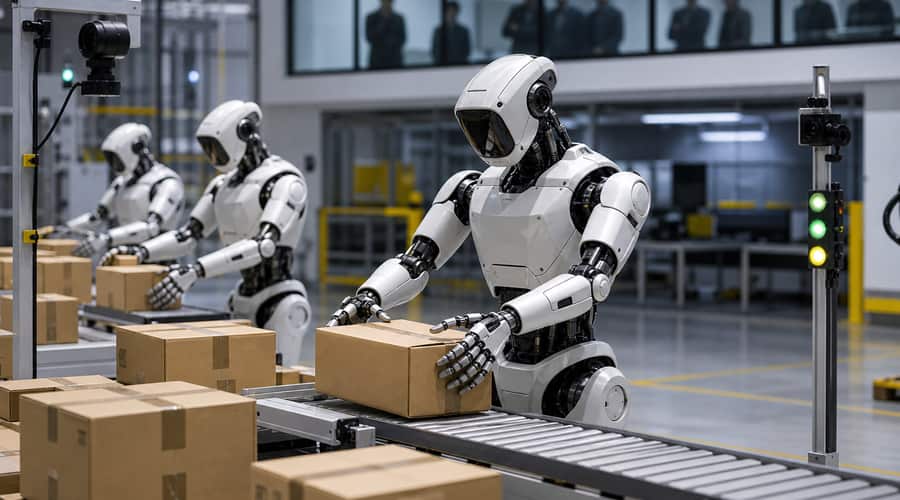
Figure AI CEO Brett Adcock wanted to make one point clear this week. The company's F.03 humanoids were not being steered from behind the curtain while sorting packages on camera. They were running Helix 02 autonomously, with no teleoperation, during a warehouse-style package sorting test that began as an eight-hour livestream on May 13 and then kept going.
That matters because humanoid robotics is now part of the larger AI funding story. Investors are no longer just betting on chatbots and cloud software. They are betting that the same advances in perception, reasoning and control can move into factories, warehouses and eventually homes. Figure's livestream gave that argument a useful public artifact. It also gave skeptics something to inspect frame by frame.
As TechRadar reported, the initial run showed three F.03 robots sorting packages in a public livestream, with Adcock saying the system was fully autonomous and running Helix 02. Follow-up updates from Adcock said the run had passed 24 hours with more than 28,000 packages sorted, later crossed 30 hours and 38,000 packages, and kept moving toward the 40-hour mark. The task itself was narrow but not trivial: detect the barcode, pick up the package and place it barcode-face down on a conveyor. Adcock has said humans average roughly one package every three seconds on the same job.
A livestream is more credible than a 30-second edited clip. Anyone who follows robotics knows how much can be hidden in a tight video: resets, failed takes, off-camera intervention or a task that only works because the environment has been prepared with care. Eight hours, then more than a day, is harder to dismiss and more relevant to actual work.
But buyers should still treat it as company evidence, not independent evidence. Figure controlled the environment, the task, the camera, the reporting and the definition of failure. The company says there was no teleoperation, and that is an important claim. The next step is showing logs, uptime records, intervention counts, error rates and maintenance events under a customer's operating conditions.
This is where the conversation needs to become less theatrical. Did a human clear jams off camera? How often did batteries change? What happened when packages arrived damaged, labels were hard to read, or the belt timing shifted? How many people were needed to supervise the system? A robot that sorts packages for 40 hours in a visible test is impressive. A robot that does it every week with predictable service costs is a product.
The distinction is not a knock on Figure. It is the normal gap between a milestone and a deployment. BMW's work with Figure robots in manufacturing has already shown there is real industrial interest in the company's machines. But warehouses are not impressed by novelty for very long. They care about throughput, uptime, safety, labor substitution and total cost per package.
The Humanoid Shape Still Has To Earn Its Place
The other question is whether a humanoid is the right machine for this job at all. Package sorting is already one of the most automated parts of logistics. Conveyors, scanners, diverters and fixed robotic systems can process huge volumes without needing legs, hands, balance or a human-like torso.
That is the strongest argument against overreading Figure's test. If the only job is to flip packages so a barcode faces down, a warehouse operator may ask why it needs a full humanoid robot. Multiple scanners can read labels from different angles. Purpose-built arms can move faster. A fixed system can be cheaper to maintain because it has fewer degrees of freedom and does not need to solve walking, posture and whole-body control while doing a repetitive task.
The pro-humanoid argument is different. Figure is not really trying to build the world's best barcode flipper. It is trying to show that one general-purpose body can be dropped into workspaces built for people and trained across many tasks. If that works, the value is not in one conveyor station. The value is in flexibility: moving from sorting to loading, replenishing, inspection or other messy work that is not worth redesigning a facility around.
That flexibility is the entire business case. It is also the hardest part to prove. A robot can look general because it has a human shape, but general ability only appears when it handles variation without constant engineering support. Warehouses have awkward packages, shifting priorities, broken equipment, blocked paths and human workers moving through the same space. That is where autonomy becomes more than a demo word.
For now, Figure has done something useful. It has raised the evidence bar for humanoid robotics companies that rely on polished clips and big labor-market claims. A long public run creates pressure on competitors to show endurance, not just motion. It also creates pressure on Figure to publish the dull details that matter most.
The next phase will be less about whether people believe a livestream. It will be about whether customers can measure a return. If Figure can show repeatable uptime, low supervision, manageable maintenance and better economics than fixed automation in real facilities, humanoids move from AI spectacle to industrial equipment. Until then, the May livestream is a serious signal, but not the final proof.
Also read: YouTube makes deepfake protection a mainstream account feature • Cisco shows that record AI revenue does not protect jobs • OpenAI turns ChatGPT into a personal finance dashboard